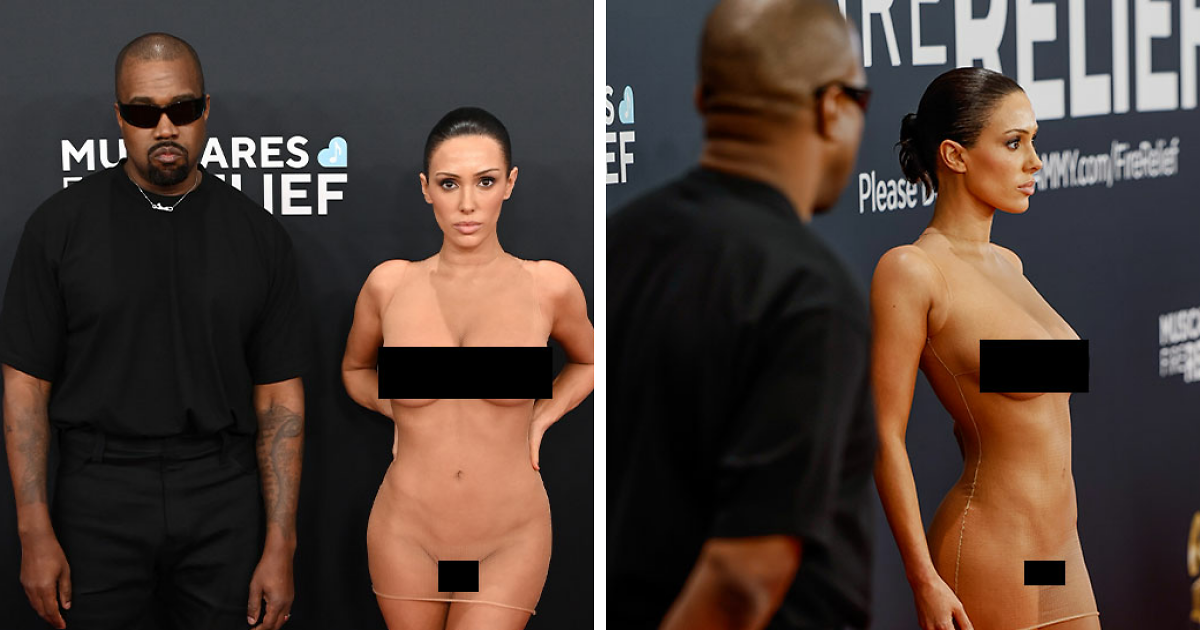
At the 2025 Grammy Awards, the red carpet was supposed to be a runway for music’s biggest night: dazzling gowns, sharp tailoring, trophy hopefuls, and the occasional celebrity who treats a step-and-repeat like a personal fireworks show. Then Bianca Censori arrived alongside Kanye West, and suddenly the internet stopped arguing about award predictions and started debating one very sheer dress.
Censori, the Australian architectural designer and wife of Kanye West, stepped onto the Grammys red carpet in Los Angeles wearing a dramatic dark coat. Moments later, she dropped the coat and revealed a nearly transparent mini dress that appeared to be worn without visible undergarments. West, dressed in a simple all-black outfit and sunglasses, stood beside her while cameras flashed. The contrast was impossible to miss: he looked covered, controlled, and almost understated; she became the visual headline of the evening.
The reaction was instant. Some viewers called the look bold, artistic, and intentionally provocative. Others found it inappropriate for a televised awards event, especially one connected to a mainstream broadcast. A third group asked the question that now follows nearly every Kanye West and Bianca Censori public appearance: was this fashion, performance art, branding, or simply shock value with a very expensive red carpet?
What Happened at the 2025 Grammys?
The 67th Annual Grammy Awards took place on February 2, 2025, at Crypto.com Arena in Los Angeles. The ceremony was already packed with major music storylines, from high-profile nominations to emotional moments connected to Los Angeles wildfire relief. Yet before many viewers even settled into the broadcast, the red carpet became its own separate drama.
Kanye West, also known as Ye, appeared at the event after a long absence from the Grammys. He had been nominated in the Best Rap Song category for “Carnival,” his collaboration with Ty Dolla Sign, Rich the Kid, and Playboi Carti. His return alone would have drawn attention. Add Bianca Censori in a barely there sheer dress, and the evening produced the kind of viral moment that entertainment editors both dread and secretly thank the algorithm for.
The Coat Drop That Started the Firestorm
Censori initially arrived covered in a large dark coat. That first impression suggested a dramatic but familiar red carpet reveal. Fashion has long loved the “before and after” moment: a cape removed, a train unfurled, a hood dropped, a silhouette transformed. But this reveal landed differently because the dress underneath was almost entirely transparent.
Photos and videos from the carpet spread within minutes. The outfit was described by many entertainment and fashion outlets as a sheer mini dress or transparent slip. It left very little hidden, which made the moment difficult to frame as ordinary celebrity glamour. This was not simply a plunging neckline, a high slit, or a strategic cutout. It was a full-scale test of the modern red carpet’s tolerance for nudity, celebrity performance, and viral provocation.
Why the Look Sparked So Much Outrage
Celebrity fashion has always flirted with controversy. Jennifer Lopez’s green Versace dress at the 2000 Grammys helped change internet search history. Lady Gaga arrived at the Grammys in an egg. Lil Nas X has turned red carpet dressing into a theatrical sport. But Bianca Censori’s 2025 Grammys look triggered outrage because it seemed to push beyond “daring” into something many viewers considered uncomfortable.
It Was a Mainstream Awards Show, Not a Private Fashion Installation
The Grammys are not just a celebrity party. They are a major televised cultural event watched by families, fans, journalists, industry executives, and casual viewers who may have tuned in to see performances rather than a red carpet debate about public exposure. That setting matters. A look that might be expected at an avant-garde fashion editorial or underground art event can feel more jarring when placed in front of a global awards audience.
Critics argued that the outfit crossed the line between bold fashion and attention-seeking spectacle. Supporters countered that the Grammys have never been a modesty convention. After all, this is the same awards universe where sequins, latex, feathers, body chains, and optical illusions gather every year like a glamorous family reunion with questionable boundaries.
The Kanye West Factor Changed the Conversation
If Bianca Censori had appeared alone, the conversation may have centered more narrowly on fashion risk and personal expression. But she appeared beside Kanye West, one of the most controversial and polarizing figures in modern entertainment. That changed the tone immediately.
West’s public image carries years of artistic reinvention, headline-making behavior, business controversy, and public scrutiny. Because of that, many viewers did not see the Grammys moment as simply “Bianca wore a daring dress.” They saw it as another chapter in the couple’s ongoing public performance style, where Censori’s revealing outfits often contrast sharply with West’s covered, monochrome clothing.
That contrast sparked debate about agency. Was Censori confidently expressing herself? Was the couple making a calculated visual statement? Were audiences projecting assumptions onto a woman who had not publicly explained the outfit in that moment? The internet, naturally, answered all of those questions at once and with the confidence of a group chat after three coffees.
Were Kanye West and Bianca Censori Kicked Out?
One of the biggest rumors after the red carpet appearance was that Kanye West and Bianca Censori had been escorted out of the Grammys. Early chatter suggested the couple had been removed after the outfit caused a scene. However, later reporting from entertainment outlets clarified that the couple were not officially kicked out. Instead, they walked the red carpet and left shortly afterward.
This distinction matters. The story became more exaggerated as it traveled across social media, where “left after the red carpet” quickly turned into “dramatically expelled from music’s biggest night.” That is the modern celebrity news cycle in miniature: one real event, three assumptions, ten viral posts, and by dinner everyone is suddenly a security expert.
Why the Rumor Spread So Quickly
The rumor spread because it felt believable to many viewers. Censori’s outfit appeared to challenge broadcast standards, and the couple’s quick exit made the story look suspicious. Add West’s reputation for unpredictable public moments, and the narrative practically wrote itself.
Still, responsible coverage needs to separate confirmed facts from viral fiction. The confirmed story is already dramatic enough: Censori wore a nearly transparent dress on the Grammys red carpet, West appeared beside her, the pair left soon after, and the internet erupted. No extra seasoning required.
Did the Outfit Violate a Dress Code?
The Grammys have a long and complicated relationship with wardrobe rules. CBS previously circulated a now-famous wardrobe advisory in 2013 that asked on-camera talent to avoid overly revealing clothing, including sheer garments that could expose intimate areas. That older guidance resurfaced after Censori’s 2025 look because many viewers wondered whether the same standards applied.
In practice, red carpet enforcement is not always simple. Awards shows operate at the intersection of fashion, publicity, live broadcasting, and celebrity autonomy. Performers and presenters may face stricter standards because they are part of the planned broadcast. Red carpet arrivals, especially in the age of digital-first media coverage, are harder to control.
The Difference Between Fashion Risk and Broadcast Risk
Fashion risk is when a look makes people gasp. Broadcast risk is when producers worry about what can appear on television, streaming clips, and official photography. Censori’s outfit sat directly in that overlap. It was a fashion statement, but it also raised questions about what a mainstream awards show can show, promote, or ignore.
That is why the controversy grew beyond celebrity gossip. It became a debate about standards: who sets them, who enforces them, and whether women’s bodies are policed differently than men’s. West’s covered outfit only sharpened that point. He was dressed in black from head to toe, while Censori’s body became the center of attention. For some viewers, that visual imbalance was more unsettling than the dress itself.
Fashion Statement or Publicity Stunt?
Calling the look a “publicity stunt” may sound dismissive, but celebrity fashion has always been partly promotional. A red carpet is not a sidewalk. It is a stage with lighting, photographers, brand deals, image strategy, and a global audience trained to react instantly. Outrage can be currency. Attention can become the product.
Bianca Censori and Kanye West understand visual branding. West has spent decades using fashion, music, architecture, religion, minimalism, and controversy as parts of a single public identity. Censori, with her background in architecture and design, has increasingly become part of that visual language. Her looks often feel less like traditional styling and more like conceptual provocation: stripped-down silhouettes, neutral tones, transparent materials, and body-focused presentation.
The “Less Is More” Idea Taken to the Extreme
Minimalism is supposed to remove excess. In Censori’s case, the concept sometimes appears to remove almost everything. That is why her Grammys outfit became such a powerful SEO headline and social media magnet. It was simple, shocking, easy to describe, and impossible to ignore. In the attention economy, those are dangerous ingredients.
But simplicity does not automatically equal sophistication. The strongest fashion moments usually combine risk with meaning, craft, beauty, or cultural timing. Some viewers saw Censori’s dress as a fearless rejection of conservative expectations. Others saw it as empty provocation. Both reactions can be true in the same public moment because fashion is not a courtroom. It is a mirror, and everyone brings their own lighting.
Social Media Reaction: Outrage, Jokes, and Concern
Social media turned the look into an instant debate. Some users joked that the Grammys red carpet had become “the world’s most expensive hallway.” Others criticized West, questioned Censori’s comfort, or argued that the outfit was inappropriate for an awards show. Fans of avant-garde fashion defended the appearance as a form of body confidence and performance.
The jokes came quickly because the internet processes discomfort through comedy. Memes compared the coat drop to a movie reveal, a magic trick, and a “terms and conditions” warning nobody had time to read. Yet beneath the jokes, there was genuine unease. Many people were not simply reacting to skin; they were reacting to context, power dynamics, and the repeated pattern of Censori appearing extremely exposed while West remains heavily dressed.
The Agency Debate
One of the most sensitive parts of the conversation involved Bianca Censori’s agency. Some commentators suggested she was being controlled or styled by West. Others warned against assuming that a grown woman cannot make her own fashion choices simply because those choices are provocative. That tension is important.
It is unfair to erase Censori’s autonomy without evidence. It is also fair for audiences to discuss why certain public images feel uncomfortable, especially when they repeat over time. The best analysis avoids turning Censori into a helpless prop or a villain. She is a real person, not just a headline wearing clear heels.
How the Look Fits Into Red Carpet History
Nearly nude fashion is not new. Designers have long played with illusion mesh, sheer panels, body stockings, crystal netting, and skin-toned fabrics. What has changed is the speed and scale of public reaction. A controversial Grammys look in 2000 might become a magazine cover and a morning-show segment. In 2025, it becomes a global argument before the ceremony ends.
Censori’s outfit belongs to a lineage of red carpet moments designed to test the boundary between clothing and exposure. The difference is that her look seemed to remove the usual fashion “buffer.” Many sheer gowns use embroidery, crystals, lining, or strategic shaping to create the illusion of nudity while still delivering craftsmanship. Censori’s Grammys dress appeared more direct, which made it feel less like classic glamour and more like an act of confrontation.
Why This Moment Will Be Remembered
The 2025 Grammys will be remembered for music, winners, performances, and industry milestones. But in pop culture memory, Bianca Censori’s red carpet appearance will remain one of the night’s most replayed visuals. It had all the elements of a lasting celebrity moment: a famous couple, a shocking reveal, conflicting reports, moral debate, and a thousand think pieces waiting to stretch before typing.
Whether people loved it or hated it, the look succeeded at one thing: it seized attention. In modern celebrity culture, attention is often treated as proof of impact. The harder question is whether every attention-grabbing moment deserves to be celebrated.
What Brands, Stylists, and Event Producers Can Learn
The Bianca Censori Grammys controversy offers lessons beyond celebrity gossip. For stylists, it shows that shock can dominate a news cycle but may also overshadow the person wearing the look. For event producers, it raises questions about how red carpet standards should be communicated and enforced in a digital media environment. For brands, it is a reminder that virality is not always positive sentiment.
A look can trend for the wrong reasons. It can create curiosity while damaging trust. It can make a person famous while reducing them to a single image. That is the tricky math of modern celebrity fashion: the outfit may win the algorithm and lose the room.
Controversy Is Not the Same as Cultural Value
Controversy can start a conversation, but it does not automatically deepen it. The most powerful fashion moments usually reveal something larger about identity, art, politics, beauty, gender, or time. Censori’s look certainly revealed plenty in the literal sense, but its deeper meaning remains disputed.
Some will remember it as a brave act of body autonomy. Some will remember it as an uncomfortable spectacle. Some will remember it as another Kanye West-adjacent media storm. And some will remember it mainly because their group chat exploded during dinner. Pop culture history is not always elegant, but it is rarely boring.
Experience-Based Reflections: Covering a Celebrity Fashion Firestorm
When writing or thinking about a topic like “Bianca Censori Sparks Outrage With Scandalously Bare 2025 Grammys Look Alongside Kanye West,” the biggest challenge is balance. It is easy to fall into either extreme: clutching pearls like a Victorian aunt who just discovered TikTok, or praising every provocative outfit as genius because it made people look. A better approach is to treat the moment as fashion, media strategy, and cultural conversation all at once.
From an editorial perspective, the first lesson is to slow down before repeating viral claims. The “kicked out” rumor is a perfect example. It spread because it matched what people expected after such a shocking appearance. But expectation is not confirmation. For anyone creating entertainment content, this is where credibility is built. A headline can be spicy without being sloppy. Readers may arrive for the scandal, but they stay when the article respects the facts.
The second lesson is that celebrity fashion should be described with precision, not cruelty. Censori’s outfit was revealing, controversial, and designed to attract attention. That can be said clearly without turning the article into body-shaming or cheap mockery. There is a difference between analyzing a public image and attacking a person’s body. Good pop culture writing knows that difference and keeps both hands on the steering wheel.
The third lesson is that context changes everything. A sheer dress on a fashion runway may read as design experimentation. A similar look at a televised awards show may read as provocation. A nearly nude outfit beside a fully covered partner may trigger questions about gender, power, and presentation. None of those reactions exist in isolation. The same garment can carry different meanings depending on who wears it, where it appears, and what story surrounds it.
For readers, the experience of watching the controversy unfold also reveals how quickly public opinion forms. Many people saw one image and instantly decided what it meant. Others waited for more context. Some defended Censori’s right to dress however she wants. Others felt the moment was inappropriate. That variety of reaction is why the story became so large. It was not just about fabric; it was about values.
For brands and public figures, the lesson is even sharper. Shock is a short-term engine. It can create massive reach in minutes. But the long-term question is what the attention attaches to. Does it make the person seem more interesting, more stylish, more powerful, more creative? Or does it flatten them into a meme? The answer depends on the strength of the story behind the image.
In Censori’s case, the Grammys look remains fascinating because it refuses to settle into one clean interpretation. It can be read as confidence, controversy, performance, partnership branding, fashion minimalism, or media manipulation. That ambiguity is why people kept talking. The dress may have been nearly invisible, but the conversation around it was impossible to miss.
Conclusion
Bianca Censori’s 2025 Grammys look alongside Kanye West was more than a revealing red carpet outfit. It became a cultural flashpoint about celebrity branding, televised standards, women’s autonomy, fashion boundaries, and the modern internet’s hunger for spectacle. Whether viewers saw the sheer dress as fearless expression or unnecessary provocation, the moment achieved undeniable impact.
The controversy also proved that red carpet fashion is no longer just about who wore what. It is about who controls the narrative, how quickly rumors spread, and how public images become battlegrounds for deeper debates. Censori and West may have left the Grammys shortly after the carpet, but the conversation they triggered stayed behind, took a seat, ordered popcorn, and kept the internet busy for days.
Note: This article is based on publicly reported information from reputable entertainment, fashion, and music-industry coverage. Source links are intentionally omitted to keep the HTML clean for publishing.