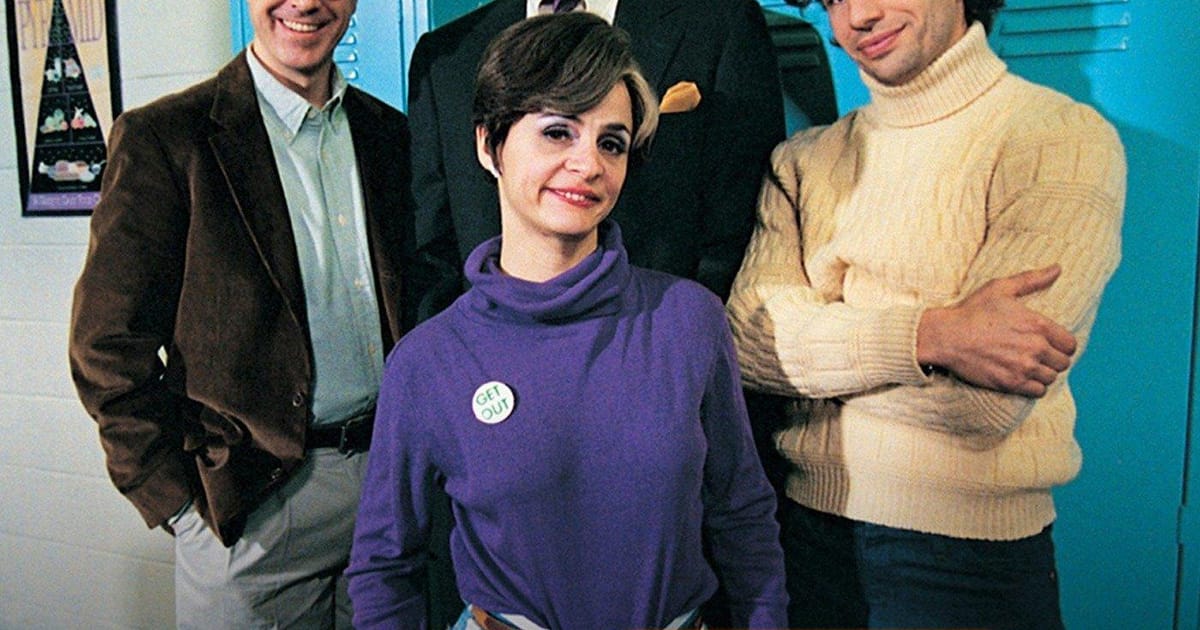
Strangers with Candy is not the kind of sitcom you casually recommend to your grandmother unless your grandmother owns a fake mustache, laughs at inappropriate school assemblies, and has strong opinions about cafeteria lighting. Created by Amy Sedaris, Stephen Colbert, Paul Dinello, and Mitch Rouse, the Comedy Central cult comedy aired from 1999 to 2000 and packed three seasons of beautifully wrong behavior into 30 episodes.
The premise sounds like a network executive lost a bet: Jerri Blank, a 46-year-old former runaway, former addict, former criminal, and current emotional tornado, returns to high school as a freshman at Flatpoint High. Instead of learning heartwarming lessons, she usually learns the exact opposite. That is the whole delicious joke. Strangers with Candy takes the old “very special episode” format, dips it in expired glue, and serves it with a smile.
This ranking is not a cold mathematical exercise. Comedy this strange cannot be measured only by ratings, popularity, or how many times Jerri’s face looks like it is trying to escape her skull. The best episodes are the ones that combine sharp satire, memorable performances, shocking punch lines, and that special Flatpoint feeling: a world where every authority figure is broken, every moral lesson is backwards, and somehow Jerri is still the most honest person in the room.
What Makes Strangers with Candy So Rankable?
Some shows have a clear best episode because they build toward a dramatic climax. Strangers with Candy is different. Its best moments often arrive sideways: a teacher makes a wildly inappropriate comment, Jerri misunderstands a basic social cue, or Principal Blackman turns a simple school problem into a civic disaster. The series is less about plot perfection and more about comic density.
The Ranking Criteria
For this Strangers with Candy ranking, episodes and characters are judged by five friendly but firm standards:
- Jerri Blank chaos: Does Amy Sedaris get room to unleash the full Jerri experience?
- Satirical bite: Does the episode smartly parody after-school specials, teen dramas, or moral panic?
- Rewatch value: Is it still funny when you already know the punch lines?
- Supporting cast strength: Do Noblet, Jellineck, Blackman, Orlando, Sara, and Derrick add memorable weirdness?
- Boldness: Does the episode take a ridiculous idea and commit to it like a substitute teacher with nothing left to lose?
Top 10 Strangers with Candy Episodes Ranked
10. “The Trip Back”
Season finales can get sentimental. Thankfully, Strangers with Candy treats sentimentality like a contaminated science project. “The Trip Back” follows Jerri as she risks undoing her school progress, and it works because it reminds viewers that Jerri’s personal growth is never a straight line. It is more like a shopping cart with one wheel missing rolling downhill toward a marching band.
The episode earns a place in the top 10 because it captures the show’s central joke: Jerri wants redemption, but she is deeply, hilariously bad at understanding what redemption requires. The comedy lands because it is both absurd and weirdly consistent with her character.
9. “Who Wants Cake?”
“Who Wants Cake?” is one of the purest examples of the show’s warped moral structure. Jerri faces a choice involving loyalty, popularity, and school authority, and naturally she handles it with all the grace of a raccoon in a trophy case. The episode parodies school episodes about peer pressure and doing the right thing, but it refuses to give viewers the usual clean answer.
It is also a strong reminder that Flatpoint High is not simply a background setting. The school is a character: petty, strange, punitive, and run by adults who should not be trusted with a laminator.
8. “Behind Blank Eyes”
“Behind Blank Eyes” takes a sensitive-topic episode format and turns it into classic Strangers with Candy discomfort comedy. Jerri’s attraction to a blind classmate becomes a setup for bad assumptions, shallow empathy, and schoolwide nonsense. It is funny because the show does not pretend its characters are enlightened. They are not. They are confidently wrong, which is often where the sharpest satire lives.
The episode also proves that the show’s humor was not random shock for shock’s sake. Its best jokes target the artificial seriousness of old educational television, where complicated human experiences were often flattened into tidy lessons.
7. “Jerri Is Only Skin Deep”
Homecoming episodes are usually built around confidence, popularity, and the touching realization that beauty comes from within. “Jerri Is Only Skin Deep” hears that idea, nods politely, and then throws it into a dumpster behind the gym. Jerri’s hunger for status makes the episode a strong showcase for Amy Sedaris’s physical comedy and fearless vanity-free performance.
This episode deserves ranking love because it understands the cruelty of high school popularity contests while exaggerating the whole thing into cartoonish social warfare. It is ugly, funny, and painfully recognizable under the fake eyelashes.
6. “Yes You Can’t”
One of the pleasures of Strangers with Candy is watching it attack motivational clichés. “Yes You Can’t” flips the language of encouragement into something darker and stranger. The episode plays with ambition, failure, and the empty cheerleading adults often give students when they do not actually want to help them.
It may not be the first episode casual viewers mention, but it is a great example of how the series could turn a familiar school-story template into a comedy of anti-inspiration. In the Flatpoint universe, believing in yourself is dangerous when yourself is Jerri Blank.
5. “Blank Stare”
The “Blank Stare” storyline gives the series room to stretch into bigger, more serialized absurdity. It has the energy of a school scandal, a family meltdown, and a public-access nightmare rolled into one. The episode works because it lets the characters behave as if something meaningful is happening while every detail grows more ridiculous.
This is also where the show’s ensemble chemistry shines. Sedaris, Colbert, Dinello, and Greg Hollimon knew exactly how to play the material: never wink too hard, never apologize, and never act as if the joke is a joke. That deadpan commitment is why the strangest scenes still feel weirdly grounded.
4. “The Virgin Jerri”
“The Virgin Jerri” is a classic example of the series turning moral purity narratives upside down. It takes the familiar teen-TV obsession with innocence and reputation and runs it through Jerri’s completely scrambled worldview. The result is both outrageous and oddly precise.
What makes the episode rank so high is its confidence. The jokes are not gentle, but the satire has a clear target: the way institutions talk about sex, virtue, shame, and youth as if slogans can solve human behavior. Jerri is the perfect character to expose that foolishness because she has already lived several lifetimes before homeroom.
3. “To Be Young, Gifted and Blank”
“To Be Young, Gifted and Blank” deserves elite status because it gives Jerri a ridiculous form of talent and then lets the adults mishandle it beautifully. The episode skewers inspirational prodigy stories, teacher ego, parental pressure, and the fantasy that giftedness automatically makes someone noble.
The best part is that Jerri never becomes less Jerri. Even when the plot suggests she might be special, the show refuses to sand off her edges. That is one reason Strangers with Candy still feels fresh: it does not reward characters for becoming marketable. It rewards them for becoming more intensely themselves.
2. “Old Habits, New Beginnings”
The first regular episode had an impossible job: introduce Jerri Blank, explain the show’s parody engine, establish Flatpoint High, and warn viewers that nothing here would behave like a normal sitcom. Somehow, “Old Habits, New Beginnings” does all of that with deranged confidence.
As a pilot-style introduction, it is close to perfect. Jerri tries to become popular, uses her old survival instincts in a school setting, and immediately demonstrates why she is one of television comedy’s great anti-heroines. The episode is not just funny; it is a mission statement. It tells viewers, “This is the show. Adjust your expectations or flee.”
1. “A Burden’s Burden”
The top spot goes to “A Burden’s Burden,” a fan-favorite episode that distills the entire Strangers with Candy formula into one gloriously inappropriate package. It has a classroom lesson gone wrong, a twisted version of responsibility, secret adult dysfunction, and Jerri trying to handle a situation for which she is spectacularly unqualified.
What makes it the best is balance. The episode is filthy, sharp, absurd, and surprisingly well-structured. It has the feel of an after-school special that was left in the sun too long and came back with a fake ID. Amy Sedaris is fearless, the supporting cast is locked in, and the jokes escalate without losing the episode’s central shape. If someone asks for one episode that explains why Strangers with Candy became a cult comedy treasure, this is the one to hand them. Preferably with gloves.
Strangers with Candy Characters Ranked
1. Jerri Blank
There is no show without Jerri Blank. Amy Sedaris created a character who is grotesque, vulnerable, selfish, needy, foolish, and unforgettable. Jerri is not “likable” in the usual TV sense, but she is magnetic. Her face alone can turn a scene into performance art. Her genius is that she wants what every teen character wants: acceptance, popularity, love, and a second chance. She just pursues those things with the judgment of a haunted vending machine.
2. Chuck Noblet
Stephen Colbert’s Chuck Noblet is a perfect parody of the stern, moralizing teacher who is secretly a disaster. Noblet speaks with authority even when he is saying something deeply absurd. That contrast makes him one of the show’s most reliable joke machines.
3. Geoffrey Jellineck
Paul Dinello’s Geoffrey Jellineck is fragile, theatrical, vain, and wonderfully ridiculous. His secret relationship with Noblet adds one of the show’s funniest ongoing tensions, especially because both men behave as if they are masters of discretion while being about as subtle as a marching tuba.
4. Principal Onyx Blackman
Greg Hollimon’s Principal Blackman brings grand institutional foolishness to Flatpoint High. He is the kind of principal who can turn a small problem into an announcement, an investigation, and possibly a mural.
5. Sara and Derrick Blank
Jerri’s stepmother Sara and half-brother Derrick make home life just as hostile and surreal as school life. They are not comforting family-sitcom figures. They are emotional obstacles with furniture.
Best Season of Strangers with Candy
Season 1 is the strongest overall season because it feels the most concentrated. The show’s concept is fresh, the satire is cleanly aimed, and the episodes have a raw confidence that makes them instantly memorable. Season 2 expands the world and contains several excellent installments, while Season 3 has wild highlights but can feel more uneven depending on the viewer’s tolerance for chaos.
That said, the complete series is short enough to reward full viewing. Thirty episodes is not a homework assignment. It is a weekend with snacks, questionable decisions, and at least one moment where you pause the screen and ask, “How did this air?”
Does Strangers with Candy Still Hold Up?
This is where opinions get interesting. Strangers with Candy absolutely remains funny, but it is also very much a product of its time. The show uses offensive language, taboo subjects, and deliberately ugly behavior as part of its satire. Modern viewers may find some jokes harder to enjoy, especially when the target of the joke feels less clear.
The best way to watch it today is with context. The show is not asking viewers to admire Jerri’s worldview. It is mocking moral hypocrisy, shallow tolerance, institutional stupidity, and the fake neatness of old lesson-based television. Still, intent does not automatically erase impact. Some jokes age better than others. That is true of almost every boundary-pushing comedy, but it is especially true here because Strangers with Candy made boundaries its playground.
Movie vs. TV Show: Which Is Better?
The TV series wins. The 2005 prequel film has moments that fans can enjoy, especially because Sedaris, Colbert, and Dinello return to the world of Flatpoint. But the show’s format is better suited to short, concentrated bursts of wrongness. At 22 or 23 minutes, an episode can make its point, offend the furniture, and leave before the air gets stale.
The movie sometimes feels like an extended episode with more room than it needs. For devoted fans, it is worth watching. For newcomers, start with the series. Meeting Jerri through the show is like entering a funhouse through the front door. Starting with the film is like crawling in through the air vent.
Why Fans Still Talk About Strangers with Candy
The biggest reason is originality. Even now, there are not many shows that look, sound, and misbehave like Strangers with Candy. It arrived before the modern wave of anti-sitcoms and cringe comedies became more common. It was strange at a time when being strange on basic cable still felt like smuggling a raccoon into a PTA meeting.
The second reason is performance. Amy Sedaris did not simply play Jerri Blank; she built her from posture, voice, wardrobe, facial expressions, and emotional desperation. Colbert and Dinello matched her with deadpan commitment. Together, they created a comic universe that felt both artificial and fully inhabited.
The third reason is influence. The show helped carve out space for comedies that were darker, weirder, and less interested in comforting the audience. It may never have been a ratings monster, but cult classics do not need everyone. They need the right weirdos.
Viewing Experience: How Strangers with Candy Feels Today
Watching Strangers with Candy today is a peculiar experience because it feels both ancient and ahead of its time. The clothes, lighting, and after-school-special parody carry a late-1990s cable-TV texture. Yet the rhythm of the comedy feels connected to later shows that embraced awkwardness, antiheroes, and deliberately uncomfortable humor.
The first episode can be a shock. Viewers used to polished streaming comedies may need a few minutes to adjust to the show’s intentionally cheap, stiff, educational-video atmosphere. The sets look like a school built from bad memories. The music has that “public service announcement before lunch” flavor. The adults talk like they read one pamphlet in 1978 and decided to become experts forever.
Then Jerri appears, and the whole machine clicks. She is ridiculous, but she is also the emotional engine. The funniest thing about her is not just that she says outrageous things. It is that she wants so badly. She wants friends. She wants attention. She wants approval. She wants romance. She wants to be a normal student, even though everything about her suggests she wandered into high school from a police sketch and a motivational poster at the same time.
The best viewing experience is not to binge the entire series too quickly. Too much Jerri at once can feel like eating frosting with a ladle: thrilling at first, then spiritually complicated. Two or three episodes at a time is ideal. That gives the jokes room to breathe and lets the show’s patterns become funny instead of overwhelming.
It is also a fantastic group-watch comedy, but only with the right group. This is not background television for a polite dinner party. This is a show for friends who enjoy analyzing jokes after saying, “I cannot believe they did that.” A good Strangers with Candy watch party includes snacks, open-minded viewers, and at least one person willing to explain what after-school specials were.
For new viewers, the most useful mindset is curiosity. Do not expect a traditional sitcom. Do not expect moral comfort. Do not expect characters to become better people. Instead, watch how the show uses bad lessons to expose the emptiness of simplistic moral storytelling. The joke is not simply that Jerri is inappropriate. The joke is that everyone around her is also broken, selfish, performative, or absurdly unqualified to guide her.
Rewatching the show can be even more rewarding. The first time through, Jerri dominates the eye. On later viewings, the smaller details stand out: Noblet’s stiff delivery, Jellineck’s wounded ego, Blackman’s bizarre authority, Sara’s cold domestic hostility, and the way Flatpoint High seems designed to produce emotional damage as an extracurricular activity.
That is the real lasting experience of Strangers with Candy. It is not merely a collection of shocking jokes. It is a complete comic ecosystem. It has rules, rhythms, and a worldview. The rules are terrible, the rhythms are deranged, and the worldview probably should not be allowed to supervise a bake sale. But as cult comedy, it remains one of the strangest and most memorable shows of its era.
Final Opinion: Is Strangers with Candy Worth Watching?
Yes, with the right expectations. Strangers with Candy is not for every viewer, and that is part of its identity. It is rude, strange, fearless, uneven in places, and occasionally uncomfortable in ways that deserve discussion. But it is also brilliantly performed, sharply conceived, and still capable of producing laughter that feels half joyful and half illegal.
The best episodes remain essential cult comedy viewing. “A Burden’s Burden,” “Old Habits, New Beginnings,” “To Be Young, Gifted and Blank,” and “The Virgin Jerri” show exactly why the series earned a devoted fan base. If you enjoy dark satire, anti-moral lessons, and comedy that looks like it was filmed inside a corrupted guidance counselor’s office, Strangers with Candy belongs on your watchlist.
Jerri Blank may never learn the right lesson, but viewers can learn one useful thing from her: sometimes the wrong choice makes unforgettable television.