Note: The title is preserved as requested, though the Austrian designer is most commonly referenced in design sources as Thomas Feichtner.
Some flatware politely waits beside your dinner plate. Thomas Feichtner’s Cutt Flatware does not wait politely. It leans into the scene like a tiny architectural model, a silver conversation starter, and possibly the only fork that looks as if it has read a manifesto before dessert. Designed in 2006 for Wiener Silber Manufactur in Austria, Cutt is not ordinary silverware. It is sculptural flatware that questions what a spoon, fork, and knife are supposed to look like before calmly proving that, yes, they can still help you eat dinner.
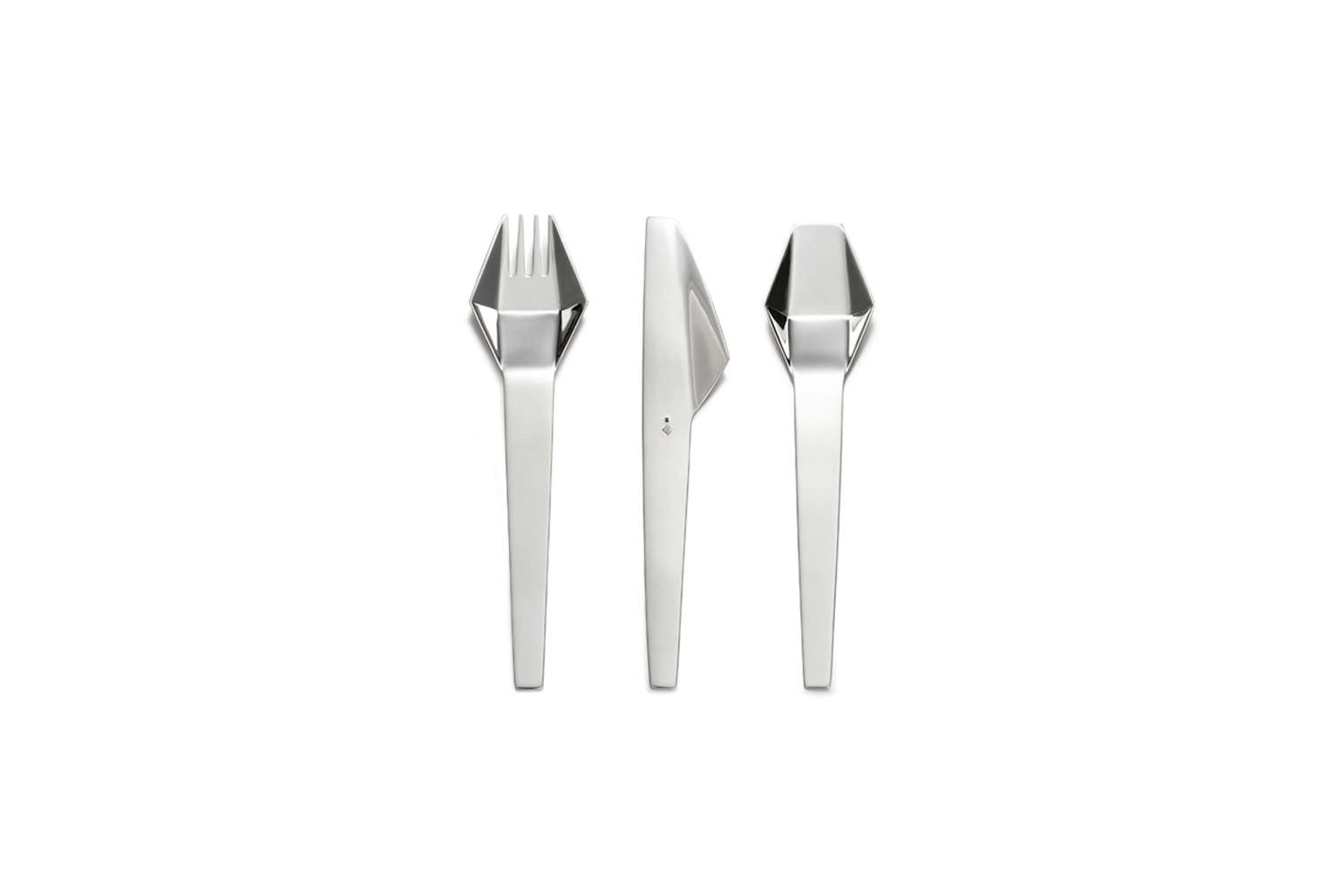
At first glance, Cutt looks more like folded metal geometry than tableware. The forms are sharp, planar, and deliberately reduced to points, lines, and surfaces. The spoon and fork appear almost abstract until you understand how the folded surfaces become bowls, tines, handles, and usable eating tools. That little moment of discovery is the magic trick. Cutt is the rare cutlery set that makes you pause before taking a bite, which is impressive considering most forks spend their lives being noticed only when they go missing from the drawer.
What Is Thomas Feichtner’s Cutt Flatware?
Thomas Feichtner’s Cutt Flatware is an experimental cutlery design created for Wiener Silber Manufactur, a Viennese silver manufacturer known for traditional craftsmanship. The set was first produced on a small scale and is often discussed as a design object rather than a basic kitchen purchase. In other words, this is not the flatware you buy because your old teaspoons mysteriously disappeared into the office lunch bag dimension.
Cutt belongs to the world of collectible tableware, contemporary silver design, and European craft revival. Its material has been listed as silver 940/000, and its approximate size has been documented at 200 x 50 x 15 mm. The design uses a few highly controlled geometric moves instead of the flowing curves we expect from classic flatware. Feichtner does not hide the construction logic. He makes the folds visible, the planes confident, and the object almost diagrammatic.
The Designer Behind Cutt: Thomas Feichtner
Thomas Feichtner is an internationally recognized Austrian industrial designer. Born in Brazil and raised in Austria, he studied industrial design at the University of Art and Industrial Design in Linz. His career has moved between industrial production, traditional manufacturing, limited-edition objects, and experimental design. That combination matters because Cutt feels exactly like a meeting point between the workshop and the white-walled gallery.
Feichtner has designed products for major international brands and historic manufacturers, including Swarovski, Laufen, Bene, Adidas, Head, Absolut, Lobmeyr, Augarten, and Carl Mertens. His work is often described as standing between industry and handicraft, series production and one-of-a-kind design. Cutt captures that position beautifully. It is precise enough to feel industrial, handmade enough to feel precious, and unusual enough to make your average dinner fork look like it needs a vacation.
Why Cutt Flatware Looks So Different
Most flatware is designed around comfort first. A spoon curves. A fork tapers. A knife has a familiar handle and blade. Cutt flips that expectation. Instead of starting with soft ergonomic shapes, it starts with formal expression. The surfaces fold into function. The spoon bowl is not carved into a traditional oval; it emerges from a folded plane. The fork does not look like a typical fork that merely got a stylish haircut; it feels like an object built from a design language of cuts, creases, and edges.
This makes Cutt a strong example of form-led design. That does not mean it ignores function. It means the function reveals itself only after the eye has done a little detective work. The user sees an abstract object, picks it up, and then realizes how the geometry performs. It is a small act of surprise at the table, and surprise is not something most cutlery manages unless it falls loudly onto tile.
Cutt and the “Form Follows Function” Debate
Modern design history often celebrates the phrase “form follows function.” Cutt politely raises a silver eyebrow at that idea. Feichtner’s design suggests that form can lead, challenge, and reshape function rather than simply obey it. The set squares up to the old rulebook by asking: What if a spoon does not have to look like every spoon before it? What if a fork can be built from surfaces instead of inherited curves?
The result is not design rebellion for rebellion’s sake. Cutt still belongs to the dining table. It still refers to the cultural history of European tableware. But it refuses to be invisible. In a world where many household objects aim to disappear into convenience, Cutt insists that eating tools can carry ideas. It is flatware with a point of view, and luckily, several actual points as well.
The Role of Wiener Silber Manufactur
Wiener Silber Manufactur is essential to the story of Cutt. The manufacturer connects the piece to Vienna’s long silver tradition, including the legacy of refined table culture, handcraft, and decorative arts. Feichtner’s design does not simply imitate historical silverware. Instead, it responds to that history with a contemporary vocabulary.
This is important because Cutt is not trying to be nostalgic. It does not wear scrolls, floral ornament, or old-world curves. It respects the tradition of silver production by using precious material and careful making, but its shape belongs to the present. The contrast is the point: a historic craft language is pushed into a sharper, more experimental form. It is a little like inviting your great-grandmother’s silver chest to an avant-garde architecture lecture. Somehow, everyone behaves.
Material Matters: Why Silver Changes the Conversation
When people shop for everyday flatware today, they often compare stainless steel grades such as 18/10, 18/8, and 18/0. Stainless steel is practical, relatively low-maintenance, and comfortable in the dishwasher. Cutt sits in another category. Silver flatware brings a different kind of weight, luster, value, and responsibility. It is less “throw it in the dishwasher and forget it” and more “please treat me like I might be invited to a museum someday.”
Silver also changes the emotional quality of the object. It develops a relationship with time. It can tarnish, polish, glow, and age. That makes Cutt more than a visual statement. The material turns the design into something tactile and ceremonial. You do not just own silver flatware; you maintain it, store it, and bring it out with intention. Cutt’s geometry may be modern, but its material asks for an old-fashioned kind of care.
How Cutt Compares With Everyday Flatware
Everyday flatware usually succeeds when it is balanced, easy to clean, durable, and comfortable for many users. A great stainless steel set can serve breakfast cereal, weeknight pasta, and holiday turkey without making a speech. Cutt is different. It is best understood as collectible flatware, designer silverware, and functional art.
That difference is not a weakness. It simply means Cutt has a different job. It is not trying to be the most practical solution for a family of five eating pancakes on a Tuesday morning. It is trying to expand the meaning of tableware. It is the kind of flatware that works beautifully in a curated dining setting, a design collection, a special dinner, or an interior where objects are chosen for both use and meaning.
Design Details That Make Cutt Memorable
Folded Planes
The defining feature of Cutt is its folded surface language. The spoon and fork appear to be shaped from planar sections rather than rounded volumes. These folds are not decorative afterthoughts; they create the usable parts of the utensils.
Reduced Geometry
Cutt avoids unnecessary ornament. Its character comes from a disciplined arrangement of lines and angles. The set feels minimal, but not quiet. It has the energy of a sketch transformed into silver.
Functional Surprise
The design challenges the user at first sight, then rewards handling. A piece that looks almost conceptual turns out to be functional. That delayed recognition is central to its appeal.
Material Presence
Because Cutt is made in silver, it has visual depth and a sense of ceremony. The precious material softens the severity of the geometry and makes the object feel refined rather than cold.
Who Is Cutt Flatware For?
Cutt is ideal for design collectors, architecture lovers, tableware enthusiasts, and anyone who believes the dinner table should have more personality than a conference room. It appeals to people who enjoy objects that ask questions. Why must a spoon be round? Why should a fork look familiar? Why does the butter knife get to be the quiet one?
It is also a strong choice for collectors of Austrian design, contemporary silverware, and limited-production craft objects. Since Cutt has found its way into design collections, it carries cultural credibility beyond simple table use. It is a piece to study, display, discuss, and occasionally use with great dramatic restraint while serving soup.
How to Style a Table With Cutt Flatware
Because Cutt is visually assertive, it works best when the rest of the table gives it room to perform. Think plain white porcelain, black stoneware, clear glass, linen napkins, and a restrained centerpiece. A table full of competing patterns may overwhelm the flatware’s geometry. Let Cutt be the lead singer. The plates can play bass.
For a modern dinner party, pair Cutt with matte ceramics, architectural glassware, and low floral arrangements. For a more dramatic look, use dark plates and simple candles. The silver surfaces will catch the light beautifully, while the angular shapes will create small shadows and highlights. Even a simple salad becomes more interesting when the fork looks like it was designed during an excellent thunderstorm.
Care and Maintenance: Treat It Like Silver, Not a Spoon Army
Designer silver flatware requires thoughtful care. Handwashing is generally safer than dishwashing, especially for silver or collectible pieces. Use mild soap, warm water, and a soft cloth. Dry the pieces immediately to prevent water spots. Avoid abrasive pads, harsh detergents, and casual tossing into a drawer with stainless steel utensils. Cutt may be tough in concept, but silver deserves manners.
For storage, keep pieces in a treated silver cloth, soft roll, or lined case when not in use. Anti-tarnish storage can help reduce exposure to air and sulfur compounds. If polishing is needed, use a non-abrasive silver polish and a soft cloth, following the maker’s care recommendations when available. The goal is to preserve the surface, not buff it into a state of panic.
Why Cutt Still Feels Relevant
Cutt was designed in 2006, but it still feels fresh because it addresses a timeless design question: how much can you change a familiar object before it stops being itself? Flatware is one of the most common tools in human life. We use it daily, rarely think about it, and often replace it only when the drawer starts looking suspiciously spoon-free. Feichtner takes that ordinary category and turns it into an intellectual and sensory experience.
In today’s design world, consumers increasingly care about objects with stories. People want pieces that express taste, values, and individuality. Cutt fits this mood perfectly. It is sustainable in the cultural sense because it resists disposability. You do not buy Cutt because it is trendy. You choose it because it has a point of view strong enough to outlast trends.
Experience Notes: Living With the Idea of Cutt Flatware
The experience of Cutt Flatware begins before food reaches the table. Imagine setting it beside a simple ceramic plate. The first reaction is usually not “Pass the salt.” It is closer to “Wait, what is that?” That is the power of the design. It interrupts routine without shouting. The fork, spoon, and knife create a small architectural pause in an everyday ritual. Guests notice the shape, then the material, then the fact that the object is actually useful. That sequence turns dinner into a design conversation before the first course has even had a chance to be judged.
Using a piece like Cutt also changes how you move. Ordinary flatware disappears into muscle memory. Cutt invites attention. You become aware of the handle, the angle, the fold, the surface, and the way light slides across silver. This does not mean every bite becomes a museum tour. Nobody wants to analyze a fork for three hours while the risotto gets cold. But it does add a moment of presence. You notice the object in your hand, and that awareness makes the meal feel more intentional.
For hosts, Cutt works best when treated as a highlight rather than a prop. It does not need an overly decorated tablescape. In fact, the simpler the setting, the more confident it looks. A linen napkin, a quiet plate, a clear water glass, and Cutt Flatware can feel more luxurious than a crowded table covered in sparkle. The set brings its own drama. Add too much more and the table may start auditioning for a chandelier commercial.
There is also a practical emotional experience: responsibility. Silver flatware asks for care. After dinner, you do not fling it into the dishwasher and hope for the best. You wash it gently, dry it carefully, and put it away like something worth keeping. That routine can feel slow, but it is part of the pleasure. In a fast kitchen culture full of disposable shortcuts, caring for a crafted object feels grounding. The maintenance becomes a reminder that design is not only about owning beautiful things; it is about building habits around them.
Cutt may not be the flatware for every meal, and that is perfectly fine. Some mornings require a regular spoon, a large coffee, and no philosophical debate with breakfast. But for special dinners, design-focused interiors, or collectors who love objects with intelligence, Thomas Feichtner’s Cutt Flatware offers an experience that is rare: it makes eating feel newly considered. It turns the table into a small exhibition, the hand into a participant, and the meal into something slightly more memorable. That is a lot of work for a spoon, but Cutt seems up for it.
Conclusion: Cutt Flatware as Functional Art
Thomas Feichtner’s Cutt Flatware is a brilliant example of how a familiar object can become surprising again. Designed for Wiener Silber Manufactur, it combines Viennese silver craft, contemporary geometry, and a bold challenge to traditional cutlery design. Its folded surfaces, reduced forms, and silver material make it more than a set of utensils. Cutt is a design statement for the table.
For everyday practicality, stainless steel flatware may still win the weeknight dinner race. But for collectors, design lovers, and hosts who want the table to speak before the wine does, Cutt offers something richer: a direct encounter with form, function, history, and craft. It proves that even the humble fork can have an artistic identity. And frankly, after centuries of doing the same job, the fork deserves a little drama.