Note: This article is an original, web-ready synthesis based on documented PDP-1 history, Spacewar! preservation work, and modern FPGA-based retrocomputing projects.
When a 1959 Computer Meets a Modern FPGA
Long before gaming PCs had RGB lighting, liquid cooling, and fans that sound like tiny jet engines, there was the PDP-1: a room-filling, blinking-light marvel from Digital Equipment Corporation. It was not built to run battle royales, stream movies, or remind you that your operating system needs another update. It was built for interactive computing, and that alone made it revolutionary.
Today, one of the most fascinating ways to experience that revolution is through FPGA emulation. A project known as FPG-1 recreates the DEC PDP-1 in Verilog and runs it on modern FPGA hardware, especially the MiSTer platform based on the Terasic DE10-Nano board. The result is not just another software emulator hiding inside a laptop window. It is a hardware-level tribute to one of computing’s most influential machines and to Spacewar!, the classic game that helped prove computers could be playful, visual, social, and strangely addictive.
That matters because the original PDP-1 is not exactly something you can pick up on eBay, unless your garage is climate-controlled, your wallet is heroic, and your neighbors are unusually patient. Only a tiny number of PDP-1 machines were made, and even fewer survive. A working original is a museum treasure. FPGA recreation gives curious players, engineers, students, and retrocomputing fans a practical way to interact with the ideas that helped shape modern gaming culture.
What Was the PDP-1?
The PDP-1, short for Programmed Data Processor-1, was introduced by Digital Equipment Corporation in 1959. Compared with the giant mainframes of its era, it represented a shift toward interactive computing. Instead of treating the computer as a distant calculating priesthood fed by punch cards and patience, the PDP-1 invited direct user interaction through devices such as a typewriter, paper tape reader, light pen, and CRT display.
In modern terms, the PDP-1 was modest. Its architecture used 18-bit words, magnetic-core memory, and a processing speed that looks microscopic beside a cheap smartwatch. Yet judging it by today’s numbers is like criticizing the Wright brothers’ airplane for lacking beverage service. The PDP-1 was important because of what it made possible: real-time interaction, graphical output, experimental software, and a culture where people could explore what computers might become.
A Machine Built for Interaction
The PDP-1’s design made it unusually friendly to custom input and output devices. That flexibility was crucial. Users could connect displays, light pens, paper tape equipment, and eventually controllers for games. This was not merely convenient; it encouraged a generation of programmers to treat computers as creative instruments rather than locked cabinets for batch processing.
That is why the PDP-1 is often remembered not only as a computer, but also as a cultural catalyst. It helped nurture early hacker culture at places such as MIT, where brilliant, curious users pushed hardware far beyond what a sales brochure could have predicted. In other words, the PDP-1 was a serious scientific computer that accidentally became one of the earliest gaming platforms. History has a sense of humor.
Why Spacewar! Still Matters
The classic video game at the heart of this story is Spacewar!, developed at MIT in the early 1960s. Steve Russell wrote the first version, with important contributions and improvements from Martin Graetz, Wayne Wiitanen, Peter Samson, Dan Edwards, and others. The game placed two players in command of spaceships battling around a star, complete with gravity, thrust, torpedoes, and an astronomically inspired star field.
Calling Spacewar! “old” is accurate but unfair. A fossil is old. A tax form is old in spirit. Spacewar! still feels clever because its core design is instantly understandable: two ships, one dangerous star, limited control, and human rivalry. The game did not need a cinematic trailer or a downloadable skin economy. It needed physics, timing, and players willing to shout at a screen.
Not Just a Game, But a Demonstration
Spacewar! became famous partly because it showed off what the PDP-1 could do. The game required rapid calculations for ship movement, gravity, player input, and display output. It also made the computer’s graphical abilities visible in a way that charts and technical demos could not. A spaceship duel was easier to appreciate than a spreadsheet, especially if the spreadsheet did not explode.
The game also helped establish several ideas that remain familiar today: real-time action, two-player competition, custom controllers, physics-based movement, and a display that was not just for numbers. It is not the only early electronic or digital game in history, but it is one of the most influential early computer games and a direct ancestor of modern video game culture.
How FPGA Emulation Brings the PDP-1 Back
An FPGA, or field-programmable gate array, is a chip whose internal logic can be configured after manufacturing. Instead of running old hardware as a program on a conventional CPU, an FPGA can be configured to behave like the original digital logic. That distinction matters. Software emulation imitates a machine through code running on another machine. FPGA implementation attempts to recreate the structure and timing behavior of the machine in programmable hardware.
The FPG-1 project uses Verilog, a hardware description language, to recreate the PDP-1. According to the project description, it implements the PDP-1 in FPGA logic and enables Spacewar! to run on a modern display with gamepad input. It targets the MiSTer platform, a popular open-source FPGA retrocomputing system built around the Terasic DE10-Nano board.
Why This Is More Than “Just an Emulator”
The phrase “just an emulator” does not do justice to the engineering involved. The PDP-1 had its own instruction set, memory model, input/output behavior, console controls, paper tape workflow, and iconic Type 30 CRT display. Recreating that environment means thinking like both a historian and a hardware designer. The goal is not only to make Spacewar! appear on a screen; the goal is to preserve the feel of the machine that made the game possible.
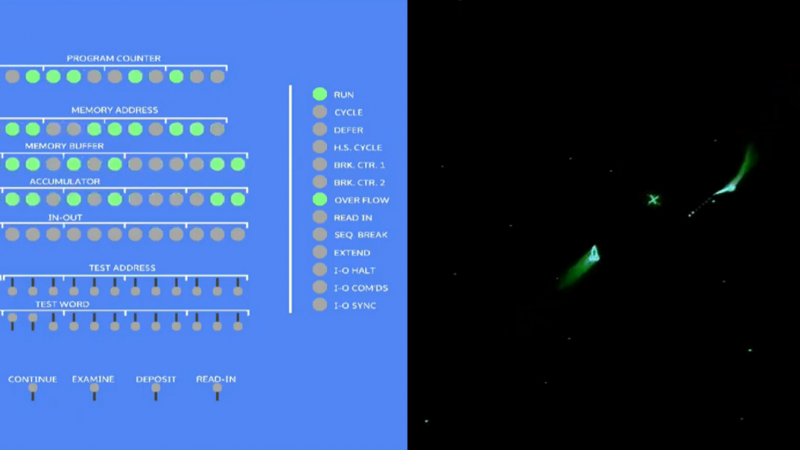
FPG-1 includes representations of classic PDP-1 features such as the operator console, paper tape reader, teletype, core memory, and CRT display. These details matter because old computers were ecosystems. A PDP-1 was not simply a processor. It was a set of switches, lights, peripherals, timing quirks, and display behaviors. Remove too many of those details and the experience becomes a costume party rather than preservation.
The Magic of the Type 30 CRT Look
One of the most charming parts of the PDP-1 experience is the Type 30 CRT display. Unlike modern raster displays that scan pixels in regular rows, the PDP-1’s display was a point-plotting system. It could draw points and vectors directly, producing a distinctive visual style. On original hardware, the phosphor persistence created fading trails that gave moving objects a ghostly, space-age glow.
Reproducing that look on modern HDMI output is not trivial. A plain digital display can make old graphics look too sharp, too clean, and too emotionally sterile. The FPG-1 approach simulates the fading behavior by storing plotted points with brightness values that decay over time. This gives the display a visual memory, as if the screen is thinking about where the ships used to be.
Why the Glow Matters
Authenticity in retrocomputing is not only about instruction accuracy. It is also about experience. The glow, delay, flicker, and trails of an old display affect how a game feels. In Spacewar!, the fading trails make the duel look more physical, more dangerous, and more alive. The ships do not simply move; they carve temporary marks into electronic darkness.
That kind of detail explains why FPGA preservation is so exciting. It respects the machine as a whole, including the weird parts. Especially the weird parts. The weird parts are usually where the personality lives.
MiSTer, DE10-Nano, and the Retrocomputing Revival
The MiSTer FPGA ecosystem has become a favorite among retrocomputing and classic gaming enthusiasts because it supports hardware-style recreations of old computers, consoles, and arcade systems. The DE10-Nano board at its center includes a Cyclone V system-on-chip FPGA, combining programmable logic with an ARM-based processor system. For hobbyists, that combination is powerful, flexible, and surprisingly approachable.
MiSTer is especially valuable because it gives hardware preservation projects a shared platform. Instead of every enthusiast needing to design a custom board from scratch, developers can build cores that run on widely available hardware. That helps projects like FPG-1 reach more people, which is essential for digital preservation. A preserved machine that nobody can experience is like a library with the lights off.
Preservation Through Participation
Museums preserve artifacts. FPGA communities preserve behavior. Both are important. A restored PDP-1 in a museum shows us the original machine, but access is naturally limited. An FPGA core lets people explore the architecture, run software, study timing, and play Spacewar! without risking damage to irreplaceable hardware.
That does not make the FPGA version a replacement for the original. It makes it a bridge. The original machine is the historic artifact; the FPGA recreation is a hands-on learning tool. Together, they let history be both protected and experienced.
Why Engineers Love Projects Like FPG-1
For engineers, recreating a PDP-1 is a delightful puzzle. It requires reading historical documentation, understanding an old instruction set, modeling hardware behavior, handling display output, and building interfaces for modern controllers and screens. It is retrocomputing with enough technical challenge to keep your brain busy and enough nostalgia to make the late nights feel noble.
The project also shows why FPGA development is such a useful learning path. Writing Verilog is not the same as writing a typical software program. You are describing hardware structures and timing relationships. Mistakes can feel strange at first because the design does not simply “run” line by line. Logic happens in parallel. That shift in thinking is one reason FPGA projects are so educational.
A Better Way to Learn Computer Architecture
Reading about computer architecture is useful. Building or studying a working recreation is better. With a PDP-1 FPGA implementation, learners can see how instructions, memory, input/output, display hardware, and control panels fit together. The machine becomes less abstract. Suddenly, “architecture” is not a diagram in a textbook; it is a spaceship rotating around a star while two players panic.
Classic Video Games Deserve Hardware-Level Preservation
Games are often preserved as files: ROM images, disk dumps, screenshots, manuals, and source code. Those are essential, but they are not the whole story. A game’s behavior depends on the hardware it ran on. Timing, display characteristics, controller latency, sound quirks, and memory limits all shape the experience.
Spacewar! is a perfect example. Its importance is tied to the PDP-1’s interactive design and display capabilities. Running it in a browser can be convenient and educational, but running it through an FPGA recreation of the original machine gives a different kind of insight. It helps users understand why the PDP-1 was special and why the game felt so futuristic in the early 1960s.
The Past Is Not Dead Code
Old software can seem fragile, but it is also stubbornly alive. Every time someone recreates a machine like the PDP-1, they keep more than a program running. They keep design ideas available for study. They keep engineering decisions visible. They keep the strange, playful, experimental spirit of early computing from fading into a footnote.
Experience: What Working With a PDP-1 FPGA Recreation Teaches You
Spending time with a PDP-1 FPGA recreation feels different from launching a modern retro game collection. At first, it can seem almost too simple. There is no glossy menu full of box art. There are no achievements popping up to congratulate you for pressing a button. Instead, there is a sense that you are approaching a machine from another world, one where every display point and switch has a reason to exist.
The first lesson is patience. Classic computing does not always behave like modern computing. You become aware of loading methods, machine state, display timing, and control mapping. Even when the FPGA platform makes everything easier, the PDP-1’s personality still comes through. It asks you to slow down and understand what is happening. That is refreshing in a world where most technology tries to hide itself behind rounded icons and cheerful error messages.
The second lesson is respect for constraints. Spacewar! works because its creators understood the PDP-1 deeply. They did not have unlimited memory, high-level graphics engines, or physics middleware. They had a machine, math, curiosity, and enough nerve to make a computer do something joyful. The result still teaches a design principle modern developers sometimes forget: limitations can sharpen creativity.
The third lesson is that authenticity is emotional. When the simulated CRT glow fades across the screen, it is not merely a visual effect. It changes your relationship with the game. You are no longer watching clean digital sprites. You are watching traces of motion appear and disappear, like the machine is drawing with light. That atmosphere makes Spacewar! feel less like a museum specimen and more like a living performance.
The fourth lesson is that hardware history is easier to understand when it is interactive. Reading that the PDP-1 supported direct user interaction is one thing. Using a recreation to play a real-time two-player space duel is another. Suddenly, the historical claim becomes obvious. This was not just a calculator with ambition. This was a computer people could sit with, experiment on, and enjoy.
The fifth lesson is community. Projects like FPG-1 do not exist in isolation. They grow from documentation, museum restoration work, open-source FPGA platforms, retrocomputing forums, archived manuals, and enthusiasts willing to share discoveries. One person may write a core, but the broader preservation effort is collective. It depends on people who care enough to scan manuals, repair hardware, test software, explain old systems, and occasionally argue passionately about display phosphor behavior. That may sound niche, but niche is where culture often keeps its best treasures.
Finally, using an FPGA PDP-1 recreation reminds you that “old” does not mean irrelevant. The PDP-1 helped define interactive computing. Spacewar! helped define computer games. FPGA technology helps modern users experience both in a form that is practical, accurate, and deeply engaging. It is not nostalgia for nostalgia’s sake. It is a working conversation between past and present, conducted in logic gates, pixels, and tiny spaceships that still refuse to stop fighting.
Conclusion: A Classic Machine Finds a New Orbit
The story of an FPGA emulating a PDP-1 is more than a charming retrocomputing headline. It is a reminder that computer history is not locked away in glass cases. With careful engineering, open documentation, and modern programmable hardware, landmark machines can be studied, experienced, and appreciated by new generations.
The PDP-1 helped move computing toward interaction. Spacewar! helped show that computers could be playful, visual, and social. The FPG-1 project connects those achievements to the present by recreating the PDP-1’s behavior on accessible FPGA hardware. That is preservation with a pulse.
In the end, the most exciting thing about this project is not simply that it runs an old game. It is that it revives an old way of imagining computers: as open-ended machines for experimentation, learning, and fun. The PDP-1 may belong to the 1960s, but through FPGA emulation, its influence still has fuel in the tank.