Note: Body-only HTML prepared for direct web publication.
Some artists paint majestic lions surveying the savanna. Others capture birds soaring dramatically across a golden sunset. Teo Zirinis, the illustrator behind HandsOffMyDinosaur, looks at the animal kingdom and apparently wonders, “What would happen if a hedgehog tried a new shampoo?”
That question leads somewhere far more entertaining than a traditional wildlife portrait.
In this collection of 30 funny animal illustrations, Zirinis places sharks, flamingos, turtles, dinosaurs, worms, crabs, and other creatures inside situations that feel suspiciously familiar. They attend parties, struggle with unfinished books, become exhausted before dinner, compare vacation photos, and endure the consequences of stepping on building blocks. The characters may have feathers, shells, fins, or prehistoric skeletons, but their problems are undeniably human.
The result is a playful combination of animal cartoons, visual puns, minimalist design, and everyday observational comedy. Each illustration delivers its joke quickly, yet the best ones encourage a second look. Beneath the cute expressions and clever captions sits a surprisingly accurate portrait of modern lifeonly with more snails.
Meet the Artist Behind HandsOffMyDinosaur
Teo Zirinis is a freelance illustrator and cartoonist based in Athens, Greece. Working under the name HandsOffMyDinosaur, he transforms ideas inspired by food, books, cartoons, household objects, animals, and ordinary experiences into compact visual jokes. His work is especially recognizable for its simple shapes, warm colors, expressive characters, and fondness for puns.
Animals have remained a major source of inspiration throughout his work. Rather than drawing them as realistic wildlife subjects, he uses their physical characteristics, names, habitats, and popular associations as raw material for comedy. A long neck becomes the foundation of a drinking joke. A shell becomes a house. A slow-moving snail becomes a loading screen.
Zirinis has explained that once he has a clear concept, an illustration may take roughly two or three hours to finish. The harder and usually longer stage is brainstorming the idea. He also prefers to keep the final composition as simple as possible, which makes sense: a visual joke becomes weaker when viewers need binoculars, a dictionary, and an instruction manual to locate the punchline.
Why Funny Animal Illustrations Feel So Relatable
Animals Make Excellent Stand-Ins for People
Anthropomorphism is the practice of interpreting nonhuman beings or objects through human characteristics. Storytellers have used it for centuries because it gives audiences an immediate emotional shortcut. A tired bird does not need an elaborate backstory. We see its drooping body, recognize our own afternoon collapse, and understand the joke before the coffee machine finishes making its latest threatening noise.
Research examining the human-animal bond describes anthropomorphism, empathy, and attachment as closely connected parts of the way people relate to animals. Other studies suggest that presenting animals with relatable qualities can increase emotional engagement and, in some settings, support greater concern for their welfare.
In illustration, however, anthropomorphism does not always require putting a rabbit in a business suit. Zirinis often leaves the animal physically recognizable and changes only its situation, posture, dialogue, or attitude. That restraint is important. The creature remains an animal, but its emotional problem belongs to everyone.
The Humor Comes From a Safe Collision of Ideas
Many jokes work by presenting something unexpected without making it genuinely threatening. Psychologist Peter McGraw’s benign violation theory describes humor as something that can emerge when a situation feels wrong or surprising while remaining harmless. A dinosaur skeleton reminiscing about once being a “badass” fits neatly into that territory: extinction is not traditionally a party topic, yet the contrast between the enormous fossil and the unimpressed chicken makes it playful rather than grim.
Visual puns use a similar mechanism. Viewers begin with the ordinary meaning of a familiar expression and are then shown an absurdly literal alternative. “Goosebumps” become geese flattened into bump-like shapes. A “lightheaded” fish literally carries a glowing light on its head. “House party” becomes a celebration inside a turtle’s shell.
The moment of switching between those two meanings creates the laugh. It is a tiny mental somersault, performed without stretching first.
Thirty Illustrations, One Recognizable Human Comedy
Although these illustrations feature many different species, several themes run through the collection. Together, they form a miniature comedy about work, social behavior, insecurity, procrastination, family, exhaustion, and the strange phrases people use without questioning them.
Everyday Exhaustion Gets Feathered
One of the most relatable illustrations changes the familiar saying about the early bird. Instead of proudly collecting the worm, the bird admits that getting up early simply means becoming tired by 5 p.m. The joke works because it challenges the motivational-poster version of productivity. Waking before sunrise may sound heroic until the heroic person is yawning into dinner.
The image is minimal: a tree, a branch, a collapsed bird, and a single line of text. Nothing else is needed. The bird’s posture performs half the joke before the caption finishes it.
A pair of snails offers another clever portrayal of modern impatience. Their bodies resemble digital progress bars while one announces that it is “sloading.” The pun merges the animal’s famous pace with the universal irritation of watching a screen freeze at 43 percent. It is both a snail joke and an accurate documentary about software updates.
Social Life Becomes a Wildlife Documentary
The collection repeatedly turns animal anatomy into commentary on social behavior. In a hide-and-seek championship, a turtle retreats into its shell, an ostrich buries its head, and a giraffe attempts to disappear behind a small cloud. The first two have natural advantages. The giraffe has confidence, which is not the same thing.
Elsewhere, two turtles encounter a noisy gathering inside one of their shells. “Another house party,” complains the neighbor. The joke literalizes the phrase, but it also captures a familiar social divide: one person is enjoying music and company while someone nearby is mentally drafting a complaint.
Crabs renting a sandcastle describe it as a short-term rental, adding a beach-themed twist to the temporary housing experience. The castle looks impressive, but everyone knows the lease ends when the tide arrives.
Family Resemblance Is Taken Very Literally
One illustration shows a hedgehog enthusiastically greeting sea urchins as cousins. Their environments could hardly be more different, but their shared collection of spikes is apparently enough to justify a family reunion. It is a simple visual comparison and a warm joke about finding relatives in unexpected places.
A platypus parent and child also communicate through repeated “plat” sounds. The exchange turns the animal’s name into affectionate nonsense, resembling the private vocabulary families create without consciously deciding to do so. It is silly, compact, and oddly sweet.
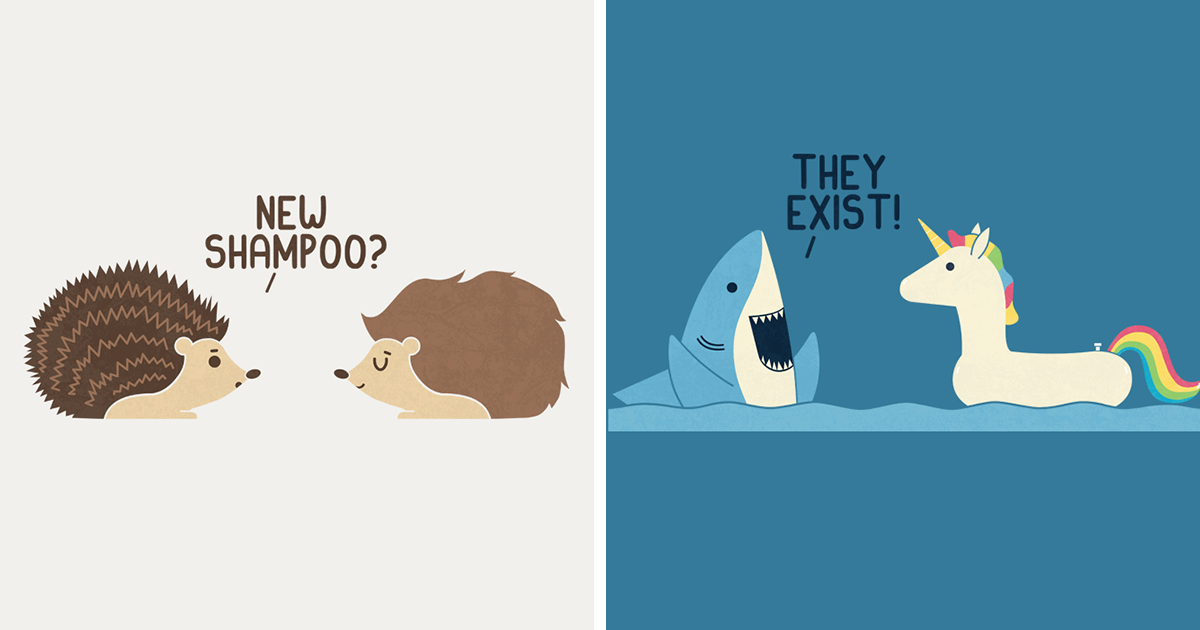
The hedgehogs discussing shampoo achieve something similar. One has sharply patterned quills while the other appears soft and fluffy. With only two words“New shampoo?”the illustration recreates an entire conversation about a dramatic makeover.
Language Becomes a Playground
Zirinis is particularly skilled at finding phrases that become funnier when taken literally. A flamingo reportedly stepped on “a Lego,” explaining why one leg is raised. Anyone who has encountered a stray block with a bare foot understands that the pose is not decorative; it is a trauma response.
A shark carrying a to-do list swims while the famous suspense rhythm from Jaws plays around it. Instead of hunting swimmers, the shark appears to be pursuing errands. The cinematic predator has become an anxious adult who remembered three tasks while trying to complete the first one.
Another shark is thrilled to discover a unicorn, only for viewers to realize that the magical creature is an inflatable pool toy. The shark’s enthusiasm makes the eventual disappointment almost visible. It is the oceanic version of believing an online product photo.
There is also an anglerfish asking a larger fish whether it feels “lightheaded.” The glowing lure provides the literal meaning, while the expression delivers the familiar meaning. The artwork explains the pun instantly without flattening it through excessive detail.
How Minimalist Design Makes the Jokes Stronger
Simple Shapes Improve Comic Timing
The collection demonstrates that detailed drawing is not automatically better storytelling. Zirinis reduces each animal to the features required for recognition: a giraffe needs a long neck and spots; a turtle needs a shell; a shark needs a fin, teeth, and a generally suspicious attitude.
This visual economy allows viewers to identify the characters immediately. Because the eye is not busy processing complex textures, shadows, or backgrounds, attention moves directly toward the relationship between the image and the caption. In other words, simplicity controls timing.
Cartoon humor often depends on noticing what is unusual in a scene. Research using captioned cartoons has shown how challenging humor can be to explain because the joke may depend on a surprising relationship among the setting, image, caption, and shared cultural knowledge. Zirinis makes that relationship unusually clear by removing anything that does not contribute to it.
Color Establishes Mood Without Stealing Attention
The illustrations use restrained palettes rather than complicated gradients or highly realistic coloring. Soft beige, teal, brown, green, blue, orange, and pink backgrounds make the collection feel warm and approachable. Darker backgrounds are reserved for underwater scenes, fossils, or nighttime-style compositions.
The color choices help separate silhouettes and guide the eye, but they rarely compete with the joke. Even a bright flamingo or giraffe remains part of a calm composition. The work feels polished without losing the looseness of an idea scribbled during a particularly imaginative lunch break.
Expressions Do More Than Dialogue
Small changes in eyebrows, mouths, and posture carry much of the emotional information. A tired bird slumps. A shark opens its mouth in amazement. A worm leans toward another worm with the urgency of someone conducting a book-club intervention.
The characters are expressive enough to communicate but not so exaggerated that the humor becomes noisy. This balance makes them charming. They are not screaming for attention; they are quietly waiting for viewers to understand the pun and groan affectionately.
Why Cute Animal Humor Works So Well Online
Funny animal art is exceptionally shareable because it crosses several barriers at once. It requires little specialist knowledge, can be understood quickly on a small screen, and combines emotional warmth with humor. The viewer does not need to recognize a celebrity, follow a political debate, or know what happened in episode seven of a complicated television drama.
Animals also create a comfortable degree of distance. An illustration about a tired office worker might feel too specific or slightly bleak. A sleepy bird communicates the same emotion while remaining gentle. A procrastinating worm is funny because it reflects us without directly accusing us. The worm is taking the blame for the entire reading community.
Humor itself can also make an experience easier to remember and discuss. The American Psychological Association has noted connections among laughter, attention, learning, and reductions in stress-related responses. A small cartoon will not solve a difficult day, but it may interrupt one long enough to create a welcome mental reset.
What Illustrators Can Learn From This Collection
Begin With a Familiar Experience
The strongest concepts often start with ordinary annoyances or habits: waking up too early, attending a loud party, waiting for something to load, finishing a book, taking vacation photos, or trying to hide when hiding is physically impossible.
Familiarity gives the audience an immediate entry point. The animal then transforms that experience into something unexpected.
Search for a Natural Connection
Rather than choosing an animal randomly, effective visual puns use a recognizable feature. Snails are slow, giraffes are tall, turtles carry shells, hedgehogs are spiky, and anglerfish produce light. The joke feels satisfying because the species is essential to the idea.
A good test is simple: could the same joke work equally well with any animal? When the answer is yes, the concept may need another round of brainstorming. When replacing the animal destroys the joke, the connection is probably strong.
Remove Everything the Joke Does Not Need
Extra details can weaken a punchline by delaying recognition. The background should support the idea, not begin an unrelated side quest. Zirinis frequently uses empty space, centered characters, and one short caption because the central relationship is enough.
This approach is especially useful for social media illustrations, editorial cartoons, greeting cards, and merchandise, where the image may appear briefly or at a reduced size.
Let the Audience Complete the Thought
A visual pun becomes more satisfying when viewers discover the connection themselves. The artist provides the piecesthe animal, the situation, and a carefully chosen phrasebut leaves a tiny gap for the audience to close.
That gap creates participation. We are not merely receiving a joke; we are helping it work.
A Reader’s Experience: Seeing Daily Life Through Animal Eyes
Moving through this collection feels a little like walking through an unusually polite zoo where every enclosure contains a joke about your personal habits. At first, the illustrations seem to offer uncomplicated cuteness. Then the recognition begins. The early bird is not merely sleepy; it is everyone who enthusiastically adopted a productivity routine and discovered that 5 a.m. has consequences. The slow-loading snail is every frozen application encountered five minutes before a deadline.
That recognition changes the viewing experience. Instead of observing animals from a distance, readers begin matching the characters to people and situations they know. The hide-and-seek giraffe may resemble the friend who believes standing behind a narrow lamp makes them invisible in photographs. The house-party turtle may recall a neighbor with powerful speakers and an adventurous interpretation of the phrase “reasonable volume.”
The jokes also encourage readers to slow down. Many can be understood instantly, but the most enjoyable images have a second layer. The first reaction comes from the caption. The second comes from noticing how carefully the animal’s anatomy supports it. The giraffe’s neck determines the size of its glass. The turtle’s shell becomes real estate. The anglerfish’s lure becomes a medical complaint. A worm’s body becomes a natural bookmark-shaped character capable of criticizing another worm’s reading progress.
There is pleasure in seeing common language dismantled this way. People say “goosebumps,” “house party,” “lightheaded,” and “early bird” without imagining their literal components. The illustrations briefly return those phrases to a state of strangeness. Familiar words become visual objects again, and viewers are reminded that language is often wonderfully ridiculous.
The collection can also change how readers observe animals afterward. A raised flamingo leg is no longer merely a recognizable pose; it may suggest a disastrous encounter with a toy brick. A slowly moving snail can resemble a progress bar. Two spiky creatures from different habitats suddenly look like relatives who have not met since a confusing family reunion.
Most importantly, the experience is gentle. The cartoons do not rely on cruelty, humiliation, or elaborate cynicism. Their humor comes from recognition, surprise, and affectionate exaggeration. Even the prehistoric and predatory characters appear vulnerable. A shark can be disappointed. A dinosaur can be nostalgic. An orca can be terrible at pretending to fire an imaginary weapon. These creatures are not reduced by their human qualities; they become more emotionally accessible.
After seeing all 30 illustrations, readers may find themselves inventing additional scenes. Perhaps a raccoon is separating laundry with unnecessary confidence. Maybe an octopus is answering eight work emails simultaneously and regretting every career choice. A penguin could be checking whether a formal event truly requires black tie. The collection invites this kind of participation because its underlying formula is open-ended: observe an animal, notice a human habit, and search for the point where the two unexpectedly meet.
That may be why the images linger longer than their simple compositions suggest. They turn everyday frustrations into manageable, friendly jokes. Our unfinished tasks, social awkwardness, tiredness, and bad decisions become less intimidating when performed by a brightly colored creature with two dot eyes and a perfectly timed caption.
Conclusion
Teo Zirinis’s funny animal illustrations succeed because they do more than place cute creatures in human settings. They connect animal characteristics, familiar expressions, and ordinary frustrations with remarkable precision. Every shell, fin, neck, claw, beak, and set of spikes becomes part of the storytelling.
The minimalist style helps each concept arrive quickly, while the relatable situations give it emotional staying power. We laugh at the exhausted bird, the loading snails, and the partying turtles because their experiences are exaggerated versions of our own. The animals provide enough distance to keep the humor light, but not enough to prevent us from recognizing ourselves.
In a crowded digital world filled with complicated messages and relentless noise, these illustrations offer something refreshingly simple: one clever idea, one charming animal, and one small moment of recognition. Sometimes that is all a joke needs. Sometimes it also needs a flamingo that stepped on a Lego.