I have never confused myself with a professional portrait artist. Nobody has looked at one of my drawings and whispered, “The next Rembrandt has arrived.” Most people look at my sketches, tilt their heads, and ask whether the person in the picture recently lost a fight with a ceiling fan.
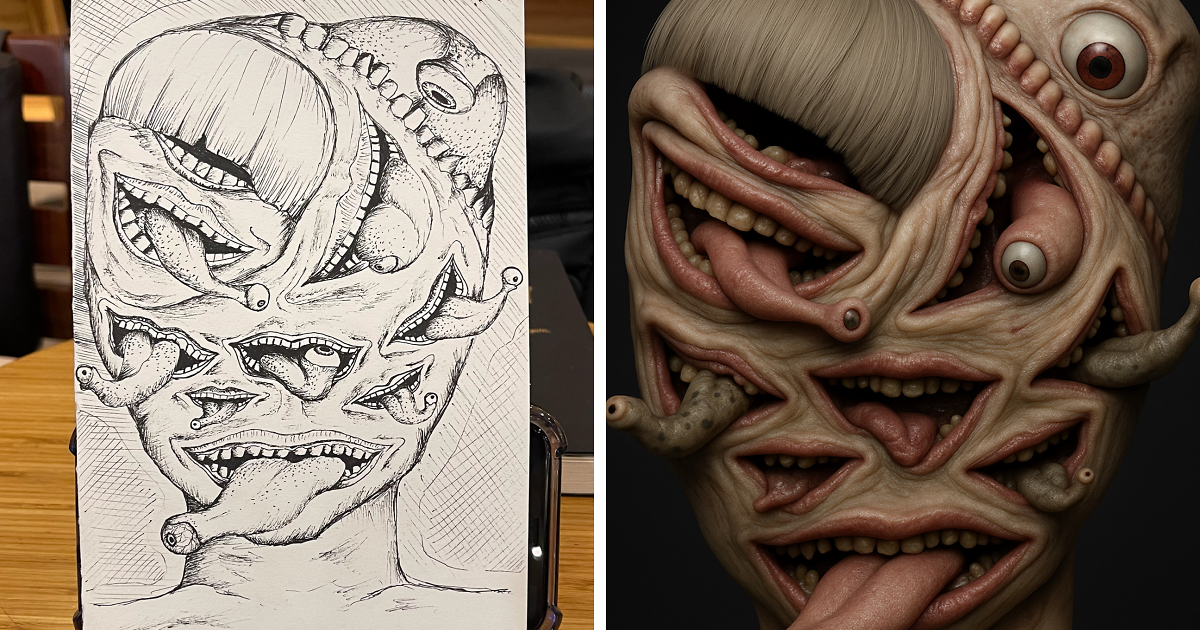
That is precisely why I decided to conduct a wonderfully unnecessary experiment: I took eight of my terrible human face sketches and asked ChatGPT to transform them into polished, three-dimensional-looking characters.
The original drawings had everything an art teacher might fearuneven eyes, wandering eyebrows, mysterious jawlines, noses that ignored basic anatomy, and ears apparently installed by separate contractors. Yet beneath the bad proportions, each sketch contained a small idea. One looked suspicious. Another seemed cheerful. A third looked like a medieval accountant who had just discovered taxes.
ChatGPT did not simply “fix” the drawings. It interpreted them. Awkward circles became cheekbones, scribbled shadows became dramatic lighting, and accidental expressions became character traits. The results ranged from surprisingly charming to magnificently unsettling.
Here is what happened when my eight terrible human face sketches were transformed into 3D-style portraitsand what the experiment taught me about AI image generation, character design, creative prompting, and the unexpected value of drawing badly.
What Does “Transformed Into 3D” Actually Mean?
Before introducing the eight victims, an important distinction is necessary. In this experiment, “3D” primarily refers to a rendered three-dimensional appearance. The generated portraits feature realistic depth, dimensional lighting, detailed skin or stylized materials, and the visual polish associated with animated films, video games, and digital sculpture.
They are not automatically production-ready 3D models with editable geometry, a movable skeleton, clean topology, or an exportable OBJ file. A convincing 3D-style portrait is still an image unless it is passed into dedicated image-to-3D or modeling software.
That difference matters. ChatGPT can interpret an uploaded sketch and create a dimensional visual concept from it. A professional artist could then use that concept as a reference while sculpting in Blender, Maya, ZBrush, or another 3D application. Specialized image-to-3D tools can go further by producing editable geometry, although those models normally still require cleanup, retopology, texturing, and artistic judgment.
For my purposes, however, I did not need a character ready to star in a $200 million video game. I wanted to see whether artificial intelligence could find a believable face inside a drawing that barely qualified as evidence of a face.
How I Prepared My Face Sketches
The process began with eight quick pencil drawings. I deliberately avoided polishing them because the entire point was to test interpretation rather than technical drawing skill. Each face was created in a few minutes using basic shapes and whatever confidence I could manufacture at the time.
I photographed the pages in bright, indirect light and cropped away the desk, coffee cup, and several crumbs that were contributing nothing to the composition. Strong contrast helped the facial lines remain visible, so I slightly increased brightness and reduced the yellow color cast from the paper.
Then I uploaded one sketch at a time and used prompts containing five useful ingredients:
- The desired medium: a cinematic 3D character render, stylized digital sculpture, or animated-film portrait.
- The features to preserve: head shape, eye spacing, hairstyle, expression, scars, wrinkles, or unusual proportions.
- The artistic direction: realistic, cartoonish, fantasy-inspired, humorous, eerie, or family-friendly.
- The technical appearance: soft studio lighting, detailed materials, shallow depth of field, and a neutral background.
- The limits: do not beautify excessively, do not change the expression, and do not replace the character with a generic model.
The final instruction was especially important. Without clear constraints, an image generator may politely abandon the ugly but distinctive parts of a sketch and produce a conventionally attractive stranger. That looks impressive, but it defeats the experiment. I wanted my mistakes promoted, not fired.
The Eight Terrible Sketches and Their 3D Transformations
1. The Potato-Shaped Philosopher
The first sketch had a head shaped like a potato standing on its narrow end. One eye was noticeably higher than the other, the mouth was a short horizontal line, and the ears appeared to be attempting an escape.
I asked ChatGPT to preserve the asymmetrical face while turning the subject into a thoughtful, middle-aged 3D character. The resulting portrait looked like a lovable professor from an animated adventure movie. The lopsided eyes became a naturally raised eyebrow, while the strange head shape became a broad forehead and soft jaw.
The transformation taught me that asymmetry is not automatically a defect. Human faces are not perfectly symmetrical, and exaggerated imbalance can communicate personality. What looked like poor measurement in pencil became intelligence, curiosity, and mild disappointment in digital form.
2. The Woman Whose Eyebrows Were Arguing
Sketch number two featured two enormous eyebrows pointing in different emotional directions. The left eyebrow looked furious. The right eyebrow seemed surprised to be involved.
Instead of correcting them, I requested a stylized 3D detective with an intense but slightly comedic expression. ChatGPT interpreted the eyebrows as deliberate acting. It added focused eyes, a sharply defined nose, a practical haircut, and dramatic side lighting.
The character looked ready to solve a complicated crime while simultaneously questioning everyone’s life choices. The biggest improvement did not come from perfect anatomy. It came from giving the face a context. Once the eyebrows belonged to a suspicious detective, their disagreement suddenly made sense.
3. The Moon-Faced Space Tourist
My third drawing had an enormous circular face, tiny lips, and two dots for nostrils. It looked less like a person and more like the moon trying to pass through airport security.
I prompted ChatGPT to transform it into a friendly retro-futuristic space traveler. The round head became a soft, stylized facial structure, while the tiny mouth and wide eyes created an expression of permanent wonder. A reflective collar and subtle blue environmental lighting completed the science-fiction appearance.
This was one of the strongest transformations because the original silhouette was simple and recognizable. Even though the anatomy was weak, the large circular shape gave the AI a clear visual foundation. A memorable outline can sometimes matter more than carefully drawn eyelashes or realistic pores.
4. The Accidental Fantasy Villain
This sketch was supposed to depict a friendly man. Unfortunately, I drew the eyes too narrow, the cheeks too hollow, and the smile too long. He looked like someone who would offer directions and then release a dragon.
Rather than fighting the obvious, I leaned into it. I requested a dark-fantasy nobleman rendered as a detailed 3D character, with pale skin, an elegant coat, controlled lighting, and an expression that remained ambiguous rather than openly evil.
The result was disturbingly effective. ChatGPT converted the hollow cheeks into aristocratic bone structure and turned the long smile into calculated confidence. The final character was not a generic monster. He looked intelligent, charming, and approximately three minutes away from betraying the kingdom.
5. The Grandma With the Industrial-Strength Chin
The fifth face had warm eyes, round glasses, curly hair, and a chin powerful enough to open canned food. I considered reducing it before uploading the sketch, but that would have been cowardice.
My prompt requested a warm, humorous 3D portrait of an elderly inventor. ChatGPT preserved the large chin while balancing it with fuller cheeks, expressive wrinkles, silver hair, and oversized protective glasses resting on her head.
She emerged as the kind of grandmother who bakes excellent cookies and secretly builds experimental aircraft in the garage. This transformation demonstrated how exaggeration can establish a strong visual identity. The chin was technically unrealistic, but removing it would have removed the character’s most memorable feature.
6. The Man With the Missing Middle Expression
Sketch six was neither happy nor sad. It was not angry, frightened, bored, or confused. Its face occupied an emotional space normally reserved for printers displaying an unexplained error code.
I described the expression as restrained uncertainty and asked for a realistic 3D office worker facing an unexpected situation. That additional story gave ChatGPT enough direction to interpret the blankness as subtle anxiety.
The generated portrait included tense lips, slightly raised inner eyebrows, and eyes focused just beyond the camera. Suddenly, the character appeared to be listening to a manager say, “We need to discuss the spreadsheet.”
This result showed how text can supply information that a rough drawing cannot. The sketch provided the structure, while the prompt supplied the emotional subtext.
7. The Crooked-Smile Game Show Host
The seventh portrait had a smile that climbed aggressively toward one ear. The teeth were represented by a single white rectangle, which made the subject resemble a friendly vending machine.
I asked for a colorful, stylized 3D game show host with an exaggerated grin, polished hair, a sparkling jacket, and energetic studio lighting. The final image looked deliberately theatrical rather than incorrectly drawn.
The crooked smile became the character’s signature expression. ChatGPT added dimples, cheek compression, and believable lighting around the mouth without making the face perfectly symmetrical. It preserved the humor of the sketch while giving the smile enough structure to feel intentional.
This was an important lesson: a good transformation should not erase the original drawing’s weirdness. It should explain the weirdness.
8. The Final Boss of Family Reunions
The final sketch combined deep forehead lines, tiny round glasses, towering hair, and a severe mouth. It looked like the person responsible for assigning seats at the world’s most stressful holiday dinner.
I requested a majestic 3D family matriarch with a commanding presence, detailed fabric, warm interior lighting, and a subtle sense of humor. ChatGPT produced a character who appeared strict but not cruel. Her expression suggested that she remembered every embarrassing thing anyone had done since 1987.
Of all eight images, this one felt most complete. The sketch already contained a strong hierarchy of features: large hair, small glasses, compressed mouth, and lined forehead. The AI’s job was mainly to connect those signals into a coherent personality.
What ChatGPT Did Surprisingly Well
It Recognized Intent Behind Bad Lines
A rough face sketch does not contain complete information. A single curved line might represent a cheek, shadow, wrinkle, or accidental movement of the pencil. ChatGPT frequently chose an interpretation that matched the surrounding features and the written prompt.
This is where conversational image generation becomes useful. I could explain that a line represented a scar rather than a smile, or that a huge forehead was intentional rather than a request for emergency resizing.
It Added Materials, Depth, and Lighting
The most dramatic improvement came from lighting and surface detail. Pencil drawings provide limited information about skin, hair, fabric, and depth. The generated portraits added soft shadows beneath the nose, reflected light along the cheeks, individual hair shapes, and materials that reacted consistently to the scene.
These details created the impression of three-dimensional form even though the result remained a flat image.
It Turned Mistakes Into Design Decisions
Several accidental features became more interesting when treated as intentional. Uneven eyes suggested skepticism. A giant chin suggested confidence. A strange smile became showmanship. The AI worked best when I asked it to preserve these irregularities rather than repair everything according to conventional beauty standards.
Where the Transformations Struggled
Identity Could Drift Between Versions
When I requested multiple variations, the character occasionally changed too much. The hairstyle shifted, the nose narrowed, or the entire face became younger. Clear instructions such as “preserve the exact head shape and eye spacing” reduced this problem, but did not eliminate it completely.
Realistic Faces Could Become Uncomfortably Almost-Human
The most photorealistic versions sometimes entered the uncanny valleythat awkward region where a synthetic face appears nearly human but contains small inconsistencies. Overly smooth skin, unusually fixed eyes, or mismatched expressions could make a portrait feel eerie.
Stylized 3D rendering often produced more appealing results because viewers do not expect cartoon characters to obey every detail of real anatomy. A slightly oversized eye feels natural in an animated character but suspicious in a supposed photograph.
A Pretty Image Was Not Necessarily a Useful 3D Asset
A rendered portrait does not provide information about the back of the head, hidden surfaces, topology, facial rigging, or animation controls. Artists creating an actual 3D model would still need front and side references, clean geometry, textures, and a proper production workflow.
The generated images were excellent concept art. They were not magic substitutes for every stage of professional 3D character creation.
How to Get Better 3D-Style Results From a Face Sketch
- Use a clean photograph or scan. Even lighting and strong contrast make the lines easier to interpret.
- Describe what must remain unchanged. Mention distinctive proportions, scars, hair, expressions, glasses, and asymmetry.
- Name the visual medium. “3D animated-film character” produces a different result from “photoreal digital human” or “clay sculpture.”
- Specify lighting and camera position. Front-facing studio lighting is useful for character reference, while dramatic side lighting creates mood.
- Make one major change at a time. Refining the face, clothing, background, and lighting separately usually provides more control.
- Protect the character’s imperfections. Ask the system not to beautify, normalize, or symmetrize features unless that is your goal.
- Request consistent follow-up views. A front view, profile, and three-quarter angle can help if the character will later be modeled.
Why Terrible Sketches Can Be Excellent Creative Material
A polished drawing often arrives with most of its decisions already made. A terrible sketch is more open. Its gaps invite interpretation, and its mistakes can lead to visual ideas that a technically careful artist might never choose deliberately.
My eight drawings were not good portraits in the traditional sense. They were compressed packages of personality. One contained suspicion. Another contained authority. Another contained the face of a man who definitely owned a dramatic cape.
ChatGPT functioned less like an automatic repair tool and more like an improvisational creative partner. It looked at each awkward collection of lines and effectively asked, “What if this weird feature were intentional?”
That question is useful far beyond AI art. Character designers frequently exaggerate silhouettes, expressions, posture, and proportions to make personalities readable. A face does not need perfect realism to communicate. It needs a clear idea.
Conclusion: My Bad Drawings Finally Found Employment
Transforming my eight terrible human face sketches into 3D-style characters was equal parts art experiment, comedy show, and lesson in visual communication. The best results did not come from asking ChatGPT to make the drawings beautiful. They came from asking it to understand what made each drawing distinctive.
The process showed that AI image generation can help non-artists explore character concepts, test styles, develop visual stories, and turn embarrassing notebook doodles into surprisingly polished digital portraits. It can also help experienced artists generate references and variations before moving into a traditional 3D production pipeline.
Most importantly, the experiment made drawing feel less intimidating. A bad sketch no longer seemed like a failed final product. It became the first message in a creative conversation.
Extended Experience: What I Learned From Spending More Time With the Eight Faces
After the initial excitement wore off, I placed the original sketches beside their generated versions and studied them more carefully. At first glance, the difference was almost ridiculous. On the left sat eight pencil creatures drawn with the confidence of someone assembling furniture without instructions. On the right stood polished characters with believable depth, controlled lighting, detailed clothing, and expressions that appeared intentional.
Yet the longer I looked, the more clearly I could see the originals inside the transformations. The professor still had my uneven eyes. The detective still wore those argumentative eyebrows. The inventor grandmother retained her heroic chin. ChatGPT had added technical polish, but the basic personality had already existed in the sketches.
That realization changed how I approached later attempts. During the first few generations, I wrote broad prompts such as “make this a realistic 3D person.” The results looked impressive, but they often felt generic. They resembled professionally rendered strangers rather than dimensional versions of my drawings.
I obtained much better results after describing relationships between features. Instead of merely requesting large eyes, I specified that the eyes should be widely spaced and positioned beneath uneven eyebrows. Instead of requesting an older woman, I described a narrow mouth, oversized round glasses, a square jaw, and tightly curled silver hair.
The experience taught me that prompt writing is not about piling glamorous adjectives into a sentence. Words such as “stunning,” “masterpiece,” and “ultra-detailed” can influence the finish, but they do not necessarily protect the character’s identity. Precise visual relationships are more valuable.
I also learned to stop chasing perfect realism. My early photorealistic portraits occasionally looked like actors wearing slightly incorrect digital masks. The skin was flawless, but the emotion was not. When I switched to stylized cinematic rendering, the faces became more convincing because exaggeration was allowed to breathe.
Another unexpected benefit was that the transformations exposed weaknesses in my drawings. When ChatGPT repeatedly misunderstood an ear, I realized the ear was attached far too low. When it turned a cheek line into facial hair, I understood that my shading was ambiguous. The generated images became a strange form of feedback, showing me how an outside interpreter might read my marks.
That does not mean every interpretation was correct. One version gave the detective three suspicious-looking earrings that were never present. Another transformed a pencil smudge into an elaborate facial tattoo. The space tourist briefly acquired enough glossy skin to qualify as a collectible figurine. These failures were frustrating, but they were also funny reminders that image generation involves interpretation rather than mind reading.
The most enjoyable part of the project was discovering stories inside the faces. Once a sketch became dimensional, I wanted to know where the character lived, what job they had, and why they were making that expression. The portraits inspired short biographies, costume ideas, and possible scenes. A simple drawing exercise grew into a miniature collection of fictional personalities.
I would repeat the experiment, but next time I would create each sketch with a stronger silhouette and include both front and side views. I would also retain more intermediate versions instead of constantly replacing them. Some imperfect generations contained excellent details that disappeared during later edits.
Ultimately, the experience did not convince me that drawing skill is unnecessary. It convinced me that rough drawing is more useful than I previously believed. A pencil sketch does not have to solve every problem. It only needs to communicate enough of an idea for the next stage to begin.
My eight faces were crooked, uneven, and anatomically questionable. They were also original. Once ChatGPT helped translate them into dimensional characters, I understood that originality had been their greatest strength all along.
Note: The transformations described in this article are 3D-style rendered images. Creating an editable, rigged, animation-ready, or printable 3D model requires dedicated modeling or image-to-3D software and may require substantial manual refinement. Creators should also disclose meaningful AI-generated elements when appropriate and review applicable platform, licensing, privacy, and copyright requirements before commercial publication.