Some landscapes look as though they were designed for horses. Iceland, apparently unwilling to do anything halfway, gives them black-sand beaches, glacier-bright mountains, moss-covered lava, silver rivers, and skies that change personality every seven minutes.
During my journey through the Icelandic countryside, I photographed horses in open pastures, beside lonely roads, beneath volcanic ridges, and in weather that ranged from glowing sunshine to horizontal rain. The resulting collection is less a formal portrait series than a conversation between an ancient breed and the land that shaped it.
Meeting the Horses of Iceland
Icelandic horses descend from animals brought to the island by early Norse settlers more than 1,000 years ago. Their long isolation helped preserve a distinctive breed known for its compact strength, heavy mane, resilient character, and unusually smooth movement. Most are smaller than many familiar riding breeds, but calling one a pony in Iceland is an excellent way to begin a very serious conversation.
The breed can perform the usual walk, trot, and canter. Many Icelandic horses also possess the tölt, a smooth four-beat gait, while some can perform the rapid flying pace known as skeið. Watching a horse tölt across an open field is mesmerizing. Its legs seem extremely busy, yet the body glides forward as calmly as a serving tray in a remarkably stable restaurant.
Although visitors often describe the animals they see beside Icelandic roads as wild horses, most are owned domestic horses living in spacious fields or seasonal grazing areas. Some roam freely over large pastures, particularly during summer, but they are not a separate population of feral horses. The wildness in these pictures belongs mainly to the sceneryand occasionally to the photographer’s hair after an hour in the wind.
Horses Beneath Mountains and Glaciers
1. The Chestnut Horse Under a Snowy Ridge
A chestnut horse stood alone beneath a mountain striped with late snow. The warm copper coat against the blue-gray ridge created the kind of color contrast photographers usually have to beg for.
2. A White Horse in the Morning Mist
Low clouds moved across the valley while a pale horse emerged from the mist. For several seconds, it seemed less like an animal entering the frame and more like Iceland inventing a myth in real time.
3. Two Friends Below the Glacier
These two horses grazed shoulder to shoulder while a glacier filled the horizon. Their quiet companionship made the enormous landscape feel surprisingly intimate rather than empty.
4. The Black Horse on the Ridgeline
A nearly black horse climbed above the rest of the herd and paused on a ridge. From below, its thick mane and upright posture produced a natural silhouette that required no direction from me.
5. A Foal Discovering the Wind
The young foal appeared fascinated and mildly offended by the Icelandic wind. It leaned forward, shook its mane, stepped backward, and then repeated the entire experiment as though expecting improved weather.
6. The Mountain Framed Between Two Ears
For this playful composition, I photographed across a horse’s head toward a distant peak. The ears formed a natural frame, proving that landscape photographers occasionally receive free assistance from their subjects.
7. Golden Light at the Foot of the Highlands
Late sunlight slipped beneath the clouds and illuminated one small section of pasture. A dun-colored horse walked directly into the light, turning an ordinary grazing scene into a brief, glowing stage.
Beautiful Icelandic Horses Among Lava Fields
8. A Mane Above the Moss
A flaxen mane lifted in the breeze above soft green moss and dark volcanic rock. The textures were distinctly Icelandic: delicate vegetation, solid lava, and enough hair to supply three shampoo advertisements.
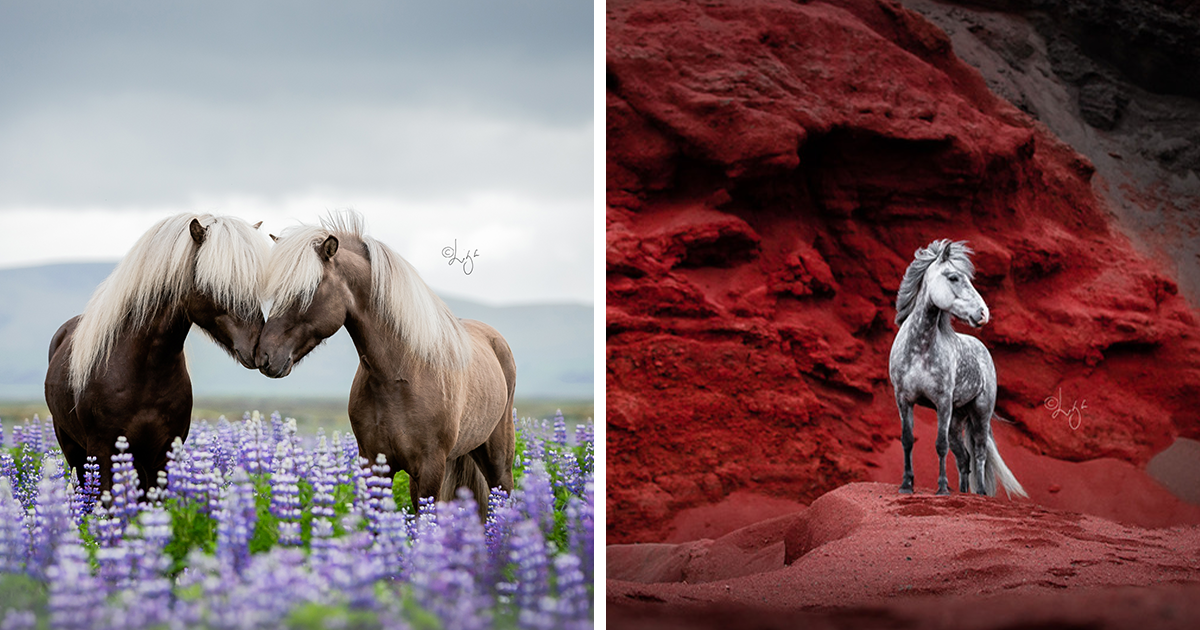
9. The Gray Horse Beside an Ancient Lava Wall
This horse’s mottled coat echoed the surface of the rock behind it. Only the movement of its ears separated the animal from the landscape at first glance.
10. Three Horses Crossing Black Ground
Three horses walked in single file across a patch of volcanic soil. Their careful steps and long shadows created a simple, graphic image with almost no color beyond brown, charcoal, and silver.
11. A Pinto Horse in a Green Lava Valley
The dramatic black-and-white markings of this pinto stood out against a valley covered in moss. It looked as if nature had temporarily switched from watercolor to bold ink.
12. Quiet Grazing Near a Volcanic Cone
While a dark cone rose behind the field, the horses continued eating without ceremony. Iceland’s geology may be internationally famous, but to the local herd it is apparently just lunchroom decor.
13. The Curious Face Beyond the Rocks
A curious horse peered over a low line of lava stones, showing only its eyes, forelock, and ears. I lowered the camera slightly and waited until its face was framed by the irregular rocks.
14. Steam, Rain, and a Patient Horse
Geothermal steam drifted across a distant hillside as rain softened the foreground. One horse remained perfectly still, giving me enough time to create an atmospheric image before the lens collected more droplets than light.
Portraits in Iceland’s Unpredictable Weather
15. The Windblown Blond
This palomino had a pale mane that swept across its face in every direction. Instead of waiting for tidy hair, I photographed the chaos. In Iceland, windblown is not a problem; it is a national visual style.
16. Snowflakes on a Dark Forelock
A brief snow shower dusted the forehead of a dark bay horse. The flakes melted almost immediately, so I worked quickly while the tiny white details remained visible.
17. A Portrait During Sideways Rain
The horse turned its hindquarters toward the rain and looked back at me with an expression that clearly questioned my decision-making. Honestly, it had a point.
18. Sunlight After the Storm
Minutes after heavy rain, sunlight broke through and illuminated droplets on a thick brown coat. The wet hair sparkled while the background remained dark, creating a portrait that looked carefully lit despite being entirely accidental.
19. The Horse With the Ice-Blue Background
A pale winter sky and distant snowfield reduced the background to cool blue tones. Against them, the horse’s warm face and dark eyes became the clear emotional center of the photograph.
20. A Close-Up of an Icelandic Winter Coat
I moved closer to photograph the dense layers of hair along the neck and shoulder. The image highlights one reason these horses look so at home in severe weather: they arrive wearing excellent equipment.
21. The Rainbow Behind the Herd
Rain moved away, sunlight arrived, and a faint rainbow appeared behind several grazing horses. The scene lasted less than a minute, which is Iceland’s polite way of reminding photographers not to put their cameras away.
Horses Along Rivers, Roads, and the Coast
22. Reflections in a Shallow River
Two horses drank from calm water while their reflections stretched beneath them. I photographed from a low angle to include both the animals and the pale clouds mirrored in the river.
23. A Horse Beside the Ring Road
This shaggy brown horse stood safely behind a fence beside Iceland’s Ring Road. Passing cars barely interested it, but the sound of my camera shutter earned a long, deeply suspicious stare.
24. The Herd Walking Toward the Sea
A loose group crossed a coastal meadow with the Atlantic beyond them. The wind flattened the grass and pushed their manes in the same direction, visually tying the entire herd together.
25. Hoofprints in Black Sand
The horses had already moved farther down the beach when I noticed the curved trail of hoofprints. I composed the image so the marks led toward the distant animals and a mountain fading into mist.
26. A Chestnut Against the Atlantic Blue
Seen from the side, the horse’s rich chestnut coat became intensely warm against the cold blue ocean. A longer lens compressed the distance, making the sea appear close behind the pasture.
27. Drinking Beneath a Small Waterfall
A narrow cascade dropped from a rocky ledge beyond the field while one horse drank from the stream below. The waterfall was modest by Icelandic standards, meaning it was merely beautiful rather than outrageous.
28. Evening Beside a Fjord
The water became almost metallic under an overcast evening sky. Several horses stood along the shore, their shapes repeated by dark rocks and distant headlands.
Movement, Friendship, and the Character of the Herd
29. Tölting Across the Field
A rider guided an Icelandic horse into tölt across open ground. I used a fast shutter speed to preserve the precise foot placement while allowing the mane to show just enough motion.
30. A Burst of Flying Pace
For a few thrilling seconds, a horse accelerated across a straight track in flying pace. The speed contrasted sharply with the calm animals grazing nearby, who appeared completely unimpressed by athletic excellence.
31. Two Horses Sharing a Scratch
One horse used the other’s neck as a convenient scratching post. Their relaxed body language and mutual patience transformed an ordinary social moment into one of the warmest pictures in the series.
32. The Foal Running Back to Its Mother
After exploring several yards of pasture, a foal suddenly hurried back to its mother. Its legs seemed too long for its plan, but the joyful, slightly uncoordinated run made a wonderfully lively photograph.
33. The Entire Herd Looking Up
A distant sound caused nearly every horse to raise its head at once. For one perfectly synchronized moment, all ears pointed forward and all attention moved beyond the frame.
34. Manes Moving in the Midnight Sun
Near midsummer, the low evening light lasted long enough for an unhurried session. Backlighting turned the horses’ manes into glowing edges while the pasture remained soft and golden.
35. The Last Horse in the Blue Hour
My final image shows a solitary horse after sunset, when the landscape had become deep blue and nearly silent. It stood still beneath the fading sky, offering a quiet ending rather than a dramatic finale.
Why Icelandic Horses Belong in This Landscape
The visual connection between the Icelandic horse and its surroundings is not simply convenient scenery. The breed developed within this environment for centuries, becoming associated with transportation, farm work, seasonal roundups, recreation, competition, and Icelandic cultural identity.
The horses also display an extraordinary range of coat colors and patterns. In a single pasture, I encountered black, bay, chestnut, gray, dun, palomino, pinto, and silver-toned animals. That variety gives a photographer endless ways to work with the landscape. A pale horse becomes luminous against lava; a black horse forms a powerful silhouette; a chestnut seems to absorb every warm ray of evening sun.
Yet scenery and color are only part of the appeal. These horses are expressive. Ears rotate toward sounds, nostrils test the air, and thick forelocks repeatedly conceal and reveal their eyes. A good portrait often depends on waiting for one small gesture rather than asking the animal to perform.
My Experience Photographing Horses in Wild Icelandic Scenery
Photographing this series changed the way I approached both animal and landscape photography. I began the trip expecting to search for grand views and place horses neatly inside them. The horses had other ideas. They turned away, walked behind one another, lowered their heads into the grass, or approached so closely that my carefully chosen mountain composition became an extreme close-up of a nostril.
The first lesson was patience. Horses spend considerable time grazing, and a pasture full of lowered heads can look surprisingly static. I learned to watch for the moment when a sound, movement, or change in weather caused one animal to look up. That small lift of the neck could reveal the eyes, separate the body from the background, and transform the entire frame.
My second lesson was to stop fighting Iceland’s weather. During one session, rain blew directly toward the camera. I kept wiping the lens and waiting for conditions to become “better.” Eventually, I realized the rain was the picture. It softened the mountains, darkened the horses’ coats, and created a moody atmosphere that clear skies could never have supplied. I protected the equipment, shortened the session, and photographed the conditions honestly.
Wind created similar opportunities. A moving mane adds energy even when a horse is standing still. Instead of waiting for calm air, I positioned myself so the wind pushed the mane away from the horse’s visible eye. That simple adjustment produced portraits that felt dramatic without disturbing the animal.
I also became more aware of distance and body language. A long lens allowed me to fill the frame without crowding the horses. When an animal turned away, flattened its ears, or moved from my position, I treated that behavior as a request for more space. No image is worth making an animal uncomfortable, crossing private land without permission, blocking traffic, or leaning over an electrified fence for a slightly better angle. The fence always wins that debate.
Some of my favorite photographs were made while sitting quietly at the edge of a pasture. Once I stopped moving, the herd gradually returned to its normal behavior. Horses groomed one another, foals wandered between adults, and individuals shifted through the landscape without reacting to me. Those moments felt less like collecting images and more like being temporarily admitted into the rhythm of the field.
Equipment mattered less than preparation. A versatile zoom lens helped me move between environmental portraits and tighter details. A fast shutter speed was useful for running horses, while continuous autofocus improved my chances of keeping an approaching animal sharp. Lens cloths, waterproof layers, spare batteries, and gloves were equally important. Artistic vision becomes rather difficult when your fingers have resigned.
The experience also taught me to photograph beyond the obvious hero shot. Wide landscapes established the location, but details gave the series personality: snow caught in a forelock, hoofprints crossing black sand, two noses touching, or rain collecting on a winter coat. Together, these smaller observations made the collection feel like a story rather than a stack of postcards.
Most of all, I learned that successful horse photography depends on cooperation without control. I could choose the lens, position, and exposure, but the horses supplied the gestures. Iceland supplied the weather. The best photographs happened when I stopped demanding a specific image and became alert to the one already unfolding.
Final Thoughts
These 35 pictures of beautiful Icelandic horses capture more than a photogenic breed. They show a relationship among animals, weather, history, and terrain. The horses bring scale to enormous valleys, warmth to cold volcanic ground, and movement to landscapes that can otherwise appear timeless.
Iceland may offer glaciers, waterfalls, lava fields, fjords, and black beaches in quantities that feel almost unreasonable. Place an Icelandic horse in the foreground, however, and the landscape gains a character capable of looking back at you.
Note: The Icelandic horses seen in open fields are generally owned domestic animals rather than truly wild horses. Visitors should remain outside fences, respect private property, avoid feeding or touching horses without permission, keep a safe distance, and place animal welfare ahead of photography.