A photograph feels like evidence. It appears to freeze a real moment, preserve it, and politely tell our skeptical brains, “See? It happened.” Unfortunately, photographs have been bending the truth since long before Adobe Photoshop arrived. Scissors, paint, darkroom tricks, airbrushes, cloned pixels, and carefully invented captions have all helped turn ordinary pictures into extraordinary lies.
The famous manipulated photos below fooled casual viewers, news organizations, voters, and occasionally people who should have known better. Some were harmless jokes that escaped into the wild. Others were propaganda designed to change public opinion. Together, they offer a useful lesson: a convincing picture is not automatically an honest one.
What Counts as a Photoshopped Photo?
“Photoshopped” is often used as a general term for an altered photograph, even when Adobe Photoshop was not involved. Several examples on this list were created decades before digital editing software existed. Their makers used physical cutting, retouching, composite printing, airbrushing, or darkroom techniques instead.
The important distinction is not the tool but the result. If a photograph removes a person, invents an object, combines unrelated scenes, or changes meaningful visual information, it no longer presents an untouched record of reality.
The Top 15 Famous Manipulated Photos
1. Abraham Lincoln Borrowed John C. Calhoun’s Body
One of the best-known formal portraits of Abraham Lincoln is a nineteenth-century composite. Lincoln’s head was placed onto the figure and setting of an earlier print depicting politician John C. Calhoun. The combination is especially ironic because Calhoun was an outspoken defender of slavery, while Lincoln became the president associated with emancipation.
The Library of Congress identifies the print as a composite, yet generations encountered it as an authentic presidential portrait. Long before layers and selection tools, image editors were already performing historical head swaps.
2. Stalin Made Nikolai Yezhov Disappear
A 1937 photograph showed Soviet leader Joseph Stalin walking beside Nikolai Yezhov near the Moscow-Volga Canal. Yezhov had led the Soviet secret police during some of the Great Purge’s most brutal years. After he fell from Stalin’s favor and was executed, official retouchers removed him from the photograph and replaced his figure with water.
This was not a cosmetic adjustment. Stalinist photo manipulation helped rewrite political history by making disgraced officials appear as though they had never stood beside the country’s leadersor existed at all.
3. National Geographic Moved the Pyramids
For its February 1982 cover, National Geographic used a horizontal photograph of camel riders near the Pyramids of Giza. To make the scene fit the magazine’s vertical format, editors visually shifted two pyramids closer together.
The change may sound minor compared with adding missiles or deleting government officials, but it altered a real geographic relationship. The magazine later acknowledged that the decision was a mistake. It became an influential example in discussions about photojournalism ethics: attractive page design should not be allowed to rearrange Egypt.
4. Einstein Bicycled Away From an Atomic Explosion
The viral black-and-white image of Albert Einstein casually pedaling away from a nuclear blast seems almost poetic. It is also a composite. A genuine photograph of Einstein riding a bicycle was combined with a separate image of an atomic test.
The fake works because it connects two facts people already know: Einstein enjoyed cycling, and his scientific legacy is culturally linked with nuclear weapons. The picture compresses that complicated history into one dramatic frame. Reality, meanwhile, stubbornly refuses to be quite so cinematic.
5. “Tourist Guy” Posed Above the World Trade Center
Shortly after the September 11 attacks, an email attachment appeared to show a tourist on the World Trade Center observation deck moments before a plane struck. The accompanying story claimed that investigators had recovered the camera from the wreckage.
The man was Hungarian tourist Péter Guzli, who had actually taken the vacation photograph in 1997. He later explained that he added the approaching aircraft as a private joke for friends. Once the image escaped his inbox, its shocking context and invented backstory transformed it into one of the early internet’s most famous photo hoaxes.
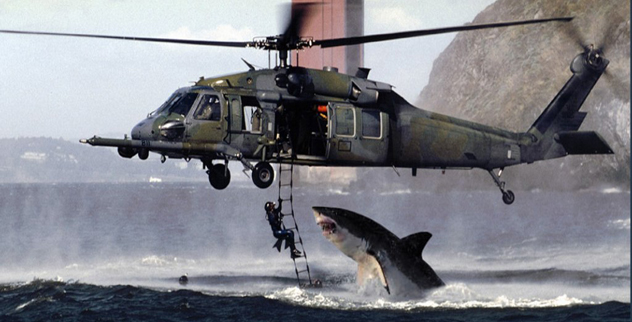
6. The Shark Attacking a Helicopter
Another classic email hoax showed a great white shark leaping toward a person hanging from a military helicopter. Messages claimed that it was a real photograph taken near South Africa and had won a National Geographic award.
In reality, the helicopter and shark came from separate photographs. The aircraft was photographed near San Francisco’s Golden Gate Bridge, while the shark image was captured in South Africa. National Geographic publicly rejected the award claim. Apparently, “shark attacks helicopter” sounded more exciting than “two unrelated photos meet in an editing program.”
7. Archaeologists Unearthed a Giant Human Skeleton
A widely shared image appeared to show archaeologists excavating an enormous human skeleton. Different captions placed the discovery in Saudi Arabia, India, Greece, or whichever location suited the storyteller’s preferred legend.
The picture originated as an entry in a digital art contest about fabricated archaeological discoveries. Its creator placed an oversized human skeleton into a genuine photograph of a mastodon excavation in New York. The contest context disappeared as the image traveled, allowing an artistic exercise to become supposed proof of ancient giants.
8. A Shark Swam Down a Flooded Highway
Whenever a major hurricane causes flooding, the internet’s most punctual shark returns. Versions of the image have been attributed to Hurricane Irene, Sandy, Harvey, Florence, and other storms. It shows a shark swimming beside vehicles on a submerged road.
The shark was lifted from a real wildlife photograph and inserted into an urban flood scene. Repeated debunking has not ended its career. Disaster images travel quickly because people are searching for urgent information, and a shark on the freeway is far more shareable than a municipal drainage update.
9. The Internet Discovered a Rare Black Lion
Images of majestic black lions have attracted millions of views, often accompanied by claims that the animals are extremely rare. Wildlife experts, however, have found no verified evidence of truly melanistic lions comparable to black leopards or jaguars.
Fact-checkers traced prominent examples to ordinary tawny or white lion photographs that had been recolored. The edits were visually impressive, especially when the mane retained realistic highlights. They succeeded because rare animals do existand because the alleged creature looked like it had wandered out of a particularly expensive fantasy movie.
10. Japan Grew Electric-Blue “Moon Melons”
A vivid photograph advertised a Japanese fruit called a moon melon. Posts claimed the blue watermelon had unusual flavors, changed taste after eating, or sold for astonishing prices. The fruit sounded less like produce and more like downloadable game content.
The original image showed a normal watermelon whose red flesh had been recolored blue. No credible agricultural source documented the supposed variety. Exotic-food claims often spread because distant locations make verification feel difficult, while bright colors deliver instant visual novelty.
11. John Kerry Shared a Platform With Jane Fonda
During the 2004 U.S. presidential campaign, a fabricated photograph appeared to show John Kerry and Jane Fonda together on a platform at an anti-Vietnam War rally. The image was constructed from separate photographs taken at different events and in different years. It was then presented like an old newspaper clipping and falsely credited to the Associated Press.
The forgery exploited the controversy surrounding Fonda’s wartime activism to damage Kerry politically. It demonstrated how a convincing caption, fake credit, and familiar historical setting can make a composite appear archival.
12. Reuters Published Extra Smoke Over Beirut
In 2006, Reuters distributed a photograph of smoke rising over Beirut after an Israeli airstrike. Observers noticed repeating shapes in the smoke and buildingsclassic signs that a cloning tool had been used.
Reuters determined that freelance photographer Adnan Hajj had digitally cloned and darkened sections of smoke, making the scene appear more extensive. The agency withdrew his images, ended its relationship with him, and strengthened editing procedures. The underlying attack was real, but exaggerating its visual evidence still violated basic photojournalism standards.
13. Iran Launched One Missile Too Many
In 2008, an image released through an Iranian military-affiliated news source appeared to show four missiles launching successfully during a test. Analysts soon identified duplicated dust, smoke, and missile components. Another version of the scene revealed that one launcher had apparently failed.
The altered photograph replaced that failure with a successful fourth launch. International outlets had already published the more dramatic image before corrections followed. It was an important reminder that official-looking material can still be manipulatedparticularly when military capability and national prestige are involved.
14. BP Filled Blank Command-Center Screens
During the 2010 Deepwater Horizon oil-spill crisis, BP posted a photograph of workers monitoring multiple video screens at its Houston command center. Investigators noticed that images had been copied onto screens that were blank in the original photograph.
BP acknowledged the alteration and replaced the picture. Adding a few active monitors did not change the spill itself, but it created the appearance of a busier, more capable response operation. During a public-relations disaster, even a small clone-stamp job can resemble a very large credibility leak.
15. North Korea Multiplied Its Military Hovercraft
In 2013, North Korea’s state news agency released a photograph of military hovercraft conducting landing exercises. Visual analysts found that several craft appeared nearly identical, suggesting that they had been copied and repositioned to make the force look larger.
Other warning signs included soft edges, inconsistent color, and missing wakes. The image illustrated a recurring propaganda technique: duplication creates the impression of military abundance without requiring additional equipment. It is the visual equivalent of inviting the same guest to stand in five places for a group photograph.
Why Photoshopped Images Fool Intelligent People
Successful fake photos rarely depend on flawless editing alone. They succeed because they arrive with emotionally satisfying stories. A giant skeleton confirms an ancient legend. A black lion offers a once-in-a-lifetime discovery. A missile photograph supports national strength. A political composite reinforces what viewers already believe about a candidate.
Context also affects judgment. During hurricanes, wars, elections, and disasters, people want information immediately. That urgency leaves little time for careful inspection. Repetition then supplies false credibility: after seeing the same picture on several accounts, viewers may assume that multiple sources independently verified it when they merely copied one another.
Experiences and Lessons From the World’s Most Convincing Photo Hoaxes
Most people’s first memorable encounter with a manipulated image did not begin with forensic analysis. It began with a forwarded email, a social media post, or a friend saying, “You have to see this.” The picture usually arrived before its source. By the time anyone asked where it came from, the emotional reaction had already occurred. We laughed at the giant cat, worried about the highway shark, or stared at the skeleton while quietly reconsidering everything learned in biology class.
A useful experience is to pause when a photograph seems perfectly designed to produce one immediate emotion. Hoaxes are often unusually efficient. They provide fear, outrage, wonder, or political confirmation without requiring background knowledge. Real events are commonly messy and incomplete; viral fakes tend to arrive gift-wrapped with a dramatic caption. If an image seems to settle a complicated argument in three seconds, those three seconds are exactly when skepticism should report for duty.
Checking an image can feel surprisingly similar to solving a small detective case. Start by locating the earliest available version rather than examining the thousandth repost. A reverse-image search may uncover the original lion, excavation, flood, or political rally. Cropping different parts of the photograph can help when the composite contains material from several sources. Searching the exact wording of the caption is also valuable because old hoaxes frequently return with only the date and location replaced.
Visual clues matter, but they should not be treated as magical proof. Repeated clouds, identical crowds, inconsistent reflections, strange edges, mismatched grain, and objects without shadows can indicate editing. Yet image compression, automatic phone processing, panorama stitching, and low-quality screenshots can create innocent abnormalities. The strongest investigation combines visual analysis with provenance: who made the picture, when it first appeared, and whether an accountable organization possesses the original file.
Another important lesson is that “fake” does not always mean every element is fictional. The helicopter, shark, missiles, smoke, and political figures in these examples were photographed in real situations. Their combination or alteration created the falsehood. Similarly, an authentic image can become misinformation when paired with a fabricated date or location. That distinction helps us evaluate evidence precisely instead of labeling everything suspicious and wandering into the opposite trap of believing nothing.
The best long-term habit is not permanent cynicism but patient verification. Trustworthy photographs still document history, expose wrongdoing, and help people understand distant events. The goal is to protect that value. Before sharing an astonishing image, take a minute to inspect its source, search for earlier versions, and see whether reputable newsrooms or fact-checkers have examined it. If the photograph survives those checks, share away. If not, you have prevented one more highway shark from completing its annual migration.
Conclusion
The history of Photoshopped photos is much older than Photoshop itself. From Lincoln’s borrowed body and Stalin’s disappearing official to cloned hovercraft and imaginary fruit, image manipulation has served art, humor, propaganda, politics, and public relations.
Technology has made convincing alterations faster, but the central weakness remains human rather than technical: we are most easily fooled by pictures that tell us what we hope, fear, or already expect to be true. A few moments of verification can separate an extraordinary photograph from an ordinary deception wearing very good lighting.
Note: “Photoshopped” is used here in its common, broad sense to describe materially manipulated photographs. Several historical examples were created with analog retouching or composite-printing techniques before Adobe Photoshop was released.