A family photo collage is supposed to create warm feelings: nostalgia, gratitude, and maybe one polite disagreement about whether Dad’s 1997 mustache deserved permanent preservation. In one widely discussed relationship story, however, a sentimental anniversary gift became a surprisingly sharp test of belonging.
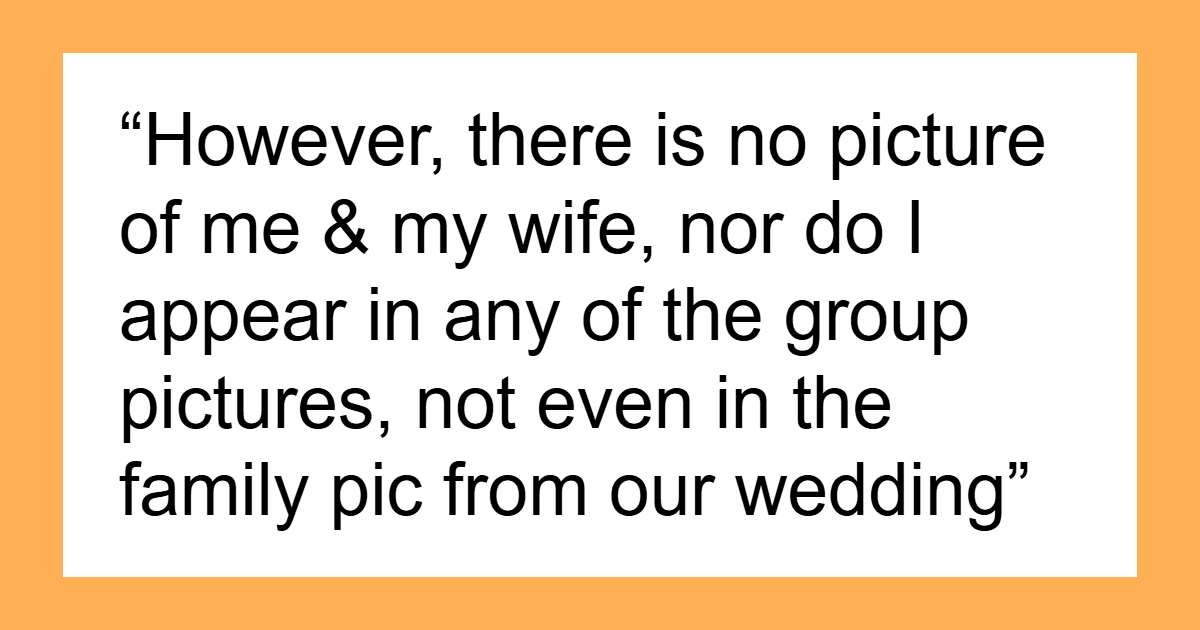
A husband noticed that his wife and her siblings had included nearly everyone in a large collage for their parents’ anniversary. There were childhood pictures, wedding memories, grandchildren, married siblings with their spouses, and even a newly engaged brother with his fiancée. The husband, however, appeared nowherenot even in a group image selected from his own wedding.
When he asked why, his wife did not simply say, “Oh no, we missed that.” Instead, she became defensive, accused him of making the gift about himself, and told him to grow up because he would be in other pictures. That response transformed a potentially fixable oversight into a larger relationship question: When someone says they feel excluded, should a spouse explain the logisticsor first acknowledge the hurt?
What Happened With the Family Photo Collage?
According to the husband’s account, his wife and her siblings worked together on a framed collage celebrating their parents’ 30th wedding anniversary. The concept was thoughtful. It traced the family’s history from the parents’ wedding through their children’s younger years and into the present generation.
The finished collage included individual photographs of the wife’s married brothers with their wives and children. It also included a photograph of a recently engaged brother and his fiancée. Yet there was no couple photo of the husband and wife, and the husband was missing from every group shot selected for the display.
His question was straightforward: If other spouses and future spouses were included, why was he the only partner left out? His wife initially said the collage was about her parents, her family, and the grandchildren. When he pointed out that the engaged couple had no children, her explanation stopped fitting the evidence. She then shifted from explaining the selection to criticizing him for raising the issue.
The public conversation largely focused on that shift. The husband said he was less upset about the collage itself than about his wife’s dismissive reaction. In a later update, she reportedly apologized for how she responded and said she would speak with her siblings about including a photograph of him.
Why One Missing Face Can Feel Like a Big Message
Technically, a photograph is only paper, pixels, or a file buried somewhere between 4,000 screenshots and a blurry picture of a parking-space number. Symbolically, however, family photos answer an important question: Who belongs in this story?
A permanent collage is not merely a random camera roll. People choose which moments deserve framing, which relationships represent the family, and which faces will be seen every day. That makes inclusion meaningful. It also makes a consistent omission noticeable, especially when people in comparable roles are present.
The husband was not demanding a solo portrait in the center with dramatic lighting and a brass nameplate. He was asking why every sibling’s partner seemed to count except him. The contrast mattered more than the raw number of pictures.
Research on social rejection helps explain why seemingly small exclusions can sting. Social exclusion can affect emotion, self-worth, and behavior, while neuroscience studies have identified overlap between some components of social pain and systems involved in physical pain. In other words, “It’s just a picture” may describe the object, but not the experience.
The Bigger Problem Was the Defensiveness
The wife may have had an innocent explanation. She may have been tired after working on the gift. She may have felt embarrassed when she realized the omission. She may have believed the collage’s purpose was obvious and experienced his question as criticism of a project she was proud of.
All of those possibilities are understandable. None required her to tell him to grow up.
Defensiveness often appears when a person hears blame, even when the other person is trying to describe hurt. Instead of responding to the concern, the defensive partner protects their intentions, effort, or self-image. The conversation then becomes a courtroom drama nobody auditioned for: One person argues, “I was hurt,” while the other argues, “I am not a bad person.” Both statements can be true, but they are not answering the same question.
The Gottman Institute describes defensiveness as a self-protective reaction that often shifts responsibility back to the partner and escalates conflict. Research on perceived partner responsiveness also emphasizes the value of feeling understood, validated, and cared for by a romantic partner. Emotional invalidationdismissing or rejecting another person’s internal experiencecan leave that person feeling irrational or unimportant, even when the dismissal was not intended to cause harm.
A healthier first response could have been remarkably simple: “I can see why that looks strange and why it hurt. I honestly didn’t notice. Let me think about how it happened.” That sentence would not confess to a secret plot. It would merely treat the spouse’s feelings as information rather than an accusation.
Was the Husband Intentionally Excluded?
Online commenters were quick to conclude that the omission had to be deliberate. Their suspicion was understandable. Several people collaborated on the collage, other spouses were included, and a photo connected to the husband’s own wedding somehow made the cut without the groom.
Still, the available account does not prove motive. Family projects are often assembled through chaotic group chats, inconsistent photo libraries, last-minute printing deadlines, and at least one sibling who responds three days late with a low-resolution image downloaded from social media. An omission can be meaningful without being malicious.
Several explanations remain possible
The siblings may have prioritized photos featuring the parents, children, and grandchildren without applying the rule consistently. The wife may have assumed someone else had submitted a couple photo. A relative may have disliked a particular image. The layout may have been finalized before anyone noticed the imbalance. There could also be unresolved tension that the husband did not mention or did not know about.
The responsible conclusion is not “She is planning a divorce” or “Her family secretly hates him.” Internet comment sections adore a plot twist, but real relationships deserve more evidence. The narrower conclusion is that the selection was inconsistent, the husband had a valid reason to ask about it, and his wife’s first response made the problem worse.
Who Was Wrong in the Argument?
Based on the account provided, the husband was not wrong for noticing the omission or asking about it. He did not demand that the anniversary gift revolve around him. He compared his absence with the inclusion of other partners and requested an explanation.
The wife was also not automatically wrong for helping create an imperfect collage. People miss things. Sentimental projects are not audited by the Department of Spousal Representation. Her mistake was responding to a vulnerable question with dismissive language and a counteraccusation.
“You’ll be in other pictures” addresses future photo opportunities, not the present concern. “Grow up” attacks the maturity of the person raising the issue. Accusing him of making everything about himself reframed a request for inclusion as selfishness. Together, those responses communicated that his feelings were the problem.
Her later apology matters because repair matters. A poor response does not have to become a permanent relationship pattern. Couples are not defined by never misfiring; they are often defined by whether they can return, take responsibility, and respond differently.
How Couples Can Repair a Conflict About Exclusion
This story offers a useful template for handling small incidents that carry larger emotional meaning. The objective is not to determine who wins the photo case. It is to understand what the incident represented to each person.
1. Start With the Feeling, Not the Accusation
The excluded partner might say, “I felt surprised and left out when I saw that every other partner was represented. I want to understand how the photos were chosen.” This is more productive than declaring that the family deliberately erased him. The first describes an experience; the second assigns a motive before the conversation begins.
2. Validate Before Explaining
Validation does not mean agreeing with every interpretation. It means recognizing that the emotion makes sense from the other person’s perspective. A spouse can say, “I understand why you felt excluded,” and still explain that the omission was accidental.
3. Take Responsibility for One Part
A person does not need to accept total blame to accept partial responsibility. “I should have noticed you were missing” or “I should not have spoken to you that way” can lower the temperature quickly. Taking responsibility is not surrender; it stops couples from wasting energy defending the indefensible five percent of an otherwise reasonable position.
4. Make a Concrete Repair
The repair could be practical: replace one image, add a companion frame, update the digital version, or choose a better family photograph for the next occasion. It could also be relational: apologize without excuses, explain what happened, and discuss whether the spouse has felt excluded in other family situations.
5. Look for the Pattern, Not Just the Incident
One missed photo may be a mistake. Repeatedly leaving a spouse out of holidays, decisions, invitations, and family traditions is a pattern. Couples should avoid catastrophizing a single event, but they should also avoid using “It’s no big deal” to dismiss repeated behavior.
Relationship guidance consistently recommends gentle openings, “I” statements, active listening, validation, and repair attempts. When a conversation becomes too heated, taking a pause and returning later can be more constructive than continuing until both partners are arguing about tone, ancient history, and something somebody’s cousin said in 2019.
What Families Can Learn Before Making a Photo Collage
Photo projects seem simple until someone has to define “the whole family.” Marriage, engagement, divorce, remarriage, stepchildren, adoption, bereavement, estrangement, and new relationships can make that definition emotionally loaded.
Before printing a permanent display, organizers should agree on a consistent rule. Are all spouses included? Are engaged partners included? Are photos selected because they show the anniversary couple, or because they represent each branch of the family? A clear standard prevents accidental hierarchies.
It also helps to conduct a final face check. List each immediate family member and partner, then confirm whether they appear. This is not about giving everyone equal square inches. It is about catching the kind of omission that becomes the only thing anyone notices after the wrapping paper comes off.
Photos can strengthen attachment and preserve shared identity, but they also reflect choices about what a family values and remembers. A thoughtful image-selection process should make people feel represented, not ranked.
Related Experiences: When a “Small” Family Moment Reveals a Bigger Need
The Holiday Card That Quietly Changed the Family Definition
Consider a couple who have been married for two years. The husband’s parents send a holiday card featuring their adult children, grandchildren, and one son’s longtime girlfriend. Their daughter-in-law is absent because the only group picture containing her was supposedly unflattering. Nobody intended an insult. Still, she wonders why image quality mattered more for her than for Uncle Ray, whose eyes were closed and whose shirt appeared to be losing a fight with cranberry sauce.
Her first instinct is to stay silent because raising the issue might sound vain. Over time, however, the card joins a small collection of moments in which plans are made without her, family news reaches her last, and her husband tells her not to take things personally. The photograph is not the entire problem. It becomes evidence in a larger internal case about whether she is truly considered family.
A better outcome begins when her husband does not debate whether the card was objectively offensive. He asks what it brought up for her, acknowledges the pattern she has noticed, and agrees to be more active about including her. The conversation shifts from “Was the photo wrong?” to “How can we operate as a team?”
The Spouse Who Was Always Behind the Camera
In another common experience, one parent takes nearly every family photograph and therefore appears in almost none of them. Years later, the albums look as if birthdays, vacations, and school events occurred under the supervision of a highly reliable ghost.
This kind of absence is rarely intentional, but it can still hurt. The solution is practical rather than dramatic: Trade camera duty, ask another person to take a picture, use a timer, and deliberately capture ordinary moments with both partners present. Representation is not only about formal portraits. It is also about creating evidence that the person doing the invisible work was part of the memory.
The emotional lesson is similar to the collage conflict. People often do not need a grand gesture. They need proof that somebody noticed. A partner who says, “I realized you are missing from most of our photos, and I want to change that,” communicates attention, appreciation, and belonging in one sentence.
The In-Law Tradition That Became a Loyalty Test
Imagine a family that takes an annual “original family only” picture with parents and adult children. At first, spouses step aside without concern. As the years pass, however, the tradition expands to include grandchildren while husbands and wives remain outside the frame. One spouse begins to feel that the image divides the gathering into permanent insiders and tolerated guests.
There is no universal rule stating that every photograph must include every person. Families can take multiple combinations: grandparents with grandchildren, siblings together, couples, cousins, and the entire group. The trouble starts when one configuration is treated as the official family image and excluded spouses are told that their feelings are ridiculous.
A flexible solution is easy: Take the traditional photograph, then immediately take a full-family version. The camera has enough storage. Nobody must be launched into the sun to create room. More importantly, the family signals that preserving an old bond does not require minimizing newer ones.
Across these experiences, the recurring need is not constant visibility. It is relational security. People want to know that their partner sees them, represents them, and responds with care when something makes them feel peripheral. A missing face can be corrected in minutes. A dismissive response can linger much longer.
Conclusion
The husband’s question was not really, “Why am I not famous in this collage?” It was, “Do you and your family see me as part of the family?” His wife may not have intended the omission, but her defensive response made that question feel more urgent.
The encouraging part of the story is the reported apology. The conflict did not require a dramatic verdict; it required acknowledgment, accountability, and a practical repair. That is the broader lesson for relationships: When a partner points to a small hurt, resist the urge to prove it should not hurt. Get curious. Listen first. Fix the photo later.
Note: This article analyzes a publicly shared account and general relationship research. It cannot verify the private motives of the people involved, and one conflict should not be used to diagnose an entire marriage.