The Motorola 6809 is one of those classic chips that makes retrocomputing people lower their voices slightly, as if discussing a rare guitar, an old race car, or a sandwich so good it deserves its own tax category. Released near the end of the 1970s, the 6809 arrived as an 8-bit processor with unusually polished ideas: clean addressing modes, two stack pointers, position-independent code support, and enough 16-bit behavior to make programmers feel as if they had smuggled a tiny minicomputer into a 40-pin package.
And then history did what history usually does: it chose the cheaper option.
The Z80 and 6502 became the household names of the 8-bit era. The 6809 powered beloved machines like the TRS-80 Color Computer and Dragon 32/64, plus famous Williams arcade hardware, but it never became the mass-market monarch its fans believe it deserved to be. Yet the chip did not disappear. In fact, the 6809 may be enjoying one of the strangest second lives in microprocessor history: it now lives inside FPGAs, running faster, cleaner, and more flexibly than the original silicon could have dreamed.
Why the Motorola 6809 Still Has a Fan Club
The 6809 was not just another 8-bit CPU with a few extra party tricks. It was a thoughtful architecture designed for people who actually had to write software, not just people who enjoyed memorizing opcode charts while muttering into coffee.
Its register set included two 8-bit accumulators that could be combined into a 16-bit D register, two 16-bit index registers, two stack pointers, a program counter, and condition-code flags. That may not sound extravagant today, when even a toaster-adjacent microcontroller can have more registers than a 1980s engineering department had chairs. But compared with many 8-bit processors of its time, the 6809 felt organized, elegant, and surprisingly modern.
Two Stacks, One Very Smart Idea
One of the 6809’s most admired features is its dual-stack design. The S stack pointer is used naturally by hardware for interrupts and subroutine calls, while the U stack pointer is available for user programs, language runtimes, or operating-system tricks. This made the 6809 especially friendly to re-entrant code, structured programming, and higher-level languages.
In practical terms, that meant a programmer could build cleaner subroutine systems, pass parameters more naturally, and write software that felt less like a wrestling match with the CPU. The 6809 was not perfect, but it was unusually civilized. If the 6502 was a fast motorcycle with no cup holder, the 6809 was a well-designed touring bike with luggage space and a surprisingly good manual.
The Price Problem: Great Chip, Awkward Timing
The 6809’s biggest enemy was not technical weakness. It was timing, cost, and market momentum. By the time the chip appeared, the 8-bit battlefield already had powerful armies. The 6502 was cheap and everywhere. The Z80 had strong software support and dominated many business and hobby systems. Meanwhile, 16-bit processors such as the Motorola 68000 were beginning to look like the future.
That left the 6809 in an uncomfortable middle seat. It was more refined than many 8-bit competitors, but also more expensive. It was powerful enough to inspire serious software, but not new enough to stop the industry from looking toward 16-bit and 32-bit systems. In short, the 6809 was the brilliant student who arrived at the party just as everyone else was leaving for college.
Where the 6809 Made Its Mark
The 6809 still found important homes. The TRS-80 Color Computer, often called the CoCo, used the 6809E and built a loyal community that remains active decades later. The Dragon 32 and Dragon 64, closely related to the CoCo family, also used the 6809E and became memorable machines in the British and European home-computer scene.
Arcade history also gave the 6809 a starring role. Williams arcade machines such as Defender, Joust, Robotron: 2084, and related hardware used the 6809 to drive fast, demanding games that still feel intense today. Robotron did not need cinematic cutscenes or photorealistic textures. It needed speed, timing, and a CPU that could help keep chaos moving. The 6809 delivered.
Then there was OS-9, Microware’s real-time, multitasking operating system. On 6809-based machines, OS-9 showed that an 8-bit processor could support serious computing ideas. Later community projects such as NitrOS-9 kept that software tradition alive, adding support for systems including the CoCo, Dragon, and CoCo FPGA platforms. That continued software ecosystem is one major reason the 6809 is more than a museum piece.
What an FPGA Changes
An FPGA, or field-programmable gate array, is a chip that can be configured to behave like custom digital hardware. Instead of merely emulating a CPU in software, an FPGA can implement the CPU’s logic directly in gates. That distinction matters. Software emulation is flexible and convenient, but FPGA implementation can reproduce timing-sensitive behavior, integrate custom peripherals, and create entire retro systems on one modern board.
For the 6809, this is a natural fit. The original chip is old enough to be fully understandable but sophisticated enough to remain interesting. A 6809 core in Verilog or VHDL can become the heart of a complete system-on-chip design, surrounded by memory controllers, video circuits, serial interfaces, sound hardware, and storage controllers. Suddenly, a computer that once required a board full of chips can live inside a compact FPGA development board.
System09 and the John Kent Lineage
One important branch of the 6809-in-FPGA story comes from John Kent’s work on VHDL 6809 systems. The System09 project built on that foundation, creating a 6809-based system-on-FPGA that demonstrated how an old processor could defeat obsolescence by becoming gateware.
System09 is especially interesting because it was not just a toy. It showed that a complete 6809-style computer could fit inside a relatively small FPGA, along with supporting peripherals and memory. In industrial contexts, this matters because old embedded systems sometimes depend on obsolete processors. Replacing an entire product can be expensive, risky, and full of surprises. Re-creating the necessary logic inside an FPGA can extend the life of legacy systems without redesigning everything from scratch.
For hobbyists, the appeal is obvious: load a bitstream, connect a keyboard and monitor, and suddenly a vintage architecture is alive again. No hunting for rare chips. No praying that a decades-old part survived shipping. No discovering that the “tested working” CPU from an auction site was tested by someone whose test procedure was “looked at it with optimism.”
Turbo9: A Classic Instruction Set With Modern Muscles
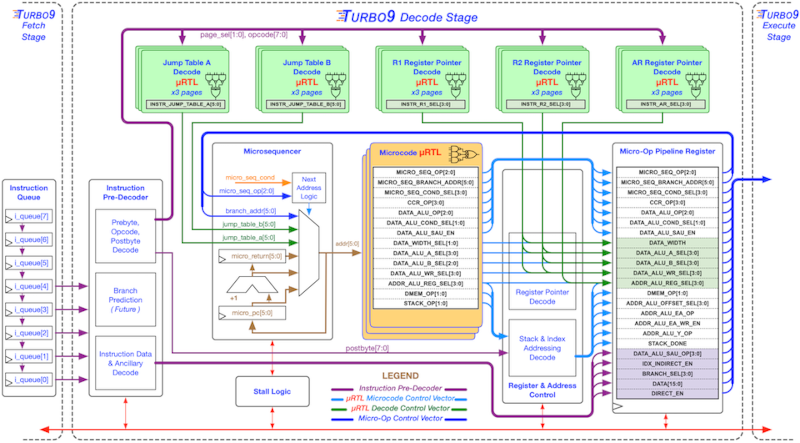
The Turbo9 project takes the idea even further. Instead of simply reproducing the old 6809 in a straightforward way, Turbo9 reimagines the architecture as a compact, efficient, pipelined microprocessor IP core written in Verilog. It executes a superset of the Motorola 6809 instruction set while using a modern internal design.
This is where things get especially fun. The 6809 instruction set is often described as CISC because it allows memory operands and rich addressing modes. But compared with later CISC monsters, it is compact and elegant. Turbo9 uses modern microarchitectural ideas to translate those classic instructions into internal operations that can run efficiently in a pipelined design.
The result is not merely nostalgia in HDL clothing. It is a serious experiment in compact processor design. Turbo9’s project materials describe a 16-bit internal datapath, compatibility with existing 6809 development tools, Wishbone bus support, and a performance goal that makes the old architecture surprisingly relevant for small embedded control applications.
Why Not Just Use RISC-V?
This is the obvious modern question. If someone wants a soft CPU in an FPGA, why not use RISC-V? It is open, modern, well-supported, and fashionable enough that mentioning it at an engineering conference will not make anyone slowly back away.
The answer is that not every embedded control task needs a big general-purpose architecture. Some systems need compactness, predictable behavior, and efficient use of logic resources. A 6809-style design can be attractive because the instruction set is dense, the register model is small, and the addressing modes map surprisingly well to pointers, arrays, stack frames, and control code.
RISC-V is excellent, but it is not automatically the best answer for every square millimeter of silicon or every FPGA project. Sometimes a lean 16-bit-flavored architecture with mature tools and a readable assembly language is exactly the right kind of weird.
FPGA Retrocomputing Is More Than Nostalgia
It is easy to dismiss FPGA retrocomputing as nostalgia with extra solder fumes. That would be a mistake. Re-creating old processors in hardware teaches digital design, computer architecture, timing, bus protocols, memory mapping, and verification. A 6809 FPGA project is a laboratory where the past explains the present.
Students and hobbyists can see how an instruction decoder works, why addressing modes affect performance, how interrupts are handled, and why video hardware once demanded careful coordination with the CPU. Modern software often hides these details under layers of frameworks, runtimes, and cheerful progress bars. FPGA retrocomputing puts the wires back on the table.
There is also a preservation argument. Old computers are physical artifacts, and physical artifacts fail. Capacitors age. Connectors corrode. Rare custom chips become expensive. FPGA implementations cannot replace the exact historical object, but they can preserve behavior, software compatibility, and educational access. They let more people experience the machine without requiring every surviving original board to be powered on until it gives up dramatically.
The CoCo, Dragon, and NitrOS-9 Connection
The 6809’s modern life is closely tied to the CoCo and Dragon communities. These machines were never just boxes of beige plastic. They became ecosystems of software, hardware expansions, operating systems, games, magazines, clubs, and stubbornly loyal users.
FPGA implementations such as CoCo3FPGA show why this matters. A CoCo-style FPGA machine can run much faster than the original hardware while keeping compatibility with familiar software. It can add better video modes, modern storage, and easier connectivity. For NitrOS-9 users, that means a classic multitasking environment can run on hardware that feels both old and new.
This is the magic trick: the user experience remains recognizably 6809, but the underlying platform gains modern convenience. You get the charm of typed commands and lean software without needing to align a floppy drive by candlelight like a monk repairing a spaceship.
What Developers Can Learn From the 6809 Today
The 6809 teaches several lessons that still matter. First, elegance counts. A clean instruction set and thoughtful addressing modes can make programming more pleasant for decades. Second, commercial success and technical quality are not the same thing. The best design does not always win the largest market. Third, preservation becomes easier when systems are understandable.
Modern processors are astonishingly powerful, but they are also difficult for one person to fully comprehend. The 6809 is complex enough to be useful and simple enough to study deeply. That makes it a wonderful educational target. You can read the programming model, write assembly, inspect HDL, simulate instructions, and eventually understand how the whole thing fits together.
For web developers, game developers, embedded engineers, and hardware hobbyists, that kind of understanding is valuable. It builds intuition. Once you have seen how a small CPU fetches, decodes, executes, branches, stacks, and interrupts, every higher-level system becomes a little less mysterious.
The 6809 Lives On Because It Still Feels Good to Use
Some chips survive because they were everywhere. Others survive because they were strange. The 6809 survives because people genuinely liked it. It had personality, but not the annoying kind. Its assembly language was expressive. Its architecture was tidy. Its quirks were usually interesting rather than cruel.
In an FPGA, the 6809 is no longer trapped by the economics of 1981. It can run faster, integrate with modern buses, talk to modern peripherals, and exist as open HDL rather than scarce old silicon. That does not erase the original chip’s history. It extends it.
The 6809 did not conquer the 8-bit world. But in a very real sense, it outlived the battle. Today it lives in repositories, FPGA boards, retro projects, industrial replacements, university research, and the affectionate arguments of people who still believe it was one of the finest 8-bit processors ever made.
Experience Notes: Building, Using, and Appreciating a 6809 FPGA System
Working with a 6809 FPGA system feels different from simply launching an emulator on a laptop. An emulator is convenient, but it keeps the old machine behind glass. An FPGA board makes the experience more physical. You load a hardware design, connect real inputs and outputs, and the machine begins to feel like an object rather than a window.
The first lesson is that old systems were balanced around limitations. A real 6809-era computer did not have endless memory, instant storage, or a graphics processor waiting politely in the corner. Code had to respect timing, memory maps, interrupts, and video hardware. When those same ideas appear in an FPGA project, they become easier to inspect. You can watch signals in simulation, trace bus activity, and understand why a certain routine behaves the way it does.
The second lesson is that speed changes personality. A CoCo-style system running a 6809 core at a much higher clock rate can feel familiar but surprisingly sharp. BASIC responds faster. Assembly routines become lively. Operating systems such as NitrOS-9 gain breathing room. The machine is still retro, but it no longer feels trapped in molasses. It is like meeting an old friend who has started jogging and now insists on taking the stairs.
The third lesson is that compatibility is both technical and emotional. A technically compatible system runs the software. An emotionally compatible system preserves the habits: the screen layout, the keyboard feel, the boot sequence, the sound of old workflows, and the small rituals that made the machine memorable. FPGA projects succeed when they respect both sides. Add modern storage, yes. Improve video, absolutely. But keep the soul recognizable.
There is also a practical joy in removing fragile dependencies. Original 6809 systems are wonderful, but they are aging. A rare chip failure can turn a weekend project into a parts hunt. FPGA systems make experimentation less scary. You can test ideas, modify memory maps, add peripherals, and recover from mistakes by reloading a design. That freedom encourages learning.
Finally, the 6809 in an FPGA reminds us that computing history is not dead material. It is reusable knowledge. The same ideas behind stacks, interrupts, buses, addressing modes, and instruction decoding still matter. The packaging has changed, but the fundamentals remain. That is why the 6809 keeps coming back. It is not merely a relic. It is a compact, understandable, surprisingly graceful machine that still has something to teach.
Conclusion
The story of the 6809 is not a simple tale of failure or success. It was a technically impressive processor that arrived in a crowded market, powered memorable computers and arcade machines, and earned long-term respect from programmers who appreciated its design. Now, through FPGA implementations and modern HDL projects, the 6809 has escaped the limits of vintage silicon.
Whether through System09, CoCo-style FPGA computers, NitrOS-9 systems, or the ambitious Turbo9 project, the old Motorola architecture continues to evolve. It proves that a processor does not need to dominate its decade to matter. Sometimes it just needs to be elegant enough that people keep rebuilding it, studying it, and giving it new homes.
The 6809 lives on in an FPGA because good ideas are stubborn. And in this case, they are also clocked a lot faster than they used to be.