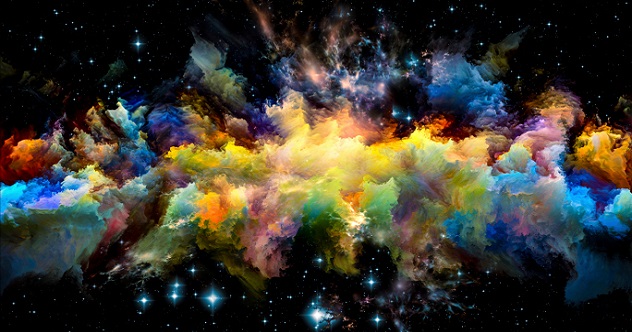
Space has never shown much interest in being reasonable. Just when you think you understand planets, stars, and galaxies, the universe produces a black hole with the mass of tens of billions of suns, a star spinning hundreds of times per second, or a planet hot enough to dismantle its own molecules.
The problem is not that these objects are difficult to describe. Astronomers can measure their masses, temperatures, rotations, and distances with remarkable precision. The problem is that the numbers quickly become too large, too fast, or too extreme for the human brain to visualize. We evolved to judge whether a berry was within reach, not whether a black hole’s shadow takes light weeks to cross.
The following mind-bending space objects are real, observed, and supported by modern astronomy. Unfortunately for your sense of scale, none of them behaves politely.
Why Extreme Space Objects Feel So Unbelievable
Most everyday comparisons stop working in deep space. A million miles sounds enormous on Earth, yet sunlight crosses that distance in only a few seconds. A temperature of 4,000 degrees sounds impossibly hot, but some planets are nearly twice that hot. Even familiar words such as “star” and “planet” become misleading when the objects involved stretch the limits of physics.
To make these cosmic wonders slightly easier to understand, each entry includes a comparison with something closer to ordinary life. “Slightly easier” is doing important work in that sentence.
1. TON 618: A Black Hole With More Than 60 Billion Solar Masses
TON 618 is an ultramassive black hole powering a distant quasar. Estimates place its mass at roughly 60 to 66 billion times the mass of the Sun. Our galaxy’s central black hole, Sagittarius A*, contains about four million solar masses, which means TON 618 operates in an entirely different weight class.
Its event-horizon region is so vast that a beam of light would need weeks to cross its shadow. For comparison, light travels from the Sun to Earth in about eight minutes. The entire orbit of Neptune could fit comfortably within the scale associated with this gravitational monster.
Why It Breaks the Brain
A black hole is not a giant cosmic vacuum cleaner, but TON 618’s gravitational influence is still difficult to comprehend. It represents the mass of an enormous galaxy’s worth of stars compressed into a region that, on a cosmic map, barely earns a dot. Calling it “large” feels like calling the Pacific Ocean “slightly damp.”
2. M87*: The Black Hole Humanity Actually Photographed
M87* sits at the center of the giant elliptical galaxy Messier 87, approximately 53 million light-years from Earth. It contains about 6.5 billion solar masses and became famous in 2019 when the Event Horizon Telescope collaboration released the first image of a black hole’s shadow.
The glowing orange ring in that image was not the black hole itself. Black holes emit no light. Astronomers recorded radiation from superheated material moving around the dark central shadow. The image required linking radio observatories across Earth so that they functioned like one planet-sized telescope.
Why It Breaks the Brain
The picture shows an object whose gravity bends light and distorts time. It also shows M87* as it existed tens of millions of years ago because that is how long its light took to reach us. Humanity effectively photographed a gravitational abyss using a telescope the size of Earth while looking into the age of prehistoric mammals. Ordinary photography suddenly seems a little underambitious.
3. PSR J1748-2446ad: A Star Spinning 716 Times Per Second
PSR J1748-2446ad is the fastest-spinning pulsar currently known. It rotates 716 times every second, equivalent to nearly 43,000 revolutions per minute. It is a neutron star: the collapsed core left behind after a massive star exploded.
A typical neutron star packs more mass than the Sun into a sphere roughly the size of a city. At 716 rotations per second, material near this pulsar’s equator may be moving at a significant fraction of the speed of light. The star completes dozens of rotations during the time it takes a person to blink.
Why It Breaks the Brain
Imagine compressing the Sun until it could fit inside a metropolitan area, then spinning it faster than the blades in any household appliance. Actually, do not imagine using it as an appliance. The warranty would be terrible, and the gravity would be worse.
4. SGR 1806-20: A Magnetar That Disturbed Earth From Across the Galaxy
SGR 1806-20 is a magnetar, an ultra-dense neutron star surrounded by an extraordinarily powerful magnetic field. Its surface field is estimated to be around 15 orders of magnitude stronger than Earth’s magnetic field.
On December 27, 2004, SGR 1806-20 produced a giant gamma-ray flare. In roughly one-tenth of a second, the eruption released more energy than the Sun produces over approximately 150,000 years. Although the magnetar lies thousands of light-years away, its radiation disturbed Earth’s upper atmosphere.
Why It Breaks the Brain
A magnetar is only about the size of a city, yet it can influence a planet from across the Milky Way. If one came dangerously close to Earth, its magnetic field could interfere with matter at the atomic level. Fortunately, SGR 1806-20 is nowhere near us. “Nowhere near” is one of astronomy’s most comforting phrases.
5. KELT-9b: A Planet Hotter Than Many Stars
KELT-9b is an ultra-hot Jupiter orbiting a blue, extremely hot star roughly 670 light-years away. The planet’s dayside temperature reaches about 7,800 degrees Fahrenheit, or around 4,300 degrees Celsius. That is hotter than the surfaces of many stars.
KELT-9b circles its star in only about 1.5 Earth days. The incoming radiation is so intense that molecules on the dayside can be torn apart into their component atoms. Its atmosphere is also puffed up and gradually escaping into space.
Why It Breaks the Brain
We tend to think of stars as hot and planets as relatively cool. KELT-9b has rejected that arrangement. It is a planet with star-like temperatures, an atmosphere being chemically dismantled, and a year shorter than a long weekend. Packing sunscreen would be an optimistic gesture.
6. WASP-12b: The Egg-Shaped Planet Being Eaten by Its Star
WASP-12b is another hot Jupiter, located roughly 1,200 light-years from Earth. It is almost twice Jupiter’s radius and completes an orbit in just 1.1 days. Its temperature is approximately 4,000 degrees Fahrenheit.
The planet travels so close to its host star that intense tidal forces stretch it into an egg-like shape. Material from its atmosphere is being pulled away, creating a stream of gas that feeds the star. Astronomers expect the planet’s orbit to continue shrinking until the world is ultimately destroyed.
Why It Breaks the Brain
Earth’s Moon creates ocean tides. WASP-12b’s star creates tides strong enough to deform an entire gas giant and strip away its atmosphere. It is less like a stable solar system and more like a very slow cosmic lunch.
7. Kepler-16b: A World With Two Suns
Kepler-16b orbits two stars instead of one, making it a circumbinary planet and the first confirmed world of its kind discovered by NASA’s Kepler mission. It lies about 245 light-years away and takes approximately 229 days to complete one journey around its paired suns.
The planet is a cold gas giant, somewhat comparable to Saturn, so there is probably no solid surface from which to admire the view. However, a hypothetical moon orbiting Kepler-16b could experience two moving suns, overlapping eclipses, and double sunsets.
Why It Breaks the Brain
For years, planets with two suns belonged mainly to science fiction. Kepler-16b demonstrated that such systems can form naturally. Its skies would turn orbital mechanics into a daily theater production, with both stars continuously circling each other while the planet circles them both.
8. The Boomerang Nebula: Colder Than Empty Space
The Boomerang Nebula is a cloud of gas surrounding a dying star approximately 5,000 light-years from Earth. Its inner region has been measured at about one degree Kelvin, just one degree above absolute zero. That makes it colder than the natural microwave background filling the universe.
The nebula became so cold because gas was expelled at tremendous speed. As that gas expanded, it cooled dramatically, much like compressed gas cooling when released from a container, only on an enormous astronomical scale.
Why It Breaks the Brain
Space already has a reputation for being cold. The Boomerang Nebula somehow became colder than its surroundings through the violent death process of a star. It is a cosmic freezer created by an expanding wind, proving that even emptiness can apparently be out-chilled.
9. R136a1: A Star More Than 250 Times the Sun’s Mass
R136a1 is one of the most massive stars known, with estimates exceeding 250 solar masses. It resides in the dense R136 star cluster inside the Tarantula Nebula, part of the Large Magellanic Cloud, a neighboring galaxy of the Milky Way.
This star is not simply a scaled-up version of the Sun. It is extremely hot, luminous, and unstable, blasting enormous quantities of material into space through powerful stellar winds. Massive stars consume their nuclear fuel at breathtaking rates, so R136a1 is expected to live only a few million years.
Why It Breaks the Brain
A red dwarf can shine for trillions of years, but a stellar titan such as R136a1 lives fast and dies young. It has hundreds of times the Sun’s mass but only a tiny fraction of its expected lifespan. In cosmic terms, it is a celebrity who arrived at the party with fireworks, a wind machine, and no intention of staying until breakfast.
10. The Phoenix Cluster: A City of Galaxies Making Stars at a Furious Rate
The Phoenix Cluster is a colossal galaxy cluster located about 5.7 billion light-years from Earth. Galaxy clusters contain hundreds or thousands of galaxies, huge reservoirs of hot gas, and even larger amounts of invisible dark matter.
At the Phoenix Cluster’s center is a supermassive black hole with an estimated mass of about 5.8 billion suns. Yet unlike the central black holes in many other clusters, it has not completely shut down star formation. The central galaxy has produced stars at rates measured in hundreds of solar masses per year, compared with roughly one solar mass per year in the Milky Way.
Why It Breaks the Brain
The Phoenix Cluster is not merely one object in the everyday sense. It is a gravitationally connected metropolis of galaxies, hot plasma, dark matter, newborn stars, and a gigantic black hole. Trying to visualize it is like trying to imagine every city on Earth merged into one structure, then discovering that the structure is still too small for the comparison to be useful.
Experiencing Cosmic Scale Without Leaving Earth
Reading astronomical measurements can become strangely numbing. After the fifth mention of “billions of solar masses,” the brain may quietly file everything under “very big” and request a snack. A better way to appreciate these extreme space objects is to turn the information into a physical or emotional experience.
Start With a Clear Night and One Familiar Object
Imagine stepping outside on a dark, cloudless night and finding the Moon. It is close enough for light to reach Earth in roughly 1.3 seconds. The sunlight illuminating it needed about eight minutes to arrive from the Sun. Already, the sky is not showing you the present. It is showing you a layered collection of recent history.
Now look for a bright star. Depending on which one you choose, its light may have traveled for years, decades, or centuries. That point of light is not a live broadcast. It is a delayed message crossing space at the fastest speed nature permits.
Build a Solar-System Walk
Place a small ball on the ground to represent the Sun. Walk about 30 paces and place a peppercorn to represent Earth. At that scale, the nearest star would still be far beyond the boundaries of an ordinary neighborhood. TON 618, the Phoenix Cluster, and other distant objects would not fit meaningfully anywhere on the same walk.
This exercise produces an important realization: illustrations of the solar system are almost always wildly compressed. Planets are drawn too large, distances are shortened, and empty space is quietly removed because an accurate diagram would contain mostly blank paper.
Listen to a Pulsar
Astronomers can convert pulsar signals into audio. A slow pulsar sounds like a steady clock. A millisecond pulsar resembles a buzzing machine because its pulses arrive so rapidly. Listening to that rhythm makes PSR J1748-2446ad feel less like an abstract catalog entry and more like an actual object spinning in the galaxy.
Then remember that the sound is a translation of radio signals, not noise traveling through space. The pulsar itself is sweeping beams of radiation across the cosmos like an impossibly fast lighthouse.
Try Holding the Contradictions Together
The most powerful experience comes from considering several objects at once. The Boomerang Nebula is colder than the background of space, while KELT-9b is hotter than many stars. R136a1 contains hundreds of solar masses, while a neutron star compresses comparable stellar material into a city-sized sphere. Kepler-16b circles two suns, while WASP-12b is being pulled apart by one.
These are not imaginary opposites created for a fantasy story. They coexist in the same universe and follow the same underlying laws of physics. Gravity, thermodynamics, nuclear reactions, and electromagnetism produce radically different outcomes depending on mass, motion, composition, and time.
Let the Scale Feel Uncomfortable
There is a temptation to “solve” cosmic scale by finding the perfect comparison. No comparison fully works. The uncomfortable feeling is part of the experience. It is the moment the mind recognizes that reality is larger than its built-in measuring tools.
That realization can be humbling, but it can also be energizing. Human beings are physically tiny, yet we have built instruments capable of measuring the temperature of a distant nebula, detecting a star rotating 716 times per second, and imaging material around a black hole in another galaxy. We may not be able to wrap our minds completely around these objects, but we can still discover them, study them, and occasionally give them wonderfully dramatic names.
Conclusion: The Universe Is Under No Obligation to Feel Sensible
These ten mind-bending space objects demonstrate how far nature can push familiar concepts. Stars can spin like turbines, planets can become hotter than stars, black holes can outweigh billions of suns, and expanding gas can become colder than the space around it.
Astronomy does not make the universe smaller or simpler. It gives us better tools for appreciating how astonishingly strange reality already is. Every new telescope adds detail, but it also reveals fresh mysteries. That may be the most difficult idea to comprehend: the objects listed here are not the limits of the universe. They are merely some of the extreme things we have managed to find so far.