Mass-market design and handmade craft do not always sit comfortably at the same table. One likes enormous production runs, predictable dimensions, and prices that do not require a financial wellness seminar. The other celebrates the hand of the maker, subtle irregularities, traditional techniques, and the pleasant fact that two objects need not look like identical twins. IKEA’s 2016 VIKTIGT collection, created with celebrated Swedish designer Ingegerd Råman, managed to bring those apparently opposing ideas into the same roomand make them look surprisingly good together.
VIKTIGT was introduced as a limited-edition collection spanning furniture, lighting, baskets, rugs, ceramics, and glassware. Its visual language was restrained rather than theatrical: clear and milk-white glass, glossy black and white ceramics, bamboo, rattan, seagrass, paper cord, and other natural fibers. The collection relied on simple shapes and traditional making techniques instead of shouting for attention with fashionable colors or complicated decoration.
That restraint was precisely the point. Råman’s work has long been associated with clarity, function, and disciplined reduction. Born in Stockholm in 1943, she built a distinguished career in ceramics and glass, studying at institutions including Capellagården, Konstfack, and the ceramics institute in Faenza, Italy. Museums and design organizations have described her as one of Sweden’s most influential designers, with a body of work rooted in deceptively simple forms made for actual use rather than display-case worship.
A Collection That Made Quiet Design Feel Important
The name VIKTIGT is wonderfully appropriate for a collection that behaves as though understatement matters. There are no peacocks here. No chair is desperately auditioning for a design museum. No bowl requires a paragraph of instructions before you can put olives in it. Instead, the objects gain character from proportion, material, texture, and the evidence of how they were made.
This was especially visible in the collection’s woven pieces. Råman worked with Vietnamese craftspeople on objects that drew from established weaving traditions, including handwoven bamboo forms. The range included storage baskets, serving pieces, airy pendant shades, and woven furniture. The handmade construction meant that small variations were not manufacturing failures to be hidden but part of the visual identity of the objects.
That idea may sound obvious now, when “artisan-inspired” has been stamped on everything from bread to Bluetooth speakers. In a large international retail system, however, accepting variation can be radical. Mass production usually aims to eliminate difference. Craft preserves it. VIKTIGT found an appealing middle ground: the objects were recognizable as a coherent IKEA collection, yet many retained the texture, irregularity, and human presence associated with handwork.
Ingegerd Råman’s Philosophy: Remove More, Then Stop at the Right Moment
Råman’s design approach is often described through simplicity, but simplicity is not the same thing as making something boring. In fact, creating a plain object that still feels distinctive is one of design’s more annoying little challenges. Add decoration and you can hide a weak proportion. Remove decoration and suddenly every curve has to behave itself.
Her glass and ceramic work demonstrates this discipline. A pitcher may be little more than a clear cylinder and a carefully shaped opening. A bowl may seem almost archetypal. Yet the relationship between diameter, height, weight, rim, transparency, and touch determines whether the object feels elegant or merely generic. Nationalmuseum has noted that Råman’s apparently simple tableware reflects a strong awareness of the user, while her broader career has moved continuously between pottery and glass design.
Function Was Never an Afterthought
The VIKTIGT glassware embodied this practical intelligence. Carafes, cups, bowls, pitchers, and serving pieces were designed with clean silhouettes and straightforward uses. Some pieces could be stacked or nested, a small-space advantage that feels particularly appropriate for IKEA customers who may be attempting to fit an entire adult life into a kitchen cabinet the width of a carry-on suitcase.
Contemporary coverage of the collection highlighted clear and milk-white glass, nesting ceramic dishes, pitchers, serving bowls, and a carafe-and-glass combination. The tabletop pieces shared the same visual restraint as the woven furniture: no unnecessary flourish, no ornamental panic, just useful forms with enough character to make the dinner table feel considered.
Natural Materials Did the Decorating
Because ornament was limited, the materials had to carry more of the aesthetic load. Bamboo showed its grain. Woven fibers created shadow. Rattan introduced warmth. Glass reflected light. Black glaze added depth without requiring a trendy pattern that might age faster than an avocado-green refrigerator.
The palette also made the collection unusually adaptable. Washingtonian described VIKTIGT as capable of moving between urban and more rustic settings, while Design Milk emphasized the collection’s understated beauty, natural materials, and functional forms. That flexibility came from refusing to over-style the objects in the first place.
The Most Memorable Pieces in the VIKTIGT Collection
Handwoven Bamboo and Natural-Fiber Baskets
The baskets captured the collection’s philosophy almost perfectly. They were storage objects, but their open structures made them sculptural enough to leave in plain sight. This is useful because real homes contain blankets, magazines, toys, laundry, and mysterious charging cables that apparently reproduce when the lights are off.
Rather than concealing the basket’s construction, the design made weaving the main event. The pattern, spacing, and changing thickness of natural material gave each piece visual energy. Contemporary product coverage specifically described VIKTIGT baskets and pendant shades as handmade by skilled craftspeople.
Airy Pendant Lamps
The pendant shades were another highlight because they demonstrated how a lightweight material can control a room without dominating it. A woven shade creates two designs at once: the physical object and the pattern of light and shadow it produces. In daylight, it reads as texture. At night, it becomes atmosphere.
Domino’s coverage singled out the handmade pendant shades for their visual lightness and versatility. Unlike a heavy metal fixture or an elaborate chandelier, a woven lamp can occupy substantial volume while still feeling almost transparent.
Glassware With Nothing to Hide
Råman’s expertise in glass gave the VIKTIGT tabletop collection particular authority. Clear glass is brutally honest. There is nowhere for the form to hide, which means silhouette and proportion become everything. The collection included pitchers, bowls, serving pieces, carafes, and drinking vessels whose appeal came from their directness.
Remodelista highlighted Råman’s long association with fine mouth-blown glassware and showed VIKTIGT pieces in clear and milk-white glass, while POPSUGAR documented several of the affordable serving and drinking pieces released with the collection.
Black and White Ceramics
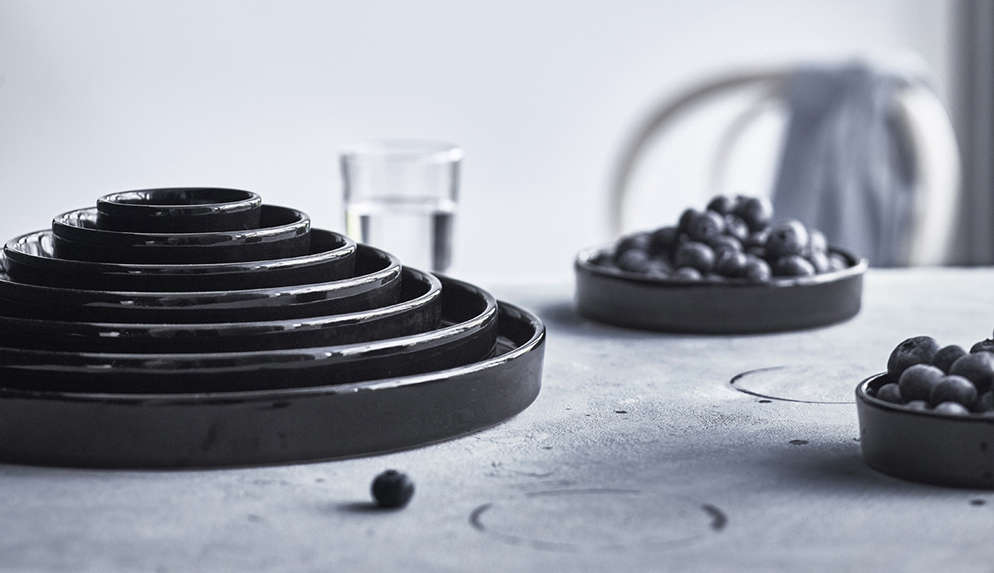
The ceramics took a similarly reduced approach. Glossy black and white surfaces allowed shape to remain the focus, while nesting forms made storage easier. The lack of decorative imagery also meant the pieces could live happily beside inherited dishes, flea-market finds, or the one inexplicably beloved mug everyone in the house fights over.
Woven Seating That Softened Minimalism
Minimalist interiors sometimes suffer from a clinical problem: remove enough stuff and the room begins to resemble a particularly tasteful dentist’s office. VIKTIGT’s woven chairs, benches, and seating pieces helped prevent that. Their natural textures brought warmth to simple silhouettes, balancing clean lines with visible craft.
The broader range included seating and other furniture alongside smaller accessories, allowing the same material language to move from tabletop scale to room scale. Contemporary reports consistently described the collection as combining streamlined design with traditional methods and natural fibers.
Why VIKTIGT Mattered Beyond Good-Looking Baskets
The deeper interest of the collection lies in the question it raised: Can handcrafted character survive mass retail?
The answer is complicated, but VIKTIGT offered a persuasive experiment. IKEA’s stated design philosophy evaluates products through form, function, quality, sustainability, and low price. Handmade production does not automatically fit neatly into a system optimized for affordability and scale, yet the collaboration demonstrated that traditional craft techniques could become part of a widely distributed contemporary collection rather than remaining limited to galleries and luxury boutiques.
That is the “craftwork for the masses” idea at its best. It does not mean pretending that a global retailer is the same thing as buying directly from an independent artisan. It means exposing a much larger audience to the tactile qualities of woven fibers, hand-shaped forms, subtle variations, and material honesty.
Råman herself presented VIKTIGT as a project built around craft and the relationship between maker and designer. Her own official archive describes the collection in terms of craftsmanship, attention to detail, handmade pieces, timelessness, and “naked design”an approach in which the material and construction are allowed to speak without excessive disguise.
The Collection’s Lasting Design Lessons
Buy Fewer Visual Gimmicks
One reason VIKTIGT still looks relevant years after its original 2016 release is that it did not depend heavily on a specific decorating fad. A clear carafe, a black bowl, or a woven bamboo pendant does not need to know which paint color a trend forecaster declared “the new neutral” this week.
Timelessness is never guaranteed, of course. Design history is full of objects once described as eternal that now look like props from a forgotten airport lounge. Still, reducing decorative signals generally gives an object more freedom to move between interiors and decades.
Let Materials Have a Personality
VIKTIGT also reminds us that natural materials do not need to be cosmetically bullied into perfect uniformity. The grain of bamboo, the slight variation of woven fibers, and the optical character of glass can provide enough visual interest. When the material already has something useful to say, the designer does not need to interrupt every five seconds.
Useful Objects Can Still Be Special
Perhaps the most important lesson is that functionality and emotional appeal are not enemies. A basket can hold laundry and still be beautiful. A pitcher can pour water and improve the table. A lamp can illuminate dinner while casting a pattern across the wall. Good everyday design often works precisely because the aesthetic pleasure arrives through repeated use.
Living With This Kind of Design: A Practical Experience
Imagine bringing a VIKTIGT-style object into an ordinary home rather than a perfectly styled catalog set. The first surprise is how little effort it asks from the room. A handwoven basket does not demand matching furniture. A clear glass pitcher does not care whether your plates came from a Scandinavian design shop, your grandmother’s cabinet, or a supermarket sale. The pieces are visually disciplined enough to coexist with other things.
The experience of using restrained, craft-focused objects is also different from owning highly decorative statement pieces. Statement pieces announce themselves immediately. They enter the room wearing a sequined jacket and asking where the cameras are. Quiet objects take longer. You notice how comfortably a glass feels in the hand, how a woven shade changes the evening light, or how a basket develops a slightly softer surface after months of use.
That gradual relationship is one of the pleasures of material-centered design. Natural fibers may develop small changes in tone. Handmade surfaces reveal variations you did not notice on day one. Clear glass becomes part of whatever it contains: water, flowers, branches, or, during a particularly ambitious weekend, homemade lemonade.
How the Look Works in a Real Room
Start with one strong natural texture rather than trying to turn the house into a Scandinavian craft exhibition overnight. A woven pendant over a dining table can soften hard surfaces such as concrete, stone, glass, or painted cabinetry. A large basket can bring warmth to an otherwise minimal living room. Black ceramics can create contrast on pale wood shelves, while clear glass keeps a small dining area visually open.
The collection’s neutral palette also makes layering easier. Bamboo and rattan work well beside oak, walnut, linen, cotton, leather, and matte metals. Clear glass can disappear into a busy table setting or become sculptural when grouped in multiples. Black and white ceramics provide enough contrast to keep a neutral room from turning into fifty shades of oatmeal.
The Value of Imperfection
Living with handmade or hand-finished objects requires a small mental adjustment for anyone trained by industrial manufacturing to expect absolute sameness. One basket may lean slightly differently from another. The weave may vary. A handworked surface may have tiny distinctions.
Those variations can make an object feel more personal, but only when the construction remains functional and durable. There is a difference between charming irregularity and a chair that appears to be reconsidering its commitment to gravity. The best craft-based products preserve evidence of human making without compromising their ability to perform the job they were designed to do.
Why Simple Objects Often Stay Longer
Another practical lesson from the VIKTIGT approach is that visually quiet objects are easier to keep through multiple decorating phases. A homeowner may move from industrial loft style to warm minimalism, then discover vintage furniture, then briefly develop an alarming interest in limewash walls. A simple woven basket or clear pitcher can survive all of this domestic identity exploration with admirable emotional stability.
That longevity is not merely aesthetic. The longer an object remains useful and desirable, the less pressure there is to replace it simply because its styling feels outdated. The principle aligns naturally with IKEA’s broader design framework, which places function, quality, sustainability, form, and affordability in conversation rather than treating them as unrelated goals.
A More Thoughtful Way to Shop
The strongest takeaway is not that every home needs a discontinued VIKTIGT collector’s hunt. It is that the collection offers a useful checklist for future purchases. Is the object genuinely useful? Does the material improve with age? Is the design dependent on a short-lived trend? Can you imagine using it in another room? Does its construction contribute to its beauty?
These questions are more valuable than asking whether an item is currently popular on social media. Trends are excellent at creating urgency and less talented at paying your credit card bill.
VIKTIGT’s appeal came from making everyday materials and traditional techniques feel contemporary without sanding away their character. It showed that accessible design could be calm, tactile, functional, and visibly connected to making. In a market crowded with objects engineered to attract attention for six months, that quiet confidence may be the collection’s most enduring achievement.
Conclusion
Ingegerd Råman’s VIKTIGT collection for IKEA was more than a particularly handsome group of baskets, lamps, glassware, ceramics, and furniture. It was an experiment in scale: an attempt to bring the character of craft into a global retail environment without turning handmade qualities into mere decoration.
The result combined Råman’s disciplined approach to glass and ceramics with woven natural materials and the knowledge of skilled craftspeople. Its best pieces did not demand attention through novelty. They earned it through proportion, texture, usefulness, and the visible intelligence of making. That is why the collection remains a valuable reference point for anyone interested in Scandinavian design, minimalist interiors, handcrafted homeware, or the difficult but fascinating relationship between mass production and craft.
Good design does not always need to shout. Sometimes it simply needs to pour the water properly, hold the blankets, cast a beautiful shadow, and still look good after the trend cycle has packed its bags and moved on.