Tariffs have financed governments, protected factories, provoked diplomatic quarrels, and made ordinary shoppers wonder why a perfectly innocent washing machine suddenly costs more. Although modern tariff debates often arrive dressed as breaking news, the policy itself is ancient. Whenever goods have crossed a border, gate, bridge, harbor, or suspiciously well-guarded mountain pass, someone has usually appeared with a ledger and a request for payment.
The history of tariffs is therefore more than a story about import taxes. It is a recurring argument over who should benefit from trade, who should bear its disruptions, and how much economic independence a country is willing to purchase through higher prices or reduced competition.
What Is a Tariff?
A tariff is a tax placed on imported goods. In the United States, the importing company generally pays the duty to the federal government when merchandise enters the country. The foreign government does not simply receive an invoice marked “your tariff bill,” tempting as that image may be.
How tariffs affect prices
Importers may absorb part of the cost, negotiate lower prices with foreign suppliers, switch suppliers, or pass the expense to customers. The final burden depends on competition, exchange rates, supply chains, and how easily buyers can find substitutes.
Governments have historically used tariffs for three broad purposes: collecting revenue, protecting domestic industries, and pressuring other countries. One tariff can pursue all three goals, although succeeding at all three simultaneously is about as easy as repairing a roof, balancing a budget, and winning an argument with a customs officer before lunch.
Ancient Customs Duties: Trade Meets the Tax Collector
Tariff-like charges existed long before economists gave them formal names. Ancient Greek cities collected duties at ports and taxed goods moving through strategically important waterways. Athens, for example, depended on maritime commerce and used customs charges to generate public revenue.
The Roman world also imposed import, export, transit, and harbor duties. Customs stations appeared at provincial boundaries and along major commercial routes. Merchants moving wine, grain, metals, spices, or textiles might owe money several times before reaching their customers.
These early duties were usually more concerned with revenue and control than with nurturing a modern national industry. They helped rulers finance armies, roads, ports, and bureaucracies. They also demonstrated an enduring political truth: taxing trade can be easier than locating every citizen and asking how much income he earned last year.
Tariffs in the Age of Mercantilism
From the 1500s through much of the 1700s, European governments embraced mercantilism. Under this system, national wealth and power were closely associated with accumulating precious metals, promoting exports, and limiting dependence on foreign goods.
Tariffs became part of a larger toolbox that included shipping restrictions, colonial monopolies, export subsidies, and navigation laws. Britain’s Navigation Acts directed colonial commerce toward British ships and ports. France’s finance minister Jean-Baptiste Colbert supported tariffs and state-directed manufacturing under Louis XIV.
Consumers sometimes paid more, but mercantilist policymakers were not running a customer-satisfaction survey. Their priorities were state revenue, naval strength, manufacturing capacity, and geopolitical advantage.
Criticism grew during the Enlightenment. Adam Smith argued in The Wealth of Nations that specialization and freer exchange could increase prosperity. He accepted limited exceptions for national defense and retaliation, but distrusted permanent protection created for politically connected industries.
Tariffs Help Build the Early United States
The Tariff of 1789
The new United States had war debts, few administrative resources, and no federal income tax. The Tariff Act of 1789, one of the first major laws passed by Congress, placed duties on numerous imports. Customs revenue became a financial foundation of the federal government.
Alexander Hamilton also viewed tariffs as a way to encourage domestic manufacturing. His 1791 Report on Manufactures argued that carefully designed government support could help young American industries compete with established European producers.
The American System and the Nullification Crisis
After the War of 1812 exposed American dependence on foreign manufactured goods, Congress adopted the Tariff of 1816, commonly regarded as the first clearly protective U.S. tariff. Henry Clay later made protective duties a pillar of his “American System,” alongside a national bank and federal investment in transportation.
The benefits and costs were uneven. Northern manufacturers welcomed protection from British competition, while many Southern exporters objected to higher prices and feared retaliation against American cotton. The extremely controversial Tariff of 1828 became known as the “Tariff of Abominations.”
South Carolina declared the federal tariffs of 1828 and 1832 null within the state, producing the Nullification Crisis. President Andrew Jackson rejected the state’s claim, while Henry Clay helped engineer the Compromise Tariff of 1833. The confrontation ended without war, but it revealed how a customs schedule could become entangled with regional power and constitutional authority.
Industrialization and the High-Tariff Era
Tariffs rose during the Civil War and remained central to Republican economic policy for decades. The Morrill Tariff of 1861 increased duties, and subsequent measures protected industries such as iron, steel, textiles, and machinery.
Supporters argued that protection encouraged investment, created industrial employment, and allowed American companies to develop behind a tariff wall. Critics countered that it raised living costs, rewarded inefficient firms, and invited lobbying by businesses seeking customized protection.
The political bargaining could become remarkably specific. Representatives traded support for duties on wool, sugar, metal, glass, and countless other products. It was legislative logrolling with a shopping list.
The Underwood Tariff of 1913 substantially lowered many rates. Ratification of the Sixteenth Amendment that same year permitted a federal income tax, reducing Washington’s historical dependence on customs revenue. Tariffs could now be debated more openly as industrial and trade policy rather than as the government’s primary method of paying its bills.
Smoot-Hawley and the Most Famous Tariff Warning
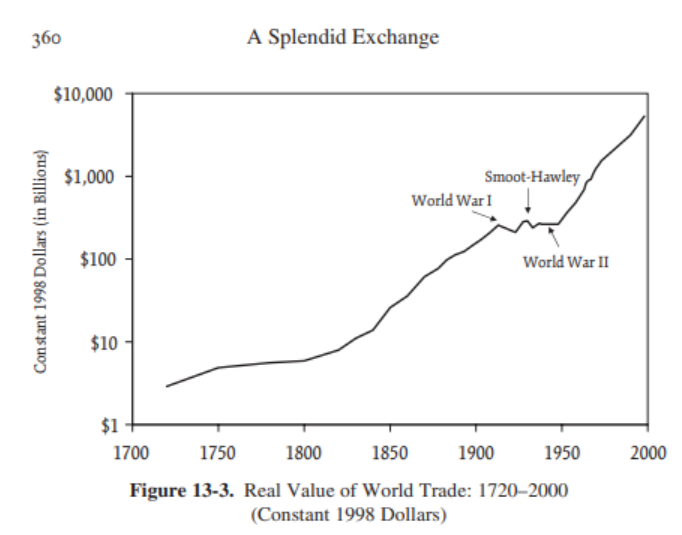
Congress raised tariffs again through the Fordney-McCumber Act of 1922. The defining episode, however, arrived with the Smoot-Hawley Tariff Act of 1930.
Originally promoted as agricultural relief, the legislation expanded into a broad collection of higher duties as industries and lawmakers sought protection. President Herbert Hoover signed it despite objections from economists and business leaders.
Other countries retaliated, international commerce contracted, and American exporters lost customers. Countries that responded directly to Smoot-Hawley sharply reduced purchases of U.S. products. Farmers who had wanted protection encountered shrinking export markets insteadan economic boomerang with excellent aim.
Smoot-Hawley did not single-handedly cause the Great Depression. Banking failures, monetary contraction, declining demand, debt, and financial instability were far more important causes. Nevertheless, the tariff worsened trade tensions, contributed to retaliation, and made international cooperation harder at an exceptionally bad moment.
Its legacy became larger than the law itself. “Smoot-Hawley” remains political shorthand for the danger of escalating protectionism during an economic crisis.
From Tariff Walls to Trade Agreements
The Reciprocal Trade Agreements Act
In 1934, Congress passed the Reciprocal Trade Agreements Act. It authorized the president to negotiate mutual tariff reductions with other countries. This transferred much practical control over trade negotiations from individual congressional bargaining to the executive branch.
The change reduced opportunities for product-by-product logrolling and tied tariff concessions to access for American exports. It established the institutional foundation for the more liberal U.S. trade policy that followed World War II.
GATT and the postwar trading system
In 1947, 23 countries concluded the General Agreement on Tariffs and Trade, or GATT. Rather than allowing every dispute to become a contest of retaliatory improvisation, members negotiated common rules and successive rounds of tariff reductions.
Average U.S. tariff levels fell dramatically over the following decades. Trade negotiations also expanded beyond simple customs duties to cover subsidies, quotas, technical standards, services, and intellectual property.
GATT evolved into the World Trade Organization in 1995. WTO members committed to published tariff ceilings and dispute procedures intended to make trade policy more predictable. The system never eliminated commercial conflict, but it gave countries somewhere to argue besides the nearest harbor.
Globalization, NAFTA, and New Sources of Tension
The second half of the twentieth century brought regional and bilateral trade agreements alongside the multilateral system. The United States entered the North American Free Trade Agreement with Canada and Mexico in 1994. NAFTA gradually removed most tariffs on qualifying regional trade and was replaced by the United States-Mexico-Canada Agreement in 2020.
China’s entry into the WTO in 2001 further transformed global production. Companies organized supply chains across multiple countries, reducing costs but also exposing workers and communities to intense import competition. Consumers gained access to inexpensive products, while certain manufacturing regions experienced plant closures and prolonged adjustment.
The political debate consequently shifted. Tariffs were no longer discussed only as taxes on finished foreign goods. They became instruments associated with supply-chain resilience, labor standards, national security, strategic technologies, and dependence on geopolitical competitors.
The Modern Tariff Revival
Tariffs returned to the center of American policy during the late 2010s. In 2018, the United States imposed duties on steel and aluminum under national-security authority and applied additional tariffs to a large volume of Chinese imports following an investigation into China’s trade practices.
China and other trading partners retaliated against American exports, including politically sensitive agricultural and manufactured products. The U.S. government provided substantial assistance to farmers affected by lost sales.
Later administrations retained many of these duties and increased protection for selected strategic sectors. During the mid-2020s, tariff policy broadened again, reflecting concerns about industrial capacity, trade deficits, economic security, and geopolitical leverage.
Research into the 2018–2019 measures found that tariffs could protect some producers from foreign competition, but manufacturers using imported components faced higher costs. Retaliation also hurt exporters. Federal Reserve research found significant tariff pass-through into U.S. consumer prices, illustrating why the question “Who pays?” rarely has a one-word answer.
Do Tariffs Work?
That depends on the objective and the design. A temporary, targeted tariff may provide breathing room for an industry facing a sudden import surge. Tariffs can also support national-security goals when a country considers domestic production essential.
However, protection does not guarantee that companies will invest, innovate, or become internationally competitive. If tariffs remain indefinitely, sheltered businesses may simply enjoy higher prices. Downstream manufacturers can also be harmed when steel, aluminum, machinery, or electronic components become more expensive.
Tariffs generate revenue, but very high rates reduce imports and therefore shrink the tax base. They can pressure a trading partner, but pressure invites retaliation. They may reduce imports from one country while redirecting purchases to another rather than returning production home.
The historical lesson is not that every tariff is disastrous or that unrestricted trade is painless. It is that tariffs redistribute costs and opportunities. The visible beneficiary may be a protected factory; the less visible costs may be scattered among consumers, exporters, retailers, and companies buying imported inputs.
What the Experience of Tariffs Looks Like on the Ground
The following evidence-based experiences are composites rather than quotations from specific individuals. They illustrate how the same tariff can look entirely different depending on where someone stands in the supply chain.
The importer’s experience
Imagine a small American appliance company bringing a shipment of components through a port. When a new tariff takes effect, the companynot the overseas governmentreceives the customs bill. Its managers must decide whether to accept lower profit, raise retail prices, redesign the product, or locate another supplier.
Changing suppliers sounds easy in a speech. In practice, the company may need new prototypes, safety tests, contracts, molds, shipping routes, and quality inspections. A policy announced on Tuesday can therefore create a procurement headache lasting months. The customs form may be only one page; the consequences have sequels.
The protected manufacturer’s experience
For a domestic producer competing directly with low-priced imports, a tariff can feel like overdue relief. Orders may increase, production lines may reopen, and planned investments may finally make financial sense. If protection is predictable and paired with worker training, infrastructure, and capital investment, the company may use the opportunity to become stronger.
Yet protection creates a test. If the firm spends its breathing room improving productivity, the tariff may support a durable industrial strategy. If it merely raises prices while postponing modernization, customers eventually pay for an industry that remains uncompetitive.
The farmer’s experience
Farmers often experience tariffs from the opposite direction. Their tractors, fertilizer, or equipment may become more expensive, while foreign retaliation reduces demand for crops. A soybean grower can be economically distant from a dispute over technology or metals and still become one of its first casualties.
Agricultural markets are particularly vulnerable because crops cannot wait indefinitely for diplomats. Storage is limited, planting decisions are seasonal, and foreign buyers can develop relationships with alternative suppliers. Once a market is lost, removing the retaliatory tariff does not guarantee that every customer returns.
The consumer’s experience
Consumers rarely see a checkout receipt with a separate line labeled “historic trade confrontation.” They experience tariffs through gradual price changes, fewer choices, delayed purchases, or altered product features.
For a high-income household, an extra charge on a refrigerator may be inconvenient. For a family with a tight budget, the increase can determine whether a broken appliance is replaced or repaired for one more heroic year. Because lower-income households spend a larger share of their earnings on goods, broad tariffs can affect them disproportionately.
The policymaker’s experience
A policymaker must weigh interests that rarely line up neatly. Protecting one sector may raise costs for another. A tariff that creates negotiating leverage may also unsettle financial markets or provoke retaliation. Exemptions can reduce unintended harm, but every exemption encourages another industry to hire a lobbyist and join the queue.
History suggests that successful tariff policy requires a defined goal, credible measurements, international coordination when possible, and an exit strategy. “We will know success when we see it” is not an exit strategy; it is how temporary measures acquire grandchildren.
The shared historical experience
Across these perspectives, one pattern persists: tariffs are simple to announce but complex in operation. They alter contracts, investment decisions, political alliances, and consumer behavior. Their effects travel through an economy long after the customs payment is made.
That is why tariff debates survive every generation. They touch a fundamental tension between the efficiency of international specialization and the desire for national control, secure employment, and economic resilience. History supplies no universal tariff rate, but it does offer a reliable warning: count the indirect effects before celebrating the direct ones.
Conclusion: An Old Instrument in a New Economy
From ancient ports to digitally managed supply chains, tariffs have remained attractive because they promise revenue, protection, and leverage in a single policy. Their history also shows that every tariff creates reactions: businesses reorganize, consumers adjust, exporters face retaliation, and political coalitions form around the new rules.
Tariffs are neither automatic economic salvation nor inevitable catastrophe. They are taxes with strategic ambitions. Used narrowly and evaluated honestly, they can support legitimate goals. Used carelessly, they can shelter inefficiency, raise prices, and turn commercial disagreements into expensive contests in which everyone insists the other side is paying.