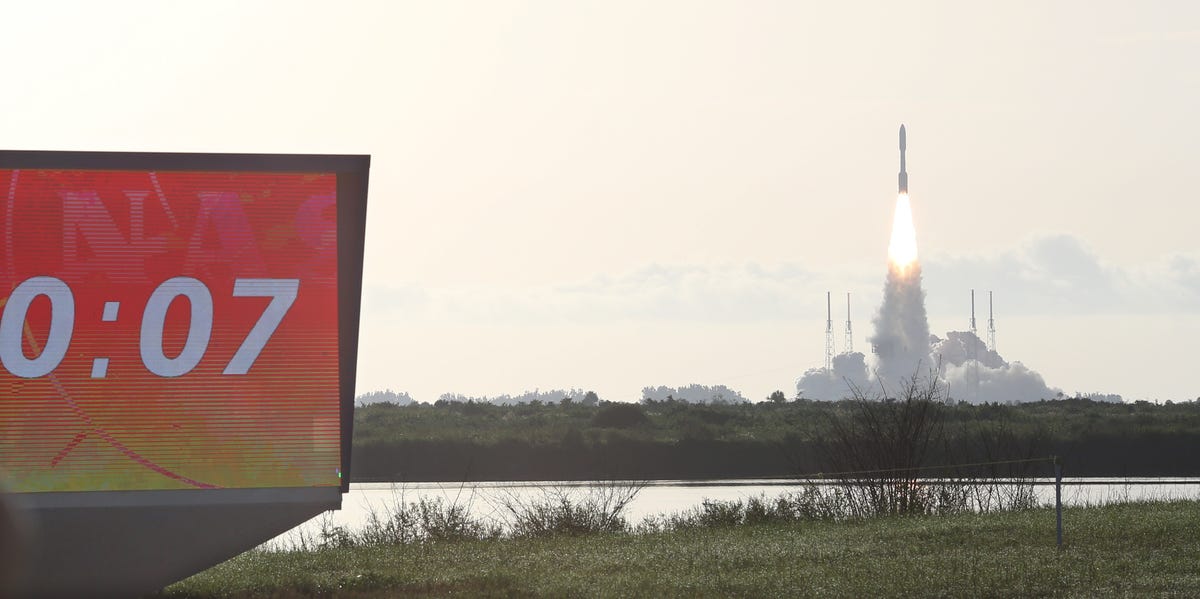
NASA’s Perseverance rover did not merely launch toward Mars; it left Earth carrying a question that has followed humanity for generations: was the Red Planet ever alive? On July 30, 2020, a United Launch Alliance Atlas V rocket rose from Cape Canaveral, Florida, with the Mars 2020 Perseverance rover tucked safely inside its protective spacecraft. It was a dramatic beginning to a journey of roughly seven months, hundreds of millions of miles, and one very nervous landing date: February 18, 2021.
At first glance, Perseverance looked like a high-tech cousin of NASA’s Curiosity rover, only with sharper scientific tools, tougher wheels, smarter navigation, and a tiny helicopter named Ingenuity riding along like the world’s most ambitious carry-on bag. But the mission was more than another robotic road trip. Perseverance was designed to search for signs of ancient microbial life, collect Martian rock and soil samples, study the planet’s geology and climate, and test technologies that could help future astronauts survive on Mars.
The title “NASA’s Perseverance Rover Is on Its Way to Mars” captures a moment of motion, suspense, and scientific optimism. Today, we know the rover successfully landed in Jezero Crater and began exploring one of the most promising ancient environments on Mars. But the journey itself remains one of the most exciting chapters in modern space exploration: a carefully choreographed leap from Earth to a cold, dusty world that may still hold secrets beneath its rust-red surface.
Why Perseverance Matters
Perseverance was built for a mission with a big personality and an even bigger to-do list. Its central goal is astrobiology, the study of life in the universe. That does not mean the rover expected to roll up to a Martian coffee shop and find microbes discussing the weather. Instead, Perseverance was sent to look for biosignatures: chemical patterns, textures, minerals, or structures that could suggest ancient life once existed when Mars was warmer and wetter.
Mars today is dry, cold, and harsh. It has a thin atmosphere, intense radiation at the surface, and dust that seems personally committed to getting everywhere. But billions of years ago, evidence suggests Mars had rivers, lakes, and environments that may have been friendly to microbial life. Perseverance’s job is to read that ancient history like a detective examining a very dusty crime scene.
The rover’s destination, Jezero Crater, was selected because scientists believe it once held a lake and a river delta. On Earth, deltas are excellent places to preserve organic material and sediments. If ancient Martian life ever left microscopic traces behind, Jezero is one of the best places to look. In short, NASA did not send Perseverance to Mars for a casual stroll. It sent the rover to a former lakebed with a rock hammer, cameras, chemistry tools, and the patience of a librarian reorganizing an entire planet.
The Launch: A Big Rocket for a Big Mission
Perseverance launched aboard a United Launch Alliance Atlas V 541 rocket, one of the more powerful configurations in the Atlas V family. The launch took place at Space Launch Complex 41 at Cape Canaveral. Liftoff came at 7:50 a.m. EDT on July 30, 2020, sending the rover into space during a launch window when Earth and Mars were favorably aligned.
That timing mattered. Missions to Mars do not depart whenever engineers feel inspired after a strong cup of coffee. Earth and Mars orbit the Sun at different speeds, so efficient launch opportunities occur about every 26 months. Miss the window, and the mission must wait. For Perseverance, the 2020 window was especially dramatic because the world was dealing with the COVID-19 pandemic. NASA and its partners had to keep the mission on schedule while protecting teams, adjusting workflows, and maintaining strict safety protocols.
The rocket did its job with the precision expected from an interplanetary launch vehicle. After leaving Earth, the spacecraft entered its cruise phase, carrying the rover, descent stage, heat shield, back shell, and cruise stage toward Mars. For the public, it was easy to imagine Perseverance simply “flying to Mars.” In reality, the trip required navigation checks, trajectory correction maneuvers, power management, communication sessions, and constant monitoring. Space travel is glamorous from a distance, but up close it involves a lot of math, checklists, and engineers refusing to blink.
What Was Riding Inside the Spacecraft?
The Perseverance rover is about the size of a small car and weighs more than 2,000 pounds. It carries a suite of scientific instruments designed to study rocks, soil, atmosphere, and potential biosignatures. It also includes a complex sample caching system, which allows the rover to drill rock cores, seal them in tubes, and store them for possible return to Earth by a future mission.
Mastcam-Z: The Rover’s Sharp Eyes
Mastcam-Z is a pair of zoomable cameras mounted on the rover’s mast. These cameras capture panoramic images, 3D views, and high-definition video. They help scientists choose targets, examine terrain, and understand the geologic setting around the rover. Think of Mastcam-Z as Perseverance’s sightseeing camera, except every “vacation photo” may contain clues about ancient Mars.
SuperCam: A Laser, Camera, and Chemistry Lab
SuperCam sits on the rover’s mast and can analyze rocks from a distance. It uses a laser to vaporize tiny spots on Martian rocks and studies the resulting light to identify chemical elements. It also includes imaging and spectroscopy tools. If a rock looks interesting but is several feet away, SuperCam lets Perseverance investigate without rolling over immediately. It is basically the rover equivalent of saying, “Let me check that out from here first.”
PIXL and SHERLOC: Close-Up Rock Detectives
PIXL, the Planetary Instrument for X-ray Lithochemistry, studies the elemental chemistry of rock surfaces at very fine scales. SHERLOC, short for Scanning Habitable Environments with Raman & Luminescence for Organics & Chemicals, searches for organic molecules and minerals that may relate to past habitability. Together, these tools help scientists decide which rocks deserve the honor of being sampled. On Mars, not every rock gets a tube. Perseverance is selective.
RIMFAX, MEDA, and MOXIE: Looking Below, Around, and Ahead
RIMFAX is a ground-penetrating radar that peers below the Martian surface to reveal buried layers and structures. MEDA measures weather conditions, including temperature, wind, pressure, humidity, and dust. MOXIE was a technology demonstration designed to produce oxygen from carbon dioxide in the Martian atmosphere. That last one matters because future astronauts will need oxygen to breathe and possibly to make rocket propellant. MOXIE was small, but its idea was enormous: learn how to use Martian resources instead of packing every molecule from Earth.
Jezero Crater: The Right Place to Ask a Big Question
Jezero Crater is about 28 miles wide and lies near the western edge of Isidis Planitia, north of the Martian equator. Scientists selected it because orbital data showed features consistent with an ancient lake, river channels, clay minerals, and a preserved delta. These are exactly the kinds of environments that excite astrobiologists. On Earth, water plus minerals plus time can create settings where life appears and where its traces can be preserved.
The delta is especially important. Rivers carry sediment, organic material, and minerals into lakes, where layers can build up and trap tiny records of the past. If Mars once had microbial life, delta deposits might preserve chemical or textural evidence. That does not guarantee Perseverance would find life, of course. Science is not a vending machine where you insert a rover and receive aliens. But Jezero offered a strong, evidence-based target.
By sending Perseverance there, NASA chose a landing site that balanced scientific promise with engineering risk. Jezero’s rocks, cliffs, and delta deposits made it exciting, but also hazardous. The rover needed advanced landing technology to avoid dangerous terrain. That is where one of the mission’s most impressive upgrades came in.
The Landing Challenge: Seven Minutes of Terror
Getting to Mars is hard. Landing on Mars is harder. Landing a heavy rover in a specific crater full of scientifically interesting hazards is the kind of problem that makes engineers both proud and sleep-deprived.
Perseverance used a sequence known as entry, descent, and landing. The spacecraft entered the Martian atmosphere protected by a heat shield. It deployed a supersonic parachute, separated from parts of its protective shell, used radar and cameras to understand its position, and finally relied on a rocket-powered descent stage. In the last moments, the descent stage lowered the rover on cables using the “sky crane” maneuver, then flew away to crash at a safe distance. It sounds like something invented during a brainstorming session where nobody was allowed to say, “That seems complicated.” Yet it worked.
Perseverance also used Terrain Relative Navigation, a system that compared images taken during descent with onboard maps. This allowed the spacecraft to steer away from hazards and aim for safer ground. That technology made it possible to target a scientifically rich area that earlier missions might have considered too risky.
Ingenuity: The Little Helicopter That Could
Attached to Perseverance’s belly during the trip was Ingenuity, a small experimental helicopter. Its mission was simple in wording but wild in reality: attempt the first powered, controlled flight on another planet. Mars has an atmosphere less than one percent as dense as Earth’s, which makes flying incredibly difficult. Ingenuity had to spin its rotors extremely fast to lift itself in thin air.
Ingenuity was originally a technology demonstration, not the main science act. But it became one of the mission’s breakout stars. After deployment on Mars, it proved that aerial exploration was possible beyond Earth. It later completed dozens of flights, scouting terrain and showing how future missions might use flying robots to explore cliffs, craters, lava tubes, and places rovers cannot safely reach.
In a mission already full of firsts, Ingenuity gave Perseverance an extra spark of wonder. It was the space exploration equivalent of bringing a drone to a geology field trip, except the field trip was on another planet and the drone had to phone home through a rover.
Sample Caching: Why Perseverance Collects Mars Rocks
One of Perseverance’s most important jobs is collecting samples. The rover drills into carefully chosen rocks, extracts pencil-sized cores, seals them inside ultra-clean tubes, and stores them. Some tubes may remain aboard the rover, while others can be placed on the surface in a depot for possible pickup by a future mission.
Why go through all that trouble? Because laboratories on Earth can analyze samples with instruments far more powerful than anything that can currently fit on a rover. If Martian rocks are returned to Earth, scientists could study them for decades, using techniques that may not even exist yet. Returned samples could help answer questions about Mars’ climate history, volcanic activity, water, habitability, and the possibility of ancient life.
Sample return is difficult, expensive, and technologically complex. But Perseverance began the first essential step: selecting and preserving the best pieces of Mars. It is a little like packing a suitcase for future scientists, except the suitcase is on another planet and the souvenirs may rewrite planetary history.
Preparing for Human Missions to Mars
Perseverance is not only a science mission. It is also a rehearsal for future human exploration. MEDA helps researchers understand Martian weather and dust, both of which could affect astronauts, habitats, solar power systems, and equipment. MOXIE tested whether oxygen can be produced from the carbon dioxide-rich Martian atmosphere. Navigation technologies demonstrated safer landing and autonomous driving capabilities.
Future astronauts will need to land heavy cargo, generate resources, avoid dust hazards, communicate across large distances, and operate in an environment that does not forgive sloppy planning. Perseverance contributes to those goals by testing ideas in real Martian conditions. Earth-based simulations are useful, but Mars has a way of grading homework with red dust and brutal honesty.
The rover also shows how robotic and human exploration can support each other. Robots can scout, sample, map, and test technologies before humans arrive. Humans, when they eventually reach Mars, may perform complex field geology much faster than robots. Perseverance is part of that long bridge between today’s robotic explorers and tomorrow’s human footprints.
What Perseverance Teaches Us About Mars
Perseverance helps scientists understand Mars as a changing world. It studies igneous rocks that tell stories of volcanic processes, sedimentary rocks that may record ancient water environments, and atmospheric conditions that shape the planet today. Its cameras document landscapes in remarkable detail, while its instruments connect those images to chemistry and mineralogy.
The mission also reminds us that Mars is not just a red dot in the night sky. It is a planet with layered history. It had impact events, flowing water, changing climate, dust storms, chemical reactions, and landscapes that evolved over billions of years. The more Perseverance explores, the clearer it becomes that Mars is not simple. It is quiet now, but it has not always been quiet.
That complexity is exactly why Perseverance matters. The rover is not searching for one dramatic clue. It is building a case, layer by layer, sample by sample, image by image. Good science often looks less like a lightning bolt and more like careful detective work. Perseverance is very good at the second kind.
Experiences and Lessons From Perseverance’s Journey
Following the story of NASA’s Perseverance rover offers a powerful experience even for people who are not professional scientists. The mission turns an abstract idea“Mars exploration”into something tangible. A rocket launches. A spacecraft cruises through deep space. Engineers wait for signals. A rover lands. Photos arrive. Suddenly, a planet that once felt distant becomes a place with rocks, shadows, wheel tracks, weather, and horizons.
One of the most memorable experiences connected to Perseverance is the emotional tension of launch and landing. Launch day feels like triumph, but it is only the opening chapter. The spacecraft still has to survive the cruise, approach Mars, enter the atmosphere, and land without real-time human control. Because radio signals take minutes to travel between Mars and Earth, the rover has to land itself. That delay makes the landing feel almost cinematic: by the time mission control receives confirmation, the event has already happened. Either the rover is safe, or it is not. Mars does not offer a pause button.
Another lesson is that exploration is a team sport. Perseverance may be the celebrity robot, but behind it are engineers, scientists, technicians, programmers, launch teams, managers, students, educators, and international collaborators. Every wheel, camera, wire, line of code, and sample tube had to meet strict requirements. The mission shows how large achievements come from thousands of small decisions done well. That is a useful reminder for any field, whether building a spacecraft, writing a book, growing a business, or fixing a leaky sink without accidentally creating an indoor waterfall.
Perseverance also teaches patience. The mission’s biggest questions cannot be answered instantly. A rock sample collected today may not reveal its full importance until years later. A landscape image may require months of analysis. A possible biosignature must be tested against non-biological explanations before anyone can responsibly claim evidence of life. In a world addicted to instant answers, Perseverance models a slower and better habit: observe carefully, test thoroughly, and do not outrun the evidence.
There is also a deeply human lesson in the rover’s name. “Perseverance” was chosen before launch, but the word gained extra meaning during 2020. The mission moved forward during a global crisis, when teams had to adapt under extraordinary pressure. The name became more than branding. It described the engineering culture behind the rover and the public mood surrounding its launch. Space exploration often looks futuristic, but it is powered by a very old human trait: keep going.
For students and young readers, Perseverance makes science feel alive. It connects physics, chemistry, geology, biology, engineering, computer science, and environmental studies in one mission. It shows that science is not a stack of textbook chapters but a toolkit for asking better questions. Why did Mars change? Where did the water go? Could life have started there? What will humans need to survive? Each answer leads to another question, which is exactly how discovery should work.
For adults, the mission offers perspective. Earthly problems do not vanish because a rover is driving on Mars, but missions like Perseverance widen the frame. They remind us that curiosity is still a public good, that cooperation can produce astonishing results, and that knowledge has value even when it takes years to mature. In that sense, Perseverance is not only on its way to Mars. It is also carrying us toward a larger understanding of where we came from, what other worlds may hold, and what humans can accomplish when we aim carefully and refuse to quit.
Conclusion: A Rover With a Long Road Ahead
NASA’s Perseverance rover began its journey to Mars as a machine, but it quickly became a symbol of scientific courage. Its launch marked the start of one of the most ambitious robotic missions ever sent to the Red Planet. Its destination, Jezero Crater, was chosen for its ancient lake and delta environment. Its tools were built to study geology, search for signs of past microbial life, collect samples, monitor weather, test oxygen production, and prepare for future human missions.
The mission combines bold questions with careful methods. It does not promise easy answers, and that is part of its strength. Perseverance explores Mars the way good science should: with curiosity, discipline, skepticism, and enough engineering brilliance to lower a car-sized rover from a rocket-powered sky crane onto another planet.
Whether studying ancient river deposits, caching rock samples, supporting Ingenuity’s historic flights, or testing technologies for astronauts, Perseverance has expanded our understanding of Mars and our confidence in future exploration. Its journey reminds us that the search for life beyond Earth is not a single moment but a long investigation. And like the rover’s name suggests, the best discoveries often belong to those who keep moving forward.