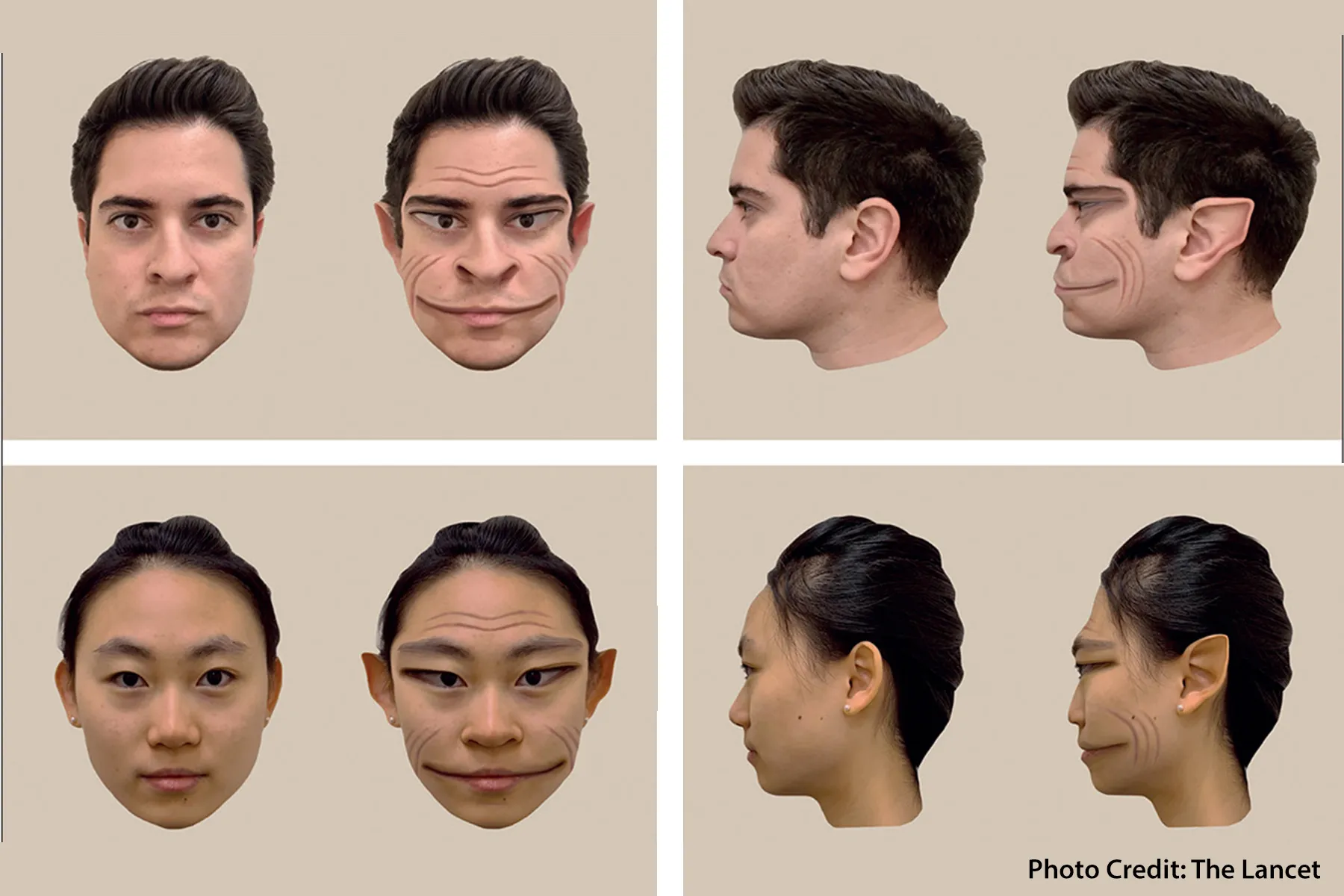
Imagine greeting a familiar coworker and suddenly seeing their mouth stretch unnaturally wide, their eyes tilt at impossible angles, or deep grooves appear across their cheeks. The person has not changed, the lighting is not playing tricks, and this is definitely not an unusually committed Halloween prank. Instead, the brain is misprocessing the visual information used to construct a face.
This rare neurological phenomenon is called prosopometamorphopsia, often shortened to PMO. It is sometimes nicknamed “demon face syndrome” because some people describe faces as frightening, grotesque, or creature-like. The nickname may grab attention, but PMO has nothing to do with demons, supernatural events, or a person’s opinion of whoever they are looking at. It is a disorder of visual perception that deserves careful medical evaluation rather than judgment or spooky background music.
What Is Prosopometamorphopsia?
Prosopometamorphopsia is an extremely rare condition in which real faces appear distorted even though the faces themselves are physically normal. The term combines a Greek word for “face” with metamorphopsia, meaning distorted visual perception.
The distortion may affect the entire face, one side of the face, a particular feature, or only certain categories of faces. Eyes may look enlarged, mouths may shift sideways, noses may seem misplaced, and facial surfaces may appear stretched, swollen, drooping, discolored, or unusually textured. Some distortions remain stable, while others move and change as the person watches.
A major scientific review published in 2021 analyzed 81 reported cases from more than a century of medical literature. Although additional cases have since been described, PMO remains so uncommon that researchers are still learning how its many variations relate to the brain’s face-processing network.
Are the Faces Hallucinations?
Usually, the person is looking at an actual face. The brain alters the appearance of that face rather than inventing a completely nonexistent person. For that reason, PMO is often described as a visual distortion or complex visual-perceptual disturbance.
Many people with PMO retain insight. They know logically that their spouse has not grown pointed ears during breakfast and that the cashier’s mouth is not physically sliding toward one cheek. This awareness can distinguish the experience from some forms of psychosis, although only a qualified clinician can make an accurate diagnosis.
What Does Demon Face Syndrome Look Like?
No single picture represents every case. PMO is more like an unpredictable graphics filter installed in the brainexcept nobody downloaded it, and the uninstall button is annoyingly difficult to locate.
Reported facial distortions include:
- Eyes that appear too large, too small, slanted, misplaced, or intensely prominent
- Mouths that look widened, twisted, stretched, or shifted out of position
- Teeth that seem elongated or unusually sharp
- Noses that appear enlarged, flattened, tilted, or displaced
- Facial features that droop, shrink, swell, rotate, or move
- Skin that appears deeply grooved, discolored, metallic, furry, or strangely textured
- One half of a face that looks distorted while the other half appears normal
- Faces that resemble animals, cartoons, monsters, or unfamiliar people
Some people see distortions only when viewing faces in person. Others experience them in photographs, mirrors, videos, memories, or imagined faces. A person may see every face differently, only unfamiliar faces differently, or even distortion limited to their own reflection.
The Unusual Dartmouth Case
A widely discussed 2024 Dartmouth case involved a man who saw disturbing distortions on faces viewed in person but saw faces normally on paper and computer screens. Researchers used that difference to create realistic visualizations of his experience. While he compared a real face with an undistorted photograph, the team adjusted the photograph according to his instructions until it resembled what he saw in the room.
The case demonstrated how strongly PMO can depend on context. It also showed why online images claiming to portray the condition should not be treated as universal examples. Another person’s distortions could look completely different.
Types of Prosopometamorphopsia
Full-Face PMO
Both sides of the observed face appear altered. The distortion may involve several features at once or transform the overall facial shape.
Hemi-Prosopometamorphopsia
Only the left or right half of a viewed face appears distorted. This pattern has helped researchers investigate how the brain’s hemispheres communicate while assembling separate visual details into one unified face.
Autoprosopometamorphopsia
The person’s own face appears distorted, particularly when viewed in a mirror. Other people’s faces may or may not be affected.
Heteroprosopometamorphopsia
The distortion affects other people’s faces rather than the observer’s own face.
Animal-Like Facial Transformation
In rare reports, human faces seem to take on animal-like characteristics. Researchers may use the term zoanthroprosopometamorphopsia for this pattern. Dramatic case reports have described dragon-like or creature-like appearances, but such presentations are not required for a PMO diagnosis.
What Causes Prosopometamorphopsia?
PMO is a symptom or perceptual syndrome rather than one disease with one predictable cause. Doctors have associated it with structural damage, temporary disruption, or abnormal electrical activity in brain networks involved in visual and facial processing.
Stroke and Blood-Vessel Problems
Several cases have occurred after an ischemic or hemorrhagic stroke. Lesions involving the occipital and temporal regions, the splenium of the corpus callosum, and other connected areas have been reported. The corpus callosum helps the brain’s hemispheres exchange information, so injury there may interfere with the integration of facial details.
Researchers have found patterns linking bilateral distortions with certain right-sided or bilateral occipital lesions, while some one-sided distortions have been associated with lesions affecting corresponding visual-processing pathways. These associations are informative, but they do not create a simple “one brain spot equals one symptom” rule. Face perception relies on a network, not a lonely neurological office cubicle.
Epilepsy and Seizure Activity
PMO can occur before, during, or after focal seizure activity. Occipital and temporal lobe seizures may produce visual symptoms because these regions participate in interpreting what a person sees. Some reported PMO episodes improved when the underlying seizure disorder was brought under control.
Migraine
Migraine can cause temporary visual disturbances, sometimes without a severe headache. Although flashing lights, zigzag patterns, blind spots, or blurred vision are more familiar migraine-aura symptoms, unusual distortions of faces have also been reported. A new facial-perception disturbance should not automatically be labeled “just a migraine,” especially when it differs from the person’s established aura pattern.
Head Injury
Traumatic brain injury may disrupt areas or connections involved in visual perception. Symptoms can begin soon after trauma or emerge later, which makes a detailed timeline important during medical evaluation.
Brain Tumors, Inflammation, Infection, and Other Disorders
Medical literature has linked facial distortions with tumors, neurosurgical complications, multiple sclerosis, brain inflammation, neurodegenerative disease, and certain infections. Eye and retinal disorders can also cause metamorphopsia, although ocular distortion commonly affects lines, shapes, or larger portions of the visual field rather than selectively targeting faces.
Developmental or Unexplained PMO
Not every patient has an identifiable lesion or sudden neurological event. Recent research has described people whose symptoms began in childhood, including individuals with no obvious acquired brain injury. These cases suggest that unusual development or connectivity within face-processing systems may sometimes play a role. Research remains limited, and a normal MRI does not prove that the symptoms are imaginary.
How the Brain Normally Processes Faces
Recognizing a face feels instantaneous, but the brain performs several jobs in fractions of a second. It detects that the object is a face, maps the positions of its features, evaluates expression and gaze, and compares the result with stored information about identity.
Regions in the occipital and temporal lobesincluding face-selective areas in the fusiform gyruswork with broader networks to complete these tasks. The superior temporal sulcus is especially involved in changing facial information such as gaze and expression. White-matter pathways connect these areas so they can exchange information.
PMO demonstrates what may happen when the brain still detects a face but constructs its geometry incorrectly. The result can remain recognizably “Mom” or “the dentist” while looking as though a movie studio’s special-effects department has been given too much coffee.
PMO vs. Other Conditions
Prosopometamorphopsia vs. Prosopagnosia
Prosopagnosia, commonly called face blindness, primarily impairs the ability to recognize identity from a face. Prosopometamorphopsia changes how facial features look. A person with PMO may recognize someone despite severe distortion, while someone with prosopagnosia may see a normal-looking face but be unable to identify it. The two conditions can occasionally overlap.
PMO vs. Psychosis
A visual-perception disorder is not automatically evidence of schizophrenia or another psychotic illness. PMO symptoms are often highly face-specific, and many affected people know that the distortion is not physically present. However, neurological and psychiatric symptoms can coexist, so evaluation should remain open-minded rather than assuming one category before completing the workup.
Dartmouth researchers have reported hearing from people whose PMO was initially treated as schizophrenia. Fear of that reaction may cause patients to hide symptoms, delaying an appropriate neurological or neuro-ophthalmological assessment.
PMO vs. Alice in Wonderland Syndrome
Alice in Wonderland syndrome is an umbrella term for unusual distortions involving the size, shape, position, distance, or movement of objects and body parts. PMO is more specifically centered on faces, although the syndromes may overlap in medical discussions.
PMO vs. Eye-Related Metamorphopsia
Retinal or macular conditions can make straight lines look bent or cause objects to appear warped. An eye examination is therefore important, particularly if distortion occurs in only one eye or affects more than faces. Selective facial distortion more strongly suggests higher-level visual processing, but self-diagnosis cannot reliably separate ocular and neurological causes.
How Doctors Diagnose Demon Face Syndrome
There is no single blood test, scan, or five-question online quiz that confirms PMO. Diagnosis usually begins with a detailed description of exactly what the person sees.
A clinician may ask:
- Did the symptoms begin suddenly or gradually?
- Are all faces distorted or only certain faces?
- Does the distortion affect one half or the entire face?
- Are photographs, video calls, mirrors, and imagined faces affected?
- Does covering either eye change the experience?
- How long does each episode last?
- Are headache, confusion, weakness, numbness, speech trouble, memory changes, or loss of awareness present?
- Was there a recent infection, head injury, medication change, substance exposure, or seizure?
The evaluation may involve a neurologist, ophthalmologist, neuro-ophthalmologist, psychiatrist, or neuropsychologist. Testing can include an eye examination, neurological examination, MRI or CT imaging, electroencephalography to assess possible seizure activity, blood tests, cognitive testing, and structured face-perception tasks.
Keeping a symptom diary can help. Record the time, duration, setting, lighting, affected part of the face, associated symptoms, sleep pattern, headache, medications, and whether the distortion appeared in person or on a screen. Do not attempt to drive while actively experiencing unsafe visual changes.
When Is Facial Distortion a Medical Emergency?
Sudden visual or perceptual changes can be associated with stroke, seizure, acute eye disease, toxic exposure, infection, or brain injury. Call 911 in the United States when facial distortion begins suddenly with weakness or numbness, speech difficulty, confusion, severe unexplained headache, loss of vision, trouble walking, loss of consciousness, or seizure activity. The CDC and American Stroke Association identify sudden trouble seeing, speaking, balancing, or moving one side of the body as stroke warning signs requiring immediate emergency care.
Urgent evaluation is also appropriate after a significant head injury, with fever and altered mental status, during pregnancy with severe neurological symptoms, or when a person becomes unable to distinguish the distortion from reality. Even if symptoms disappear, a transient event can still require emergency assessment.
Can Prosopometamorphopsia Be Treated?
There is no universal PMO medication because treatment depends on the cause. A person with seizure-related PMO may benefit from antiseizure treatment. Someone whose symptoms follow a stroke may need stroke care, rehabilitation, and management of vascular risk factors. Migraine-associated episodes may improve with an individualized migraine plan. Tumors, inflammation, eye disease, or medication effects require their own targeted treatment.
Published cases include people who recovered fully, improved partially, or continued to experience distortion for years. Some episodes last days or weeks; others become chronic. The 2021 review found meaningful recovery across a substantial portion of reported cases, suggesting that the face-processing network may sometimes compensate or reorganize after disruption.
Practical Coping Strategies
While medical investigation continues, practical adjustments may reduce distress:
- Explain the condition to trusted family members using straightforward language.
- Use voices, clothing, hairstyles, context, or name introductions to support recognition.
- Test whether screens, photographs, viewing distance, lighting, color, or brief gaze breaks change the distortion.
- Reduce unnecessary driving or hazardous tasks during active episodes.
- Plan quieter social settings if crowded rooms become visually overwhelming.
- Seek counseling for anxiety, isolation, sleep disruption, or fear caused by the symptoms.
- Ask healthcare providers to document the precise visual phenomenon rather than recording only the word “hallucinations.”
These strategies do not replace diagnosis or treatment. They simply help a person navigate daily life while clinicians investigate the neurological mysterywhich, unfortunately, is more complex than turning the brain off and back on again.
What Is the Outlook?
The outlook varies widely. Temporary PMO may resolve when a migraine episode, seizure, inflammation, or acute brain disturbance settles. Structural injuries can produce longer-lasting symptoms, but improvement may still occur through healing, compensation, and treatment of the underlying condition.
Because reported cases are few and highly diverse, doctors cannot predict recovery from a single scan or symptom description. New research is examining why distortions target faces, why they affect specific halves or features, and why photographs look normal for some patients but not others.
One encouraging development is greater awareness. When people can describe PMO by name, they may be less likely to suffer silently or be dismissed. Rare does not mean imaginary, and an intact understanding of reality does not make a warped face any less unsettling.
Experiences Related to Living With Prosopometamorphopsia
The following experience-based scenarios are composites informed by patterns described in published case reports and patient accounts. They are not quotations from one specific patient.
The First Distortion
For some people, the first episode arrives without warning. A person may be talking to a friend when one eye suddenly appears to slide downward and the smile stretches beyond its normal boundaries. Looking away provides a moment of relief, but the distortion returns when attention moves back to the face. Objects in the room still look ordinary. The lamp remains lamp-shaped, the doorway stays rectangular, and the family dog has not developed bonus eyebrows. Only the human face has changed.
The immediate reaction is often fear mixed with disbelief. The observer may blink repeatedly, clean their glasses, cover one eye, change rooms, or secretly inspect other faces. When the same distortion appears on several people, panic can follow. Some individuals hesitate to speak because the description sounds unbelievable even to them.
Recognizing Someone Who Looks Frightening
A particularly confusing feature of PMO is that recognition may remain intact. A person knows they are looking at their partner, yet the partner’s face appears deeply grooved, stretched, or creature-like. The emotional system receives two competing messages: “This is someone safe” and “This image looks threatening.”
That conflict can affect intimacy. Eye contact may become exhausting. A loving conversation can feel visually alarming even when the voice, words, and relationship remain reassuring. Some people compensate by focusing on hair, posture, clothing, or the sound of the person’s voice. Others look slightly beside the face rather than directly at it. These behaviors can be mistaken for disinterest unless the condition has been explained.
Navigating Public Places
A grocery store, workplace, classroom, or family gathering may become overwhelming when every visible face is distorted. Crowded environments deliver dozens of altered expressions at once. The person may become anxious, fatigued, or socially withdrawnnot because they dislike people, but because face-to-face interaction has become neurologically intense.
Video calls or photographs may help some individuals, especially when digital faces remain normal. For others, images are distorted too. A practical strategy may therefore require experimentation: adjusting viewing distance, changing lighting, using tinted lenses under professional guidance, taking brief visual breaks, or arranging conversations side by side rather than directly face to face.
The Difficulty of Telling a Doctor
Describing PMO can be nearly as difficult as experiencing it. Saying “people look demonic” may lead listeners toward supernatural or psychiatric explanations, even when the patient is clearly describing a specific visual distortion and knows the face is normal.
A more clinically useful description might be: “Real human faces develop symmetrical stretching around the eyes and mouth after I look at them for several seconds. Objects are unaffected, and I know the distortion is not physically present.” Details about timing, affected visual fields, photographs, mirrors, headaches, seizures, and other symptoms can help the clinician recognize the pattern.
Adjusting Without Giving Up
Long-lasting symptoms can produce grief for ordinary face-to-face connection. A person may miss seeing a child, parent, or partner as they once appeared. Nevertheless, many people develop methods for maintaining relationships and independence. Familiar voices become anchors. Honest explanations reduce awkwardness. Supportive clinicians validate the experience while investigating possible causes.
Adaptation does not mean the distortion becomes pleasant. It means the person learns that a frightening image is a perceptual error rather than a change in the people they love. With medical care, practical accommodations, and emotional support, life can become manageable even when the brain’s facial rendering system continues to behave like an overenthusiastic horror-movie editor.
Conclusion
Demon face syndrome, medically known as prosopometamorphopsia, is a rare but genuine disturbance of facial perception. It may alter the shape, position, color, texture, or movement of facial features while leaving other objects untouched. Possible associations include stroke, seizure activity, migraine, head injury, tumors, inflammation, eye disease, and developmental differences, although some cases remain unexplained.
Anyone experiencing a new facial distortion should obtain medical evaluation rather than assuming it is stress, imagination, or a psychiatric disorder. Sudden symptoms accompanied by weakness, speech problems, confusion, vision loss, severe headache, or seizure activity require emergency care. The science is still developing, but increased awareness is already helping patients describe their experiences, reach appropriate specialists, and replace fear with a clearer neurological explanation.