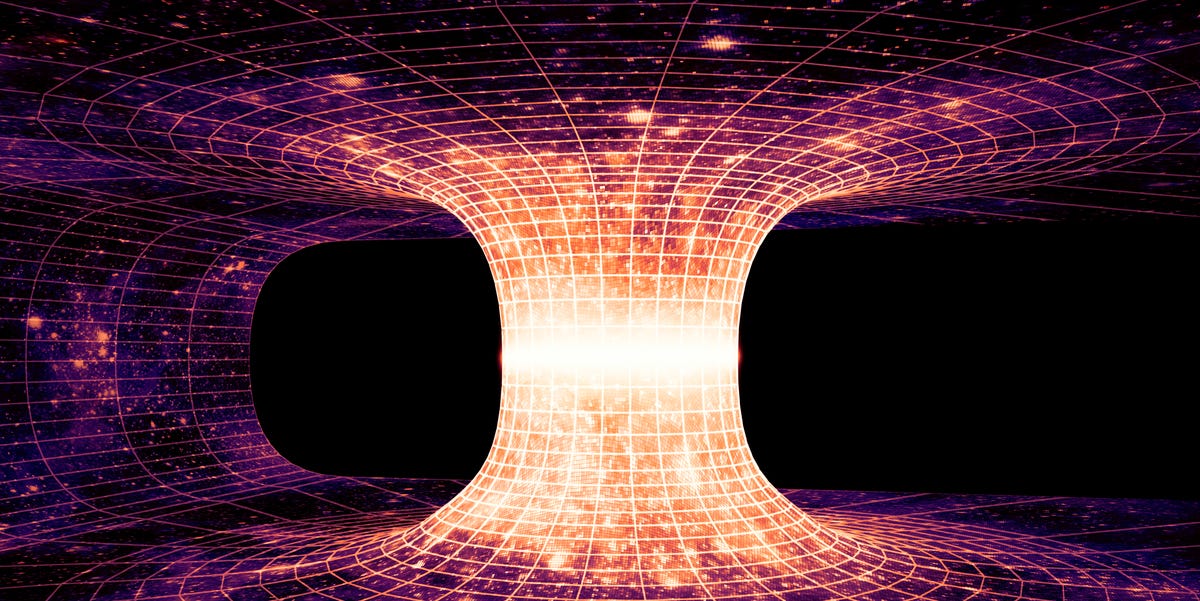
Wormholes have enjoyed a spectacular career in science fiction. They have rescued stranded astronauts, shortened interstellar road trips, and given screenwriters a convenient way to avoid explaining why a voyage to another galaxy would take longer than human civilization has existed. In real physics, however, wormholes remain hypothetical solutions to Einstein’s equationsmathematically intriguing, physically troublesome, and stubbornly absent from every telescope image.
A team of physicists proposed a fresh way to change that: stop looking for a glowing tunnel in space and instead watch how an unseen wormhole might bend and magnify the light of a distant star. Their calculations suggest that a particular kind of charged, spherical wormhole could produce a distinctive microlensing signal, including unusually strong magnification, as many as three apparent images, andin certain configurationsa light curve with two peaks rather than one.
That does not mean astronomers have found a cosmic shortcut hiding behind Orion. It means researchers have described a possible observational fingerprint. In astronomy, where most exotic objects decline to pose for photographs, a fingerprint is a very good start.
Why Wormholes Are So Difficult to Find
General relativity describes gravity as the curvature of spacetime. Matter and energy tell spacetime how to curve, while curved spacetime tells matter and light how to move. The theory predicted phenomena that once sounded almost as outlandish as wormholes, including black holes, gravitational waves, and gravitational lensing. Those predictions later became measurable science.
Wormholes also arise from solutions related to Einstein’s field equations. The classic Einstein–Rosen bridge connects separate regions of spacetime, but the original construction is not a stable, traversable hallway. It closes too quickly for a traveler to cross. Later models, especially the Morris–Thorne wormhole, explored what a traversable passage would require. The uncomfortable answer was usually some form of “exotic” matter or negative energy capable of preventing the throat from collapsing.
No macroscopic traversable wormhole has ever been observed. Worse, a compact wormhole could imitate a black hole from far away. Both could strongly curve spacetime, bend passing light, influence nearby matter, and potentially cast shadow-like structures. The cosmic lineup would contain several suspects wearing nearly identical black hoodies.
The New Strategy: Let Background Starlight Do the Detecting
The proposed search method focuses on gravitational microlensing. When a compact foreground object passes almost directly between Earth and a distant star, its gravity bends the star’s light. The separate bent images are often too close together for a telescope to resolve, but their combined brightness changes over time. Astronomers record that temporary brightening as a light curve.
Microlensing is already a practical tool. It can reveal exoplanets, faint stars, isolated black holes, and other objects that emit little or no detectable light. The lens does not need to shine; it merely needs enough gravitational influence and the good manners to cross the correct line of sight.
In the 2023 study, researchers modeled the microlensing effect of a charged, spherically symmetric wormhole with a distant light source. They calculated how the wormhole’s mass and charge terms would alter the paths of light, the number of apparent images, and the total magnification seen by an observer.
Clue One: Extreme Magnification
For some parameter choices in the model, the total magnification reached an order of about 100,000. That figure is striking, but it needs careful wording. The calculation does not establish that every wormhole would brighten every background star by exactly 100,000 times. The result depends on the wormhole geometry, charge, mass contribution, alignment, impact parameter, and distances among the source, lens, and observer.
Still, an exceptionally bright, otherwise unexplained microlensing event could earn a place on the candidate list. Astronomers love candidate lists. They are where extraordinary discoveries beginand where many perfectly ordinary binary stars go to cause paperwork.
Clue Two: A Two-Peaked Light Curve
The study’s most memorable proposed signature appears in a regime where the charge contribution dominates over the mass contribution and three images form. Instead of a single smooth maximum, the total magnification curve can show two maxima: one sharp, high peak and one gentler peak.
That shape could help distinguish the modeled wormhole from a simple isolated point-mass lens, whose textbook light curve is usually smooth, symmetric, and single-peaked. However, “could help” is the scientifically responsible phrase. Real observations are messier than textbook diagrams. Binary lenses, rotating objects, complex source stars, parallax, orbital motion, and imperfect sampling can all create unusual curves.
Later theoretical work also warned that multiple magnification peaks are not automatically a wormhole-only feature. Certain rotating black-hole models can produce complicated peak structures under specific assumptions. A double peak would therefore be a clue, not a cosmic birth certificate stamped “WORMHOLE.”
Clue Three: Up to Three Apparent Images
The charged-wormhole calculation found cases with one, two, or three apparent images. In the three-image case, one image could be much brighter than the other two. If instruments could resolve or indirectly reconstruct that image pattern, it would provide another layer of evidence.
In many microlensing events, however, the angular separation is far smaller than a telescope can directly distinguish. Astronomers then infer the lens from changes in total brightness and from the tiny apparent motion of the source’s light centroid, known as astrometric microlensing. Combining photometric and astrometric measurements would be far more convincing than relying on brightness alone.
How a Wormhole Search Would Work in Practice
A realistic search would begin with wide-field, time-domain surveys that repeatedly image crowded star fields. Each new exposure would be compared with earlier observations. Automated software would flag stars that brighten, fade, shift position, or otherwise behave as if they have recently read a physics textbook and chosen chaos.
Step 1: Identify Unusual Microlensing Events
Researchers would filter millions of variable objects to isolate events consistent with gravitational lensing. A true microlensing brightening is largely achromatic: gravity bends different wavelengths in the same basic way, although the source star and observational conditions can introduce complications. Color information helps reject stellar flares, eclipsing binaries, supernovae, and instrumental artifacts.
Step 2: Fit Competing Models
The surviving light curves would be fitted with ordinary stellar-lens, planetary, binary-lens, black-hole, and wormhole models. Scientists would compare how well each model explains the timing, peak structure, asymmetry, duration, and magnification. A wormhole interpretation would need to outperform less exotic explanations without requiring absurdly fine-tuned parameters.
Step 3: Measure Astrometric Motion
Brightness is only part of the story. A compact lens also shifts the apparent position of the background source. The size and direction of that shift can help estimate the lens mass and geometry. For an invisible compact object, a combined photometric and astrometric solution can separate a genuine gravitational lens from an object that merely happens to flicker dramatically.
Step 4: Demand Independent Evidence
A serious wormhole candidate would trigger follow-up observations across multiple wavelengths and possibly through gravitational-wave data. Researchers would look for nearby accretion signatures, radio structure, X-ray emission, orbital effects on neighboring stars, or waveforms inconsistent with an ordinary black hole. One strange light curve would be exciting. Several independent anomalies pointing toward the same spacetime geometry would be science.
Why Modern Surveys Make the Idea More Testable
The wormhole proposal benefits from a major change in astronomy: telescopes increasingly study the sky as a movie rather than a collection of still photographs. Repeated imaging allows researchers to discover transient events, measure their evolution, and search enormous databases for rare patterns.
The Vera C. Rubin Observatory’s Legacy Survey of Space and Time repeatedly images large areas of the southern sky. NASA’s Nancy Grace Roman Space Telescope is designed for wide-field infrared observations and includes an extensive microlensing program aimed toward the crowded center of the Milky Way. Neither project is a dedicated wormhole detector, but both illustrate the scale, cadence, and precision needed to find unusual lensing events hidden among ordinary ones.
The real breakthrough may come from data analysis as much as hardware. Machine-learning systems can rank strange light curves, but physicists must train them on realistic simulations. A search algorithm that has never seen a theoretical wormhole signal will probably label it “weird binary, confidence 63 percent” and move on with the emotional detachment of a parking meter.
The Biggest Scientific Obstacles
The Model Is Specific, Not Universal
The proposed signature belongs to a charged, spherically symmetric wormhole model. Other wormhole geometries may rotate, carry different fields, possess different throat structures, or produce completely different lensing behavior. Failing to find the predicted curve would rule out or constrain parts of the model space; it would not prove that all possible wormholes are absent.
Ordinary Objects Can Fake Extraordinary Signals
Binary stars and planets routinely produce multi-peaked microlensing curves. Stellar variability can distort a lensing event. Data gaps can turn one broad peak into two apparent peaks. Dust, blending from neighboring stars, and telescope systematics add further confusion. The universe has many ways to draw a suspicious squiggle.
Rare Alignment Makes Rare Objects Even Rarer
Microlensing requires a favorable alignment among a background source, the lens, and Earth. Even if wormholes exist, the chance of one crossing a monitored line of sight may be tiny. A null result might mean wormholes are absent, uncommon, too small, too distant, poorly aligned, or unlike the chosen model.
Traversability Is a Separate Question
Detecting a lens consistent with a wormhole would not demonstrate that a spacecraft could safely enter it. The object might be unstable, microscopic, nontraversable, surrounded by dangerous radiation, or connected to a region that no sensible travel agent would recommend. Finding a tunnel-shaped geometry and booking a ticket through it are different research programs.
Other Ways Physicists Are Hunting for Wormhole Signatures
Microlensing is one route among several. Some researchers study whether a wormhole would cast a shadow or photon-ring pattern distinguishable from a black hole in horizon-scale imaging. Others calculate how matter would orbit or accumulate around a horizonless compact object. Still others examine gravitational waves for echoes, scattering, unusual ringdown frequencies, or merger signals that do not match black-hole predictions.
Each method probes a different feature. Lensing measures how light travels through curved spacetime. Orbital dynamics measures how matter moves. Horizon-scale imaging tests the appearance of the compact region. Gravitational waves probe how spacetime itself vibrates. The strongest future case would combine several of these channels, because exotic claims deserve a cosmic background check.
What Finding a Wormhole Would Mean
A credible wormhole detection would be more than a spectacular astronomy headline. It would show that spacetime can possess a large-scale topology unlike any structure yet confirmed. Physicists would immediately ask what supports the throat, whether known quantum effects can supply the required stress-energy, how the object formed, whether it is stable, and whether general relativity is sufficient to describe it.
It could also sharpen the search for quantum gravity. Wormholes sit at the intersection of relativity, quantum fields, information, causality, and the geometry of spacetime. Even a failure to detect them is useful: surveys can place limits on their abundance, mass, size, charge, and distribution. Science advances not only by finding unicorns, but also by establishing that there are fewer unicorns per cubic parsec than a particular theory predicted.
A Realistic Wormhole-Hunting Experience: Reading the Sky Like a Detective
Imagine joining an observing team during a crowded-field microlensing campaign. The work does not begin with a telescope dramatically swiveling toward a glowing portal. It begins with a dashboard, a database, and enough candidate alerts to make your inbox reconsider its career choices.
One star near the galactic bulge has brightened sharply. The first plot looks promising: the event rises faster than expected, reaches a narrow maximum, dips, and then develops a smaller second bump. Someone jokes that the wormhole has finally RSVP’d. Nobody writes the press release.
The team first checks the boring explanations, because boring explanations have an excellent winning record. Was the detector saturated? Did a cosmic ray strike the pixels? Did poor atmospheric seeing blend the target with a neighboring variable star? Did the observing cadence miss part of a single broad peak? Engineers inspect calibration files while astronomers compare images from other facilities.
The event survives. Photometry in several filters shows nearly the same magnification pattern, which is encouraging for gravitational lensing. A binary-lens model is fitted and performs reasonably well, but it leaves structured residuals around the smaller peak. A planetary model improves the fit. A charged-wormhole template improves a different portion of the curve. The statistical contest is close enough to be interesting and nowhere near strong enough to be historic.
Next comes astrometry. The team measures whether the apparent center of the source light traces the path predicted by each lens model. This is delicate work: the shift may be much smaller than a pixel, and the field is crowded with stars whose light overlaps. Months of additional observations establish the unlensed baseline and reveal whether the source itself is variable.
Meanwhile, other telescopes search for a luminous foreground star. If one is present, the mysterious lens becomes much less mysterious. X-ray and radio observations look for accretion or magnetic activity. Spectroscopy checks whether the source is a pulsating star wearing a microlensing costume. Every new dataset either closes an escape route for ordinary physics or opens three more.
The emotional rhythm of the investigation is not a straight climb from curiosity to discovery. It is a cycle of excitement, skepticism, recalculation, and coffee. A parameter that looked decisive on Monday becomes degenerate with source motion on Wednesday. A dramatic residual disappears after a calibration update on Friday. This is not failure; it is the machinery that prevents science from confusing an intriguing graph with a new component of reality.
Suppose the candidate remains anomalous after years of follow-up. The team publishes the data, analysis code, model comparisons, and limitations. Other groups reprocess the observations and propose alternatives. New surveys search for similar events. Only a population of repeatable signaturesor one candidate supported by several independent probescould elevate the idea from “interesting lens” to “possible wormhole.”
That experience captures the real promise of the new method. It does not hand astronomers a wormhole detector with a cheerful green light. It gives them a falsifiable pattern to test. In theoretical astrophysics, turning an object from pure speculation into something that can be searched for, challenged, and constrained is a meaningful leap.
Conclusion: A Search Pattern, Not a Discovery
Physicists have not found a wormhole. They have developed a more concrete way to ask the universe whether certain wormholes are hiding in it. A charged spherical wormhole may create a distinctive microlensing pattern involving extreme magnification, multiple apparent images, andin a particular regimea sharp peak followed by a gentler one.
The idea is exciting because it translates exotic geometry into observable data. It is cautious science because the proposed features can be mimicked, depend on the model, and require confirmation through precise, long-term, multi-instrument observations. The next great wormhole story may therefore begin not with an astronaut entering a luminous ring, but with an astronomer staring at a peculiar light curve and saying, “That is probably a binary lensbut let’s not delete it yet.”